






Approved change to billing
Route accepted scope, performed work and required customer evidence into one reviewable finance handoff.
Explore workflows ↗Stacksync MCP is here. Give Claude, Cursor, and any MCP client governed access to your syncs, workflows, and connections.
Set up MCP Salesforce
 HubSpot
 NetSuite
 Zendesk
 Microsoft Dynamics 365 Sales
 Dynamics 365 F&O
 Attio
 Pipedrive
 Zoho CRM
 Campfire
 Rillet
 Front
 Shopify
 Amazon Seller Central
 SendGrid
Construction services and installation
Connect customer, project, material and billing records for companies that sell, supply, install and maintain physical systems.
Customer and job identities differ across branches, approved work waits for billing evidence, and coordinators chase parts and site decisions.
Explore your process in a demo, or get our shared two-way sync architecture guide.
The platform, in operating order
Keep shared customer, order, and operational records aligned, with clear field ownership.
Explore two-way sync 02Move approved work between systems, assign exceptions, and confirm the result.
Explore workflows 03Investigate cross-system questions, assemble the evidence, and prepare the next action.
Explore ai agents (genies) 04Connect trading-partner documents to operational records and exception handling.
Explore ediBuilt around your operations
US construction service and installation companies with 100–1,000 employees; operations, finance, IT and commercial leaders managing recurring cross-system handoffs.
Route accepted scope, performed work and required customer evidence into one reviewable finance handoff.
Explore workflows ↗Compare material allocation, site release and crew decisions without treating a planned date as proof of readiness.
Explore workflows ↗Assemble receipts, supplier invoices and job evidence for finance; flag ambiguous coding and approval gaps.
Explore Genies ↗Find your company type
Align multisite customers, service agreements, truck-stock evidence and closeout records across commercial MEP operations.
Explore commercial HVAC, plumbing and electrical contractors ↗Connect approved finishes, measured quantities, lot allocations and phased installation work.
Explore commercial flooring and interior installation ↗Connect installed-equipment identities, service agreements, inspection follow-ups and commercial handoffs.
Explore fire, life-safety and security integrators ↗Align approved customer scope, equipment identity, project handover and ongoing solar service records.
Explore solar installation and O&M services ↗Connect custom configurations, material requirements, shop release and field scope changes.
Explore fencing fabrication and installation ↗Connect design revisions, factory production, module delivery and site acceptance to the commercial project.
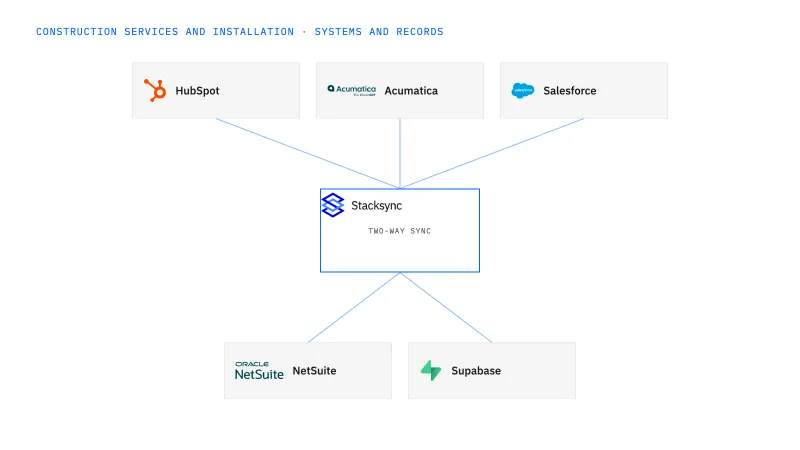
Explore modular and prefab building supply and installation ↗Your systems and records
| Record | Owner | Operating rule |
|---|---|---|
| Customer and payer | Finance and account administration | Keep relationship accounts separate from legal billing customers. |
| Site and job | Operations | Use stable identifiers across service, installation and branch systems. |
| Approved scope | Project and commercial owners | Preserve approval against the specific revision and covered work. |
| Billing evidence | Finance | Separate operational readiness from invoice approval and release. |
Supplier purchase orders, acknowledgments, shipments and invoices with line-level job allocation and explicit unit mapping.
Implementation and operating guides
Start construction two-way sync with customer, site, job and billing-status records that prevent repeated office handoffs.
Define customer, project and invoice-status ownership before connecting HubSpot with Acumatica for construction service operations.
Connect construction accounts and jobs across Salesforce and NetSuite while preserving finance ownership and approved scope.
Build construction customer portals around stable company, site and request records without confusing sync with user authorization.
Use a cross-reference layer to align acquired construction branches without collapsing billing entities or renumbering historical jobs.
Connect construction job-cost context without mistaking estimates, commitments, field usage and posted actuals for the same amount.
Move approved construction changes into a controlled billing queue with scope versions, acceptance evidence and duplicate protection.
Check installation dependencies independently before releasing crews or making customer commitments.
Build a construction invoice-readiness queue that separates technician completion from customer acceptance and finance release.
Use Genies to assemble invoice and expense evidence by job while keeping coding, approval and posting decisions reviewable.
Define the exception decisions a construction finance Genie must escalate instead of hiding them behind a confident match.
Connect construction supplier EDI documents to job purchase orders without confusing acknowledgments with acceptance or delivery.
Start with one recurring handoff and the customer, site and job records it needs. Establish identity and ownership before adding financial actions.
The operating examples illustrate designs to evaluate. They are not claims that a named customer uses the described stack or has achieved a particular result.
The download is the existing shared two-way sync architecture guide. The industry framing helps you apply its concepts to construction services; it is not a separate construction edition.
Bring one real process
Bring the systems, record types, and exceptions your team handles today. We’ll scope the connections and actions, then walk through the path to a confirmed result.
Explore your process in a demo, or get our shared two-way sync architecture guide.


