Construction Invoice Readiness: Match Work Completion, Customer Sign-Off, and Billing Evidence
Build a construction invoice-readiness queue that separates technician completion from customer acceptance and finance release.
- Author
- Ignacio Malpartida · GTM Engineer
- Published
- Read time
- 5 min read

The operating decision
A construction invoice-readiness workflow should verify the approved scope, performed work, required customer sign-off and billing prerequisites before handing a job to finance. Treat field completion, customer acceptance and invoice release as separate states. Match evidence to the actual job and scope revision, then create an owned task for missing items. The workflow's output is a traceable billing packet or supported draft action, with financial release controlled by finance.
Explore the complete construction services and installation integration and automation hub for the systems and processes around this guide.
What this looks like in construction services and installation
A maintenance firm completes a weekend repair for a commercial property. The technician closes the visit, but the customer purchase-order reference is missing and the site manager's sign-off covers only part of the work. The billing office discovers the problem days later. A readiness workflow can identify the missing authorization while the crew and customer still remember the visit, without falsely labeling the entire job billable.
Records, ownership, and update rules
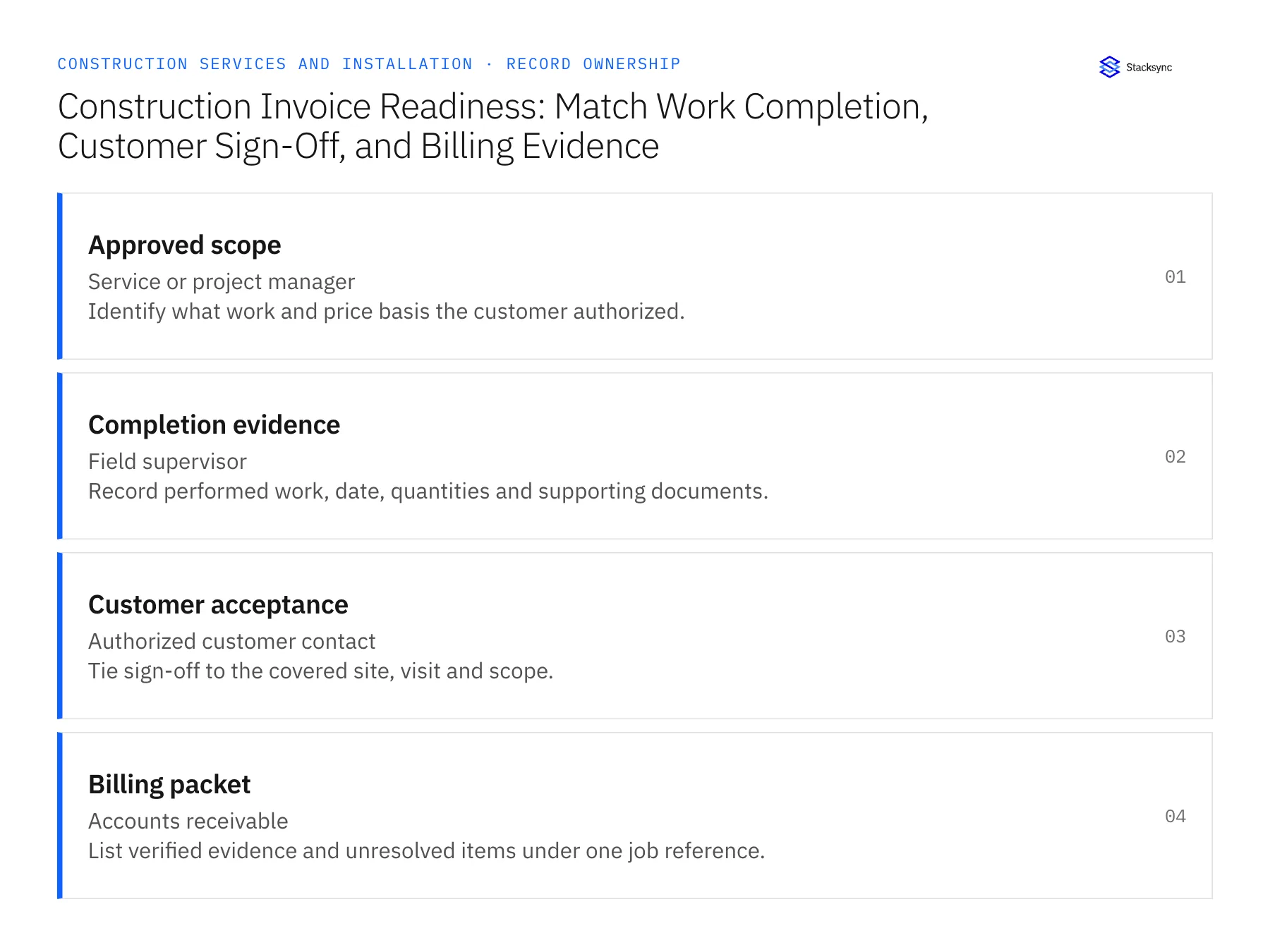
| Record | Owner | Operating rule |
|---|---|---|
| Approved scope | Service or project manager | Identify what work and price basis the customer authorized. |
| Completion evidence | Field supervisor | Record performed work, date, quantities and supporting documents. |
| Customer acceptance | Authorized customer contact | Tie sign-off to the covered site, visit and scope. |
| Billing packet | Accounts receivable | List verified evidence and unresolved items under one job reference. |
Work through the process
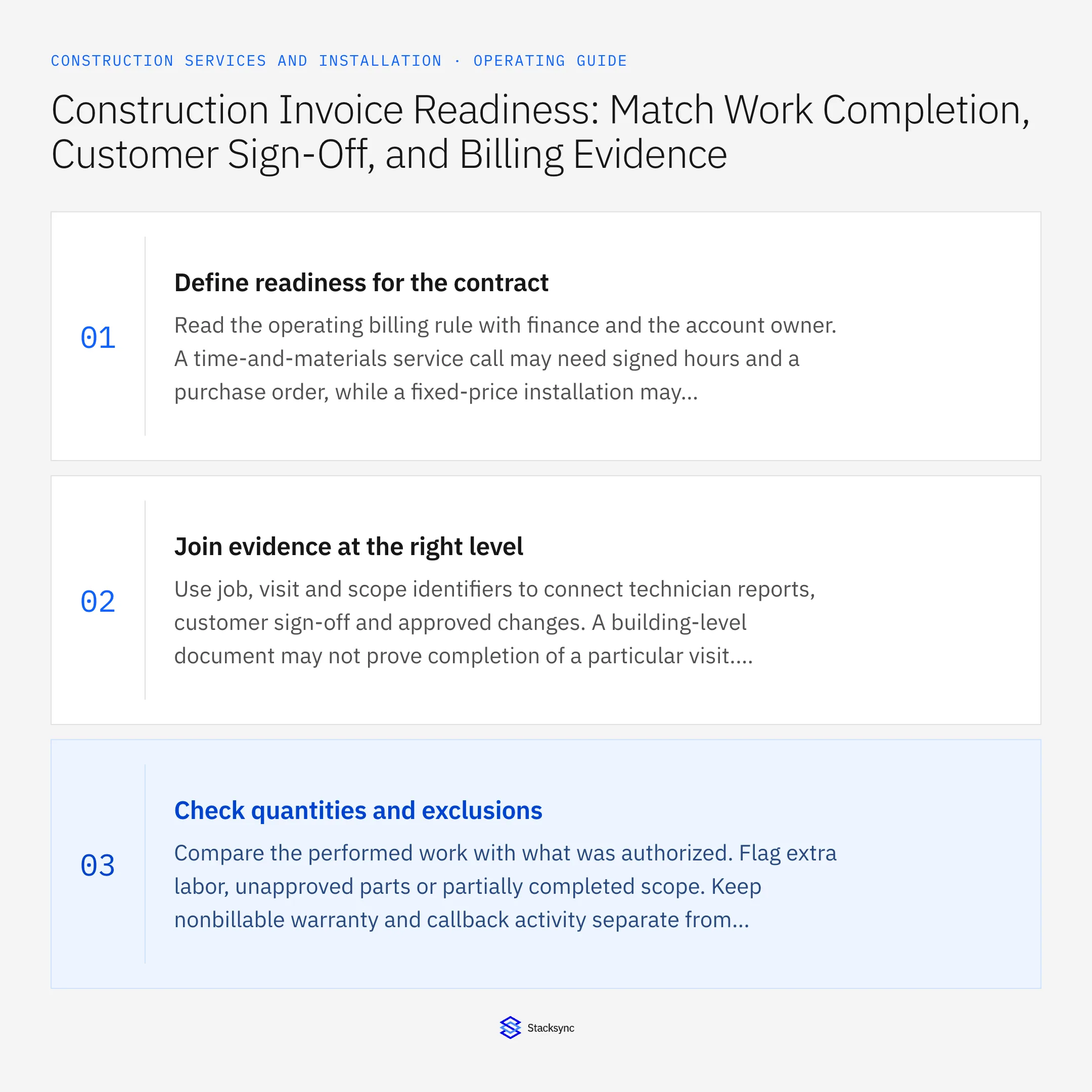
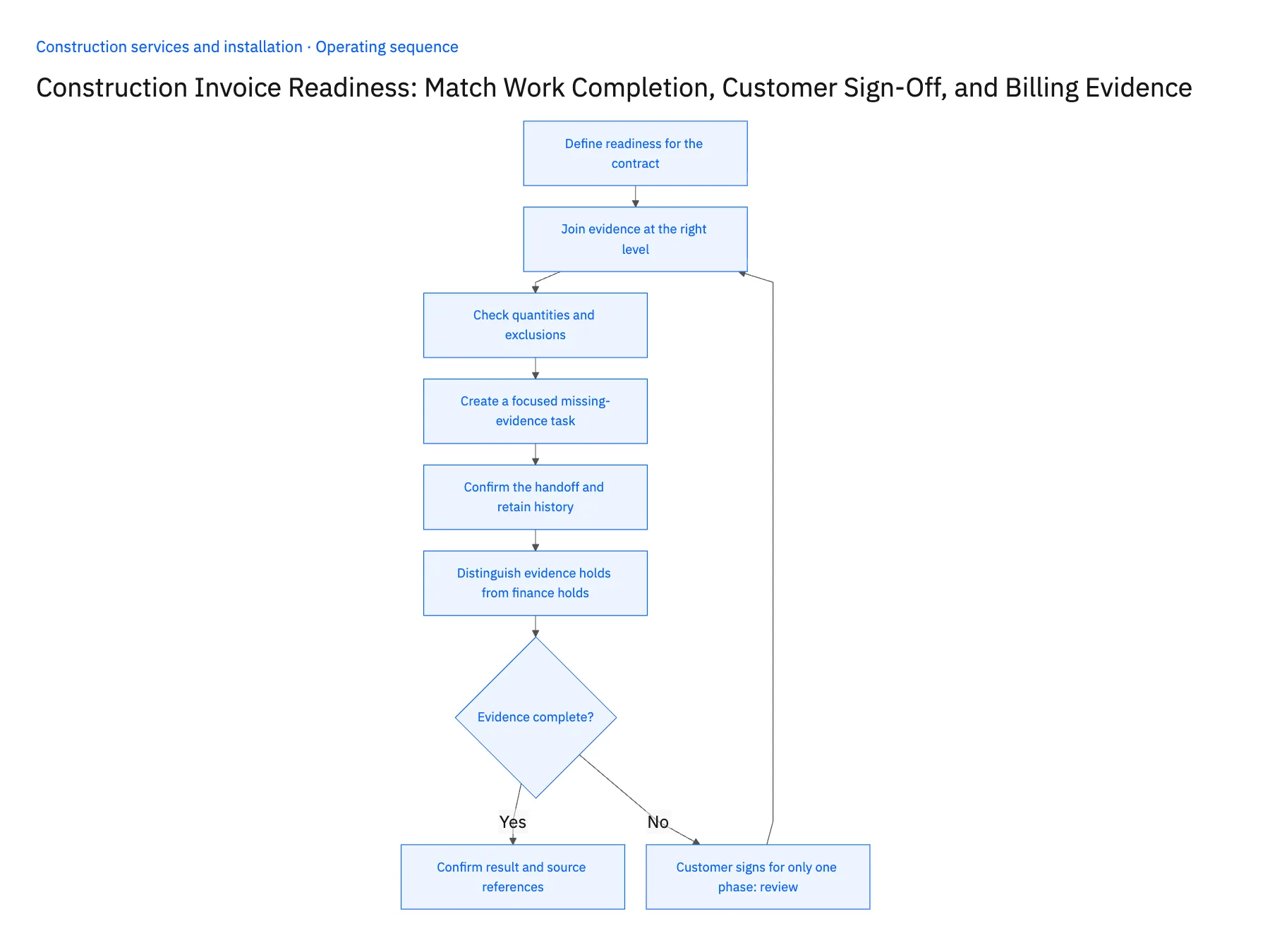
- 01Define readiness for the contractRead the operating billing rule with finance and the account owner. A time-and-materials service call may need signed hours and a purchase order, while a fixed-price installation may need milestone acceptance. Encode the requirements by work type instead of forcing every job through the same checklist.
- 02Join evidence at the right levelUse job, visit and scope identifiers to connect technician reports, customer sign-off and approved changes. A building-level document may not prove completion of a particular visit. Preserve the document date and source reference so a reviewer can see whether it covers the billed work.
- 03Check quantities and exclusionsCompare the performed work with what was authorized. Flag extra labor, unapproved parts or partially completed scope. Keep nonbillable warranty and callback activity separate from chargeable work. The purpose is to expose questions before invoicing, not to infer a charge from every recorded technician hour.
- 04Create a focused missing-evidence taskAssign each missing prerequisite to the person who can resolve it: field supervisor for work evidence, account owner for customer authorization, or finance for billing identity. Include the exact missing reference and affected lines. Avoid sending the same generic invoice blocked notification to several teams.
- 05Confirm the handoff and retain historyWhen the packet is ready, capture the finance queue or draft identifier. Mark the handoff complete only after the destination confirms it. If acceptance is withdrawn or evidence changes, reopen the relevant review with the earlier handoff attached rather than silently changing a previously approved packet.
- 06Distinguish evidence holds from finance holdsA complete operational packet may still wait for a finance decision unrelated to field documentation. Track evidence-ready and finance-released separately so supervisors do not keep chasing technicians for an issue they cannot resolve. Conversely, do not let a credit or billing hold conceal missing acceptance evidence. The reviewer should see both states and the separate owners responsible for clearing them.
Handle the exceptions explicitly
Customer signs for only one phase
Mark that phase separately and leave unfinished or unaccepted work outside the ready amount.
Technician closes the wrong visit
Correct the evidence association under supervisor review and preserve the original source record.
Required PO is missing
Route the missing reference to the account owner; do not invent one from the job number.
What to verify before expanding
- A completed visit without required sign-off remains blocked.
- Each billed line can be traced to approved and performed work.
- Warranty activity cannot silently enter chargeable labor.
- Finance receives one packet with specific unresolved items.

Connect this process to the rest of your operation
Explore Stacksync workflows and scope the records and actions against your actual systems. Book a demo with a real approved scope example and the exception your team handles most often, for example customer signs for only one phase.
- Approved Change Order to Billing Queue: Automating Construction Service Handoffs
- AI Invoice and Expense Processing for Construction Services: Prepare Job-Cost Evidence for Finance
- Construction Invoice and Expense Exceptions: Missing Cost Codes, Duplicate Receipts, and Unapproved Work
- Automated Invoice Reconciliation: Catch Billing Discrepancies Before They Cost You
- Match Invoices to Purchase Orders and Completion Evidence
The shared architecture guide covers record matching, ownership, and recovery across systems.
Technical references
FAQ
Frequently asked questions










Related articles