Construction Company Acquisitions: Unify Customer and Job IDs Across Branch Systems
Use a cross-reference layer to align acquired construction branches without collapsing billing entities or renumbering historical jobs.
- Author
- Ruben Burdin · Founder & CEO
- Published
- Read time
- 5 min read

The operating decision
After a construction company acquisition, unify record identity before trying to unify every operating process. Build a cross-reference that preserves each branch's source IDs and connects them to shared customer, site, and job identities. Keep legal billing entities and historical job numbers intact. Two-way sync can distribute approved changes across connected systems, but a data match is not permission to merge customer accounts, move financial history, or overwrite local job ownership.
Explore the complete construction services and installation integration and automation hub for the systems and processes around this guide.
What this looks like in construction services and installation
Consider two commercial service companies joining one group. Both have a customer called Central Properties and a job numbered 1042, but they serve different sites and bill different entities. The group wants consolidated customer visibility before deciding whether to replace either branch's systems. A simple name match creates a false duplicate. A careful cross-reference lets national account management recognize the relationship while finance retains the correct local customers and job histories.
Records, ownership, and update rules
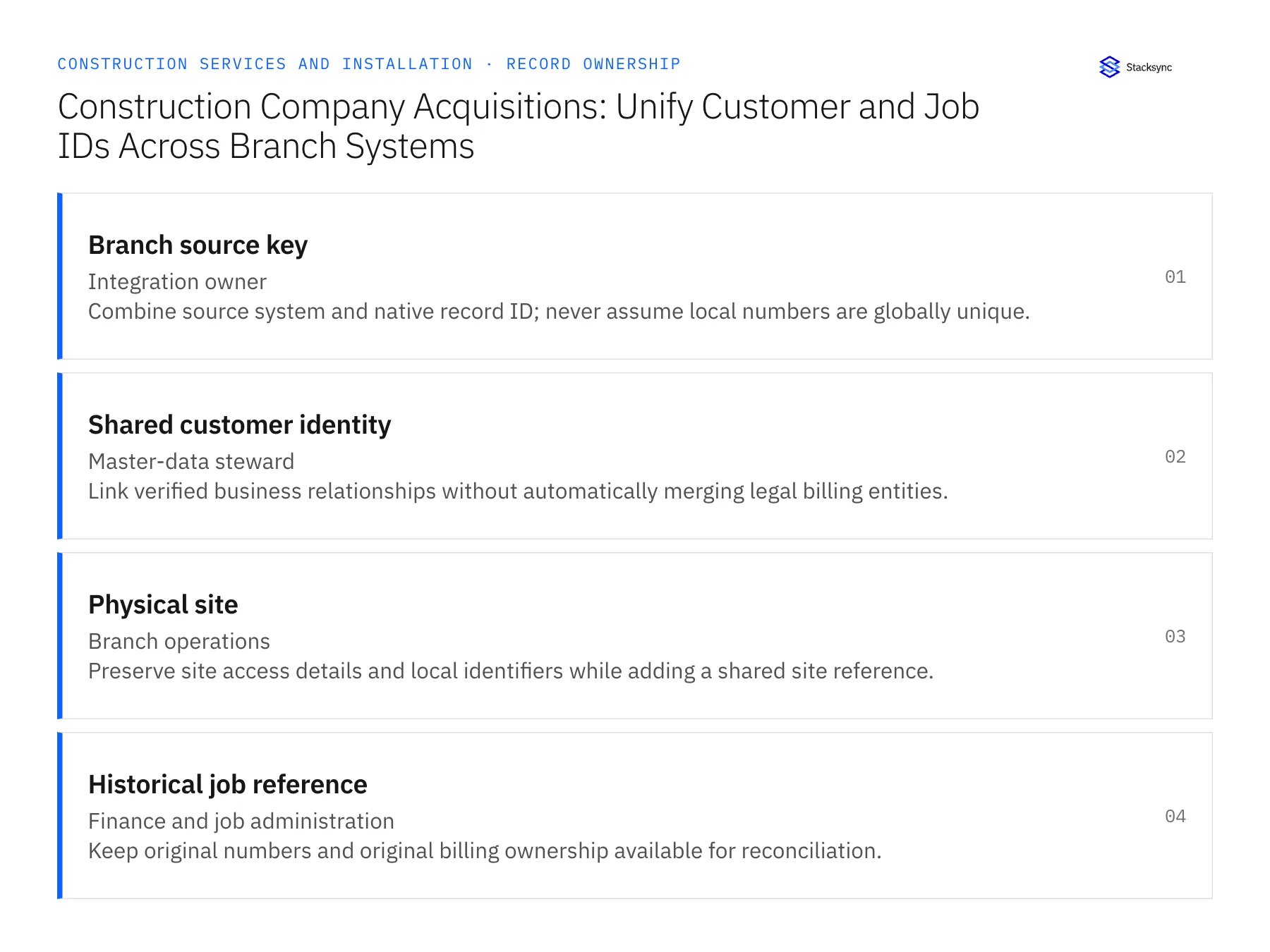
| Record | Owner | Operating rule |
|---|---|---|
| Branch source key | Integration owner | Combine source system and native record ID; never assume local numbers are globally unique. |
| Shared customer identity | Master-data steward | Link verified business relationships without automatically merging legal billing entities. |
| Physical site | Branch operations | Preserve site access details and local identifiers while adding a shared site reference. |
| Historical job reference | Finance and job administration | Keep original numbers and original billing ownership available for reconciliation. |
Work through the process
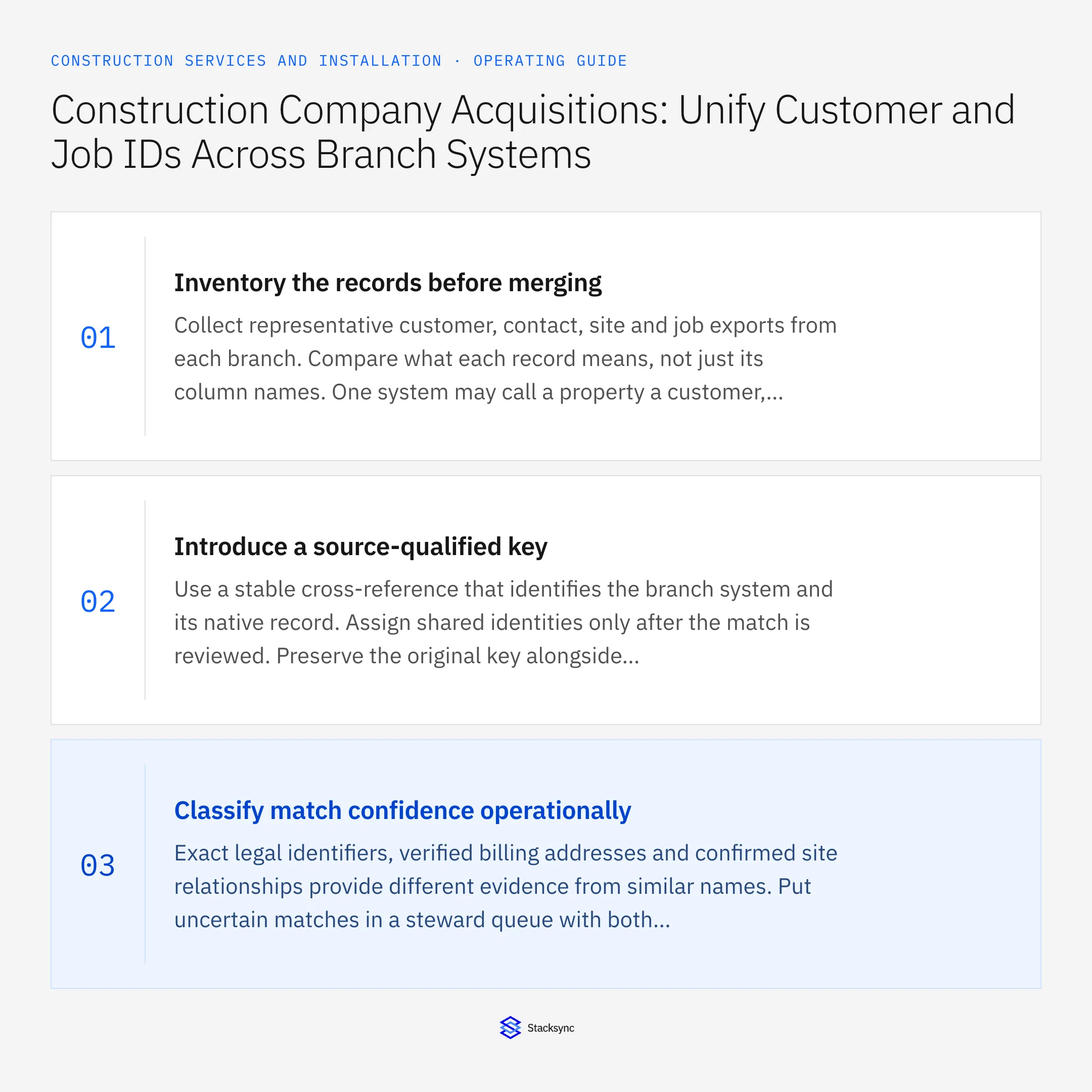
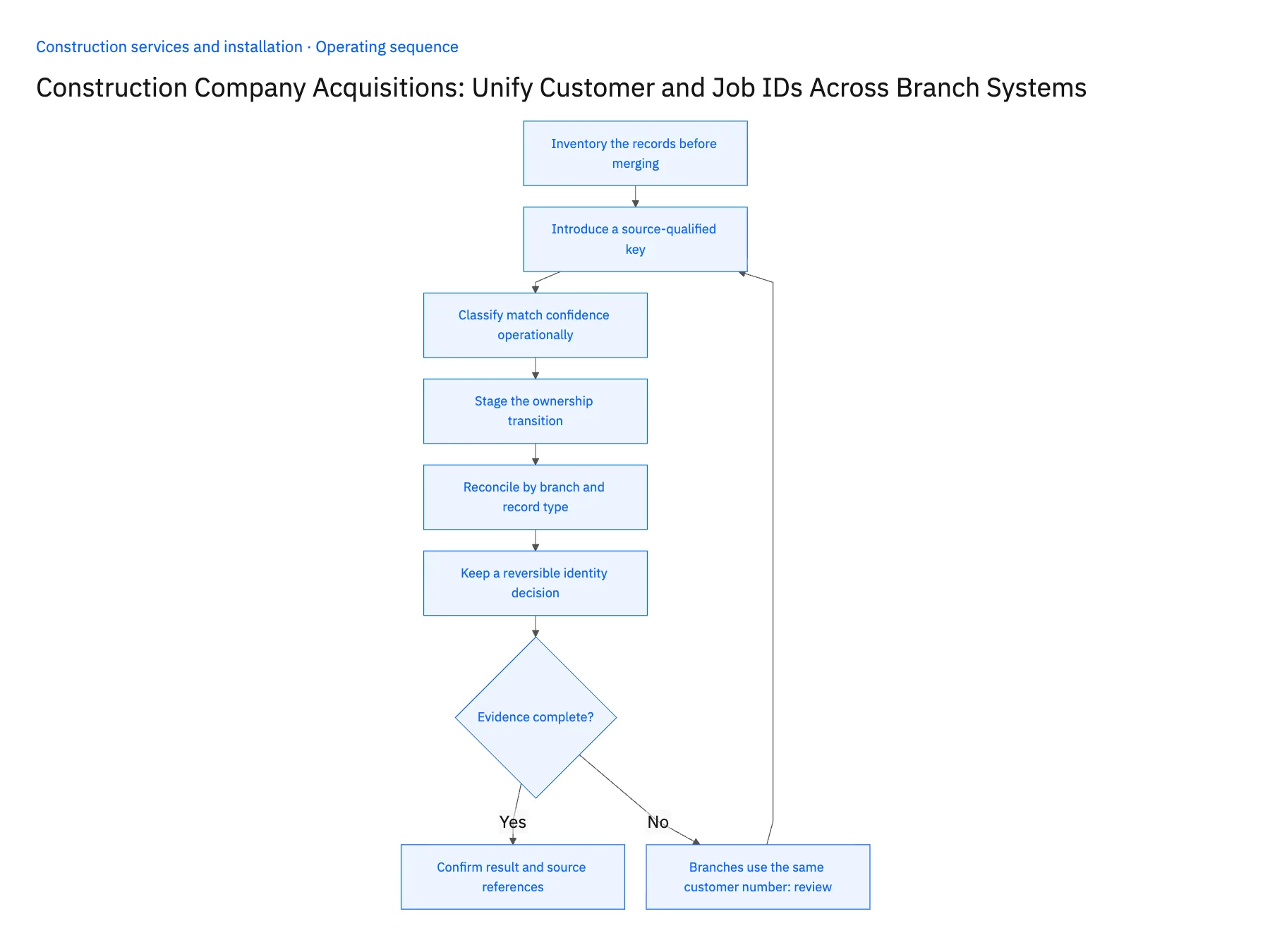
- 01Inventory the records before mergingCollect representative customer, contact, site and job exports from each branch. Compare what each record means, not just its column names. One system may call a property a customer, while another uses a separate site table. Write down these differences so later mappings do not erase them.
- 02Introduce a source-qualified keyUse a stable cross-reference that identifies the branch system and its native record. Assign shared identities only after the match is reviewed. Preserve the original key alongside the shared one so service coordinators can still find older work in the acquired company's operating system.
- 03Classify match confidence operationallyExact legal identifiers, verified billing addresses and confirmed site relationships provide different evidence from similar names. Put uncertain matches in a steward queue with both source records. Do not auto-merge records because the same property manager or generic accounts-payable email appears on both.
- 04Stage the ownership transitionStart by sharing read context and approved relationship updates. Keep job-cost and billing fields with their existing finance owner until the group agrees a migration plan. If responsibility changes, set an effective date and test how late invoices or corrections to historical jobs will be handled.
- 05Reconcile by branch and record typeCompare linked, unmatched and conflicting counts for each source. Investigate changes that unexpectedly move work between billing entities. Before adding another acquisition, replay a duplicate job number and a customer with different legal names to prove that the cross-reference prevents accidental consolidation.
- 06Keep a reversible identity decisionFor each reviewed match, record who approved it and why the records represent the same relationship. Preserve the original source records and allow a steward to separate a mistaken link without losing branch history. This matters when an acquired company uses informal customer names that initially look identical. A cross-reference is useful precisely because the group can improve identity decisions without immediately renumbering jobs or changing the financial records in either branch.
Handle the exceptions explicitly
Branches use the same customer number
Retain the branch-qualified source key and map each to the appropriate shared identity.
Customer relationship matches but payer differs
Link the commercial relationship while keeping separate finance customers.
Acquired system is retired later
Export the cross-reference and retain historical source identifiers in the replacement system.
What to verify before expanding
- Identical local job numbers remain separate jobs.
- Uncertain customer matches wait for a named steward.
- Historical invoices retain their original billing entity.
- A branch can locate its original record from the shared customer view.

Connect this process to the rest of your operation
Explore Stacksync two-way sync and scope the records and actions against your actual systems. Book a demo with a real branch source key example and the exception your team handles most often, for example branches use the same customer number.
- Construction Job-Cost Visibility: Define Ownership Across CRM, ERP, and Field Records
- Approved Change Order to Billing Queue: Automating Construction Service Handoffs
- Construction Installation Readiness: Coordinate Parts, Site Access, and Crew Release
- Real-Time HubSpot Database Integration and Salesforce Sync with Stacksync
- NetSuite Integration Failing? Fix Duplicate Data Fast
The shared architecture guide covers record matching, ownership, and recovery across systems.
Technical references
FAQ
Frequently asked questions










Related articles