


















Understanding Database Connectivity: A Deep Dive into ODBC and Modern Data Integration
ODBC is a standard API that lets any app query any database with SQL. How the four-tier driver architecture works, when to use it, and where it falls short.
- Author
- Ruben Burdin · Founder & CEO
- Published
- Updated
- Read time
- 15 min read
The Foundation of Enterprise Data Access
Enterprise organizations managing dozens of specialized applications face a critical challenge: keeping data flowing between systems without building custom integrations for each connection.
This connectivity challenge directly impacts operational efficiency, decision-making speed, and competitive advantage. Organizations rely on dozens of specialized applications, each generating and consuming data from various sources. The challenge is no longer just storing this data, but making it universally accessible across systems.
Key Takeaways
- Universal connectivity: ODBC serves as a standardized abstraction layer, allowing applications to interact with any database through a common SQL interface.
- Four-tier architecture: The system depends on an Application Layer, Driver Manager, Database Drivers, and the Data Source to enable database-agnostic communication.
- Performance optimization: Techniques such as connection pooling and batch processing can improve performance by up to 50%.
- Strategic flexibility: Unlike native drivers, ODBC reduces vendor lock-in and supports easier migrations across heterogeneous data environments.
- Modern relevance: ODBC remains essential in 2025 for AI training data access, cloud-hybrid architectures, and real-time synchronization use cases.
Open Database Connectivity (ODBC) addresses this challenge directly, serving as the backbone of enterprise data integration in 2025. ODBC has proven its enduring value over three decades by enabling diverse applications to communicate with a wide range of databases without requiring specialized code for each connection a capability that remains essential as data ecosystems grow more complex.
What is ODBC: Beyond the Basics
At its core, Open Database Connectivity is a standardized application programming interface (API) designed to provide a common language for applications to interact with databases. Understanding ODBC's full business value requires examining how this abstraction layer solves real-world integration challenges.
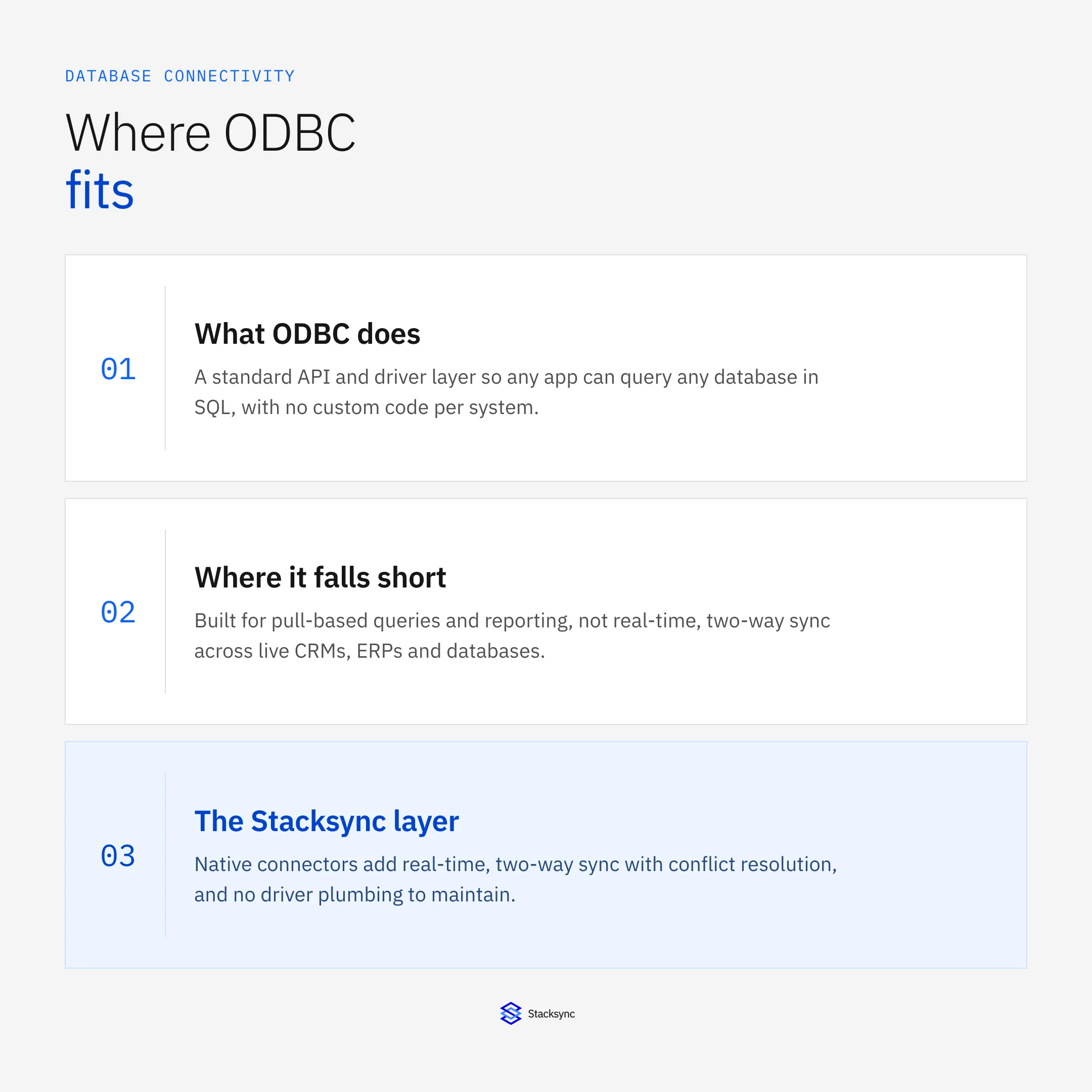
ODBC operates as an abstraction layer between applications and database management systems. This architecture allows applications to issue commands to databases using standard SQL syntax without needing to know the proprietary commands of specific database systems. ODBC functions as a standardized abstraction layer that eliminates the need for custom integration code across different database systems, reducing development time and maintenance overhead.
ODBC's practical value stems from its implementation of the Call Level Interface (CLI) specification, which provides standardized functions for database operations. This interface creates a standardized set of functions that applications can use to connect to databases, execute SQL statements, and retrieve results. This specification enables a critical capability: applications can connect to any database at runtime without database-specific code, provided an appropriate ODBC driver is available. This flexibility reduces development complexity and accelerates time-to-market for data-driven applications.
The Technical Architecture of ODBC
Understanding ODBC's four-tier architecture reveals how it delivers database-agnostic connectivity:
1. Application Layer
At the top level, applications make standardized ODBC function calls through the ODBC API. These functions handle everything from establishing connections to executing queries and processing results. This approach delivers significant development efficiency: developers write database-agnostic code once, eliminating the need for multiple database-specific versions and reducing maintenance overhead by up to 60%.
Example functions include:
SQLConnect() - Establishes a connection to a data source
SQLExecDirect() - Executes an SQL statement
SQLFetch() - Retrieves rows of data from a result set
SQLDisconnect() - Closes a database connection
2. Driver Manager
The driver manager serves as a mediator between applications and database-specific drivers. Its primary responsibilities include:
Loading and unloading appropriate database drivers
Processing ODBC function calls and routing them to the correct driver
Managing ODBC resources and handling error conditions
Providing a consistent interface for applications regardless of the underlying database
On Windows systems, the default driver manager is included with the operating system. On Linux and macOS, open-source alternatives like unixODBC and iODBC provide similar functionality.
3. Database Drivers
Database drivers are the specialized components that translate standard ODBC calls into database-specific commands. Each driver must implement the full ODBC API for its specific database system, handling the complexities of:
Converting ODBC SQL syntax to the database's native SQL dialect
Managing the physical connection to the database
Translating error codes from the database into standardized ODBC error codes
Converting data types between the application and database formats
Database vendors typically provide ODBC drivers for their products, though third-party and open-source drivers are also available for most major database systems.
4. Data Source
The final tier is the actual database or data source. This can be:
Traditional relational database management systems (RDBMS) like Microsoft SQL Server, Oracle, MySQL, or PostgreSQL
Cloud-based database services (AWS RDS, Azure SQL, Google Cloud SQL)
NoSQL databases with ODBC support
Flat files, spreadsheets, or other non-traditional data sources with appropriate drivers
While ODBC provides the foundational connectivity layer, organizations still face challenges in maintaining real-time, two-way sync between systems like Salesforce and PostgreSQL. Stacksync addresses this gap by building on ODBC's universal compatibility while adding intelligent conflict resolution, real-time change detection, and no-code configuration. These capabilities reduce integration maintenance time by 80% for mid-market companies with lean technical teams.
ODBC in Practice: Implementation Scenarios
Real-world implementation scenarios demonstrate ODBC's practical business value across diverse enterprise environments. Here are several implementation patterns commonly used in enterprise environments:
Direct Application-to-Database Connectivity
The most straightforward implementation involves a single application connecting directly to one or more databases. For example, a business intelligence tool like Tableau or Power BI can connect to multiple databases simultaneously through ODBC, allowing analysts to create reports that combine data from Oracle, SQL Server, and MySQL databases.
Configuration process:
- 01
Install the appropriate ODBC drivers for each database system
- 02
Configure DSNs (Data Source Names) that define connection parameters
- 03
Connect the application to these data sources using the configured DSNs
- 04
Create queries or reports that potentially join data across these disparate sources
Middleware and Integration Platforms
Many organizations implement middleware solutions like Dell Boomi, Informatica, or MuleSoft that use ODBC for database connectivity. However, these enterprise iPaaS platforms often introduce unnecessary complexity and cost for organizations primarily focused on operational data synchronization. Stacksync provides a specialized alternative: using ODBC's universal connectivity while delivering purpose-built, real-time bi-directional sync between CRM, ERP, and database systems, without the overhead of general-purpose workflow automation platforms. Mid-market companies typically achieve 3-5x faster implementation and 40-60% lower total cost with Stacksync compared to traditional iPaaS solutions for core sync use cases.
Data Virtualization Layers
More sophisticated implementations use ODBC as part of a data virtualization strategy. Here, a virtualization layer sits between applications and databases, using ODBC to connect to various data sources but presenting them to applications as a unified virtual database. This approach simplifies application development while providing centralized control over data access and security.
ETL/ELT Processes
Extract, Transform, Load (ETL) and Extract, Load, Transform (ELT) processes frequently leverage ODBC for database connectivity. Data integration platforms like Informatica PowerCenter, Microsoft SSIS, or Talend use ODBC to extract data from source systems, perform transformations, and load results into target databases or data warehouses.
Performance Optimization for ODBC Connections
ODBC's flexibility requires strategic optimization to maintain high performance. Organizations implementing proper optimization strategies typically achieve 40-50% performance improvements while retaining database independence. Here are key strategies for maximizing ODBC performance:
Connection Pooling
Connection pooling maintains a cache of database connections that can be reused by applications, eliminating the overhead of repeatedly establishing and closing connections. Most modern ODBC driver managers support connection pooling, but it must be properly configured.
Implementation approach:
Enable connection pooling in the ODBC driver manager settings
Configure appropriate pool size based on workload characteristics
Set reasonable connection timeouts to release inactive connections
Monitor pool usage to identify potential bottlenecks
Efficient Query Design
The way queries are constructed and executed can significantly impact ODBC performance:
Use parameterized queries instead of building dynamic SQL strings to allow query plan caching
Retrieve only the columns and rows needed rather than selecting everything
Consider using server-side cursors, or keyset cursor pagination, for large result sets
Leverage prepared statements for queries that will be executed multiple times
Batch Processing
For operations involving multiple records, batch processing can dramatically improve performance:
Use bulk insert operations rather than individual inserts
Implement array fetches for retrieving multiple rows at once
Consider transaction grouping to reduce commit overhead
Driver-Specific Optimizations
Different ODBC drivers offer various performance-enhancing options:
Enable driver-specific optimizations like asynchronous execution
Configure appropriate buffer sizes for your workload
Use driver compression options when available for network-intensive operations
Understand and leverage driver-specific cursor implementations
ODBC vs. Modern Alternatives
Organizations evaluating database connectivity strategies must understand how ODBC compares to alternative technologies to make informed architectural decisions that balance flexibility, performance, and development efficiency.
Evaluating these alternatives against specific use cases—performance requirements, development resources, and long-term flexibility needs—enables organizations to architect optimal data integration solutions.
| Technology | Best Use Case | Primary Benefit |
|---|---|---|
| ODBC | Universal or cross-platform database connectivity. | Vendor independence with broad compatibility across systems. |
| JDBC | Java-based enterprise applications. | Native integration with Java type systems and ecosystems. |
| Native Drivers | Single-database, high-performance applications. | Direct access to database-specific features and optimizations. |
| REST / GraphQL | Web and distributed applications. | Language and platform independence via HTTP-based APIs. |
| ORM | Rapid application development projects. | Abstracts SQL into object-oriented code for faster development cycles. |
Key Takeaways
ODBC and JDBC focus on standardized database connectivity, with JDBC tailored specifically for Java ecosystems.
Native drivers maximize performance and feature access when working with a single database engine.
REST, GraphQL, and ORMs prioritize developer experience and flexibility for modern web and distributed systems.
JDBC (Java Database Connectivity)
JDBC is Java's equivalent to ODBC. Key differences include:
JDBC is optimized specifically for Java applications, offering better integration with Java's type system and exception handling
It can provide better performance for Java applications compared to using JDBC-ODBC bridges
Many drivers support both JDBC and ODBC, allowing organizations to standardize on whichever is more appropriate for their technology stack
Native Database Drivers
Many applications now offer native drivers for popular databases:
Native drivers often provide better performance by eliminating the ODBC abstraction layer
They can expose database-specific features not available through ODBC
However, they lock applications into specific databases, reducing flexibility
Strategic Consideration: Organizations prioritizing maximum performance for single-database applications may benefit from native drivers, while those requiring multi-database flexibility or anticipating future database migrations typically achieve better long-term ROI with ODBC-based architectures. In practice, many choose native drivers for performance-critical applications while maintaining ODBC as a flexible option for general connectivity.
RESTful APIs and GraphQL
Modern web applications increasingly use REST or GraphQL APIs for data access:
These approaches are well-suited for distributed, internet-scale applications
They offer excellent language and platform independence
However, they often lack the query flexibility and transaction support of ODBC
Many organizations implement these APIs as an additional layer on top of database systems still accessed via ODBC or JDBC internally
ORM (Object-Relational Mapping) Frameworks
Frameworks like Hibernate, Entity Framework, and Django ORM abstract database operations into object-oriented programming models:
ORMs simplify application development by handling SQL generation
They provide strong typing and compile-time checking
Most ORMs use ODBC or JDBC under the hood, making them complementary rather than competing technologies
Performance can suffer for complex operations compared to hand-optimized SQL
ODBC in Cloud and Hybrid Architectures
Cloud computing has expanded ODBC's role in enterprise architectures, with major cloud providers offering ODBC drivers that enable hybrid and multi-cloud data integration strategies.
Cloud Database Connectivity
Major cloud providers offer ODBC drivers for their database services:
AWS provides ODBC drivers for services like RDS, Redshift, and Athena
Microsoft offers drivers for Azure SQL, Synapse Analytics, and Cosmos DB
Google Cloud supplies ODBC connectivity for BigQuery and Cloud SQL
These drivers enable seamless integration between on-premises applications and cloud databases, facilitating hybrid architecture implementations.
API Gateways and ODBC
Modern API gateways can expose ODBC-accessible databases through RESTful interfaces:
This approach combines the internal flexibility of ODBC with the external accessibility of REST APIs
It allows organizations to maintain existing ODBC-based internal systems while exposing data to modern web and mobile applications
Security can be centralized at the API gateway level rather than at the database driver level
Containerization Considerations
With the rise of containerized applications, ODBC implementation patterns have evolved:
ODBC drivers must be included in container images for applications that require database connectivity
Driver management becomes part of container orchestration and configuration
Connection pooling strategies need to account for the ephemeral nature of containers
Security Best Practices for ODBC Implementations
Security is a critical consideration for any database connectivity solution. Here are best practices specific to ODBC implementations:
Connection String Security
Connection strings often contain sensitive information like credentials:
Avoid hardcoding connection strings in application code
Use secure storage mechanisms like environment variables, key vaults, or dedicated credential managers
Consider using trusted authentication where supported instead of username/password combinations
Implement encryption for any stored connection strings
Access Control and Authorization
ODBC provides a path to your data, making proper access control essential:
Implement the principle of least privilege for database accounts used in ODBC connections
Use database roles and permissions to restrict access to sensitive data
Consider row-level and column-level security for fine-grained access control
Regularly audit and review access patterns
Transport Security
Securing the connection between applications and databases:
Enable SSL/TLS encryption for database connections where supported
Verify server certificates to prevent man-in-the-middle attacks
Configure appropriate cipher suites and protocol versions to ensure strong encryption
Use secure network zones and firewall rules to restrict database access to authorized hosts
Auditing and Monitoring
Maintaining visibility into ODBC usage:
Enable database auditing to track query patterns and potential security issues
Monitor failed connection attempts and unusual access patterns
Implement logging for sensitive operations executed through ODBC connections
Consider database activity monitoring solutions for critical systems
Troubleshooting ODBC Connections
Effective ODBC troubleshooting requires a systematic diagnostic approach that addresses the most common failure patterns:
Connection Failures
When applications cannot establish database connections:
- 01
Verify ODBC driver installation and configuration
- 02
Test connection parameters using a simple utility like isql or the ODBC Data Source Administrator
- 03
Check network connectivity between the application and database servers
- 04
Verify that database credentials are correct and the account is not locked
- 05
Examine database server logs for rejection messages or access issues
Performance Issues
For slow-performing ODBC operations:
- 01
Use query profiling tools to identify bottlenecks
- 02
Check for missing indexes or poorly optimized queries
- 03
Verify connection pooling configuration and effectiveness
- 04
Monitor network latency between application and database
- 05
Consider driver-specific performance settings and buffer configurations
Data Type and Conversion Problems
Issues with data representation across systems:
- 01
Understand the data type mappings between your application, ODBC, and the target database
- 02
Use appropriate conversion functions when necessary
- 03
Be aware of differences in date/time handling, string encoding, and numeric precision
- 04
Test with sample data that includes edge cases and special characters
Transaction and Concurrency Issues
Problems related to multi-user access and transactions:
- 01
Verify transaction isolation levels are appropriate for your use case
- 02
Check for connection leaks that may be exhausting connection pools
- 03
Examine locking patterns and potential deadlocks
- 04
Consider application-level retry logic for transient errors

Real-World Business Impact
ODBC implementations deliver measurable business value across multiple operational dimensions:
Real-World Impact: ODBC-Based Integration with Stacksync - ACERTUS, a leading logistics provider, leveraged ODBC connectivity combined with Stacksync's real-time synchronization to connect their operational PostgreSQL database with Salesforce. The result: 45% improvement in data accuracy, real-time shipment visibility for sales teams, and 60% reduction in manual data entry. 'Stacksync's ability to build on standard ODBC connectivity while adding intelligent bi-directional sync transformed our operations,' noted their VP of IT.
Vendor Independence and Flexibility
Organizations using ODBC can:
Switch database vendors without rewriting applications
Maintain a heterogeneous database environment to leverage the strengths of different systems
Negotiate better terms with database vendors, knowing they have viable alternatives
Gradually migrate between systems without disrupting operations
Unified Analytics and Reporting
With ODBC, businesses can:
Create reports that combine data from multiple disparate systems
Implement dashboard solutions that provide a complete view of operations
Perform cross-system analytics without complex data integration projects
Enable self-service BI for business users regardless of where data resides
Accelerated Application Development
Development teams benefit through:
Standardized database access patterns that work across projects
Reduced time spent learning multiple database APIs
Ability to develop against test databases and deploy against production systems
Simplified testing with database abstraction and potential mocking
Legacy System Integration
Organizations with legacy systems can:
Connect modern applications to legacy databases
Gradually modernize systems while maintaining operational continuity
Extract value from historical data without expensive migration projects
Bridge technology generations through standardized connectivity
The Future of Database Connectivity
Three emerging technology trends are expanding ODBC's role in enterprise data architectures through 2025 and beyond:
AI and Machine Learning Integration
As AI becomes more prevalent in business applications:
ODBC provides a standardized way for AI systems to access training data from diverse sources
Real-time analytics increasingly requires efficient database connectivity, so teams often pair ODBC's pull-based access with PostgreSQL change data capture for model serving
The volume of data needed for AI applications puts pressure on connectivity performance
Edge Computing Implications
With computing moving closer to data sources:
Lightweight ODBC implementations are needed for resource-constrained edge devices
Synchronization between edge databases and central systems requires efficient connectivity
Intermittent connectivity scenarios demand reliable error handling and recovery
Evolving Standards
Database connectivity standards continue to develop:
The SQL standard is regularly updated with new features that ODBC must support
Cloud-native patterns are influencing connectivity approaches
Security requirements are becoming more stringent, particularly for regulated industries
Conclusion: The Enduring Value of ODBC
ODBC's three-decade track record demonstrates its fundamental value in enterprise data integration, with continued relevance driven by its universal compatibility and proven reliability. Its strength lies in its simplicity and ubiquity. Virtually every database system supports ODBC, and countless applications rely on it for data access.
While newer technologies have emerged to address specific use cases, none has fully replaced ODBC's role as a universal database connectivity standard. Instead, these technologies often complement ODBC, creating a richer ecosystem of data access options.
Forward-thinking organizations leverage ODBC as a foundational element in comprehensive data integration strategies, combining its universal compatibility with modern integration platforms to achieve optimal flexibility and performance. By implementing ODBC effectively (with proper attention to security, performance, and architecture), businesses can maintain the flexibility to adapt to changing requirements while ensuring reliable access to their most valuable asset: their data.
ODBC remains a stable foundation for enterprise data connectivity.
Get Started with Optimized Database Connectivity
Ready to modernize your database connectivity strategy? Stacksync complements your ODBC infrastructure with real-time, two-way sync across CRM, ERP, and database systems through native connectors, so operational data stays consistent everywhere without custom integration code.

FAQ
Frequently asked questions










Related articles