







Engineering cutover coordination
Find open demand and inventory affected by an approved change and collect each owner’s disposition.
Explore workflows ↗ Salesforce
  HubSpot
  NetSuite
  Zendesk
  Microsoft Dynamics 365 Sales
  Dynamics 365 F&O
  Attio
Attio  Pipedrive
  Zoho CRM
  Campfire
  Rillet
  Front
Front  Shopify
  Amazon Seller Central
  SendGrid
 Automotive components
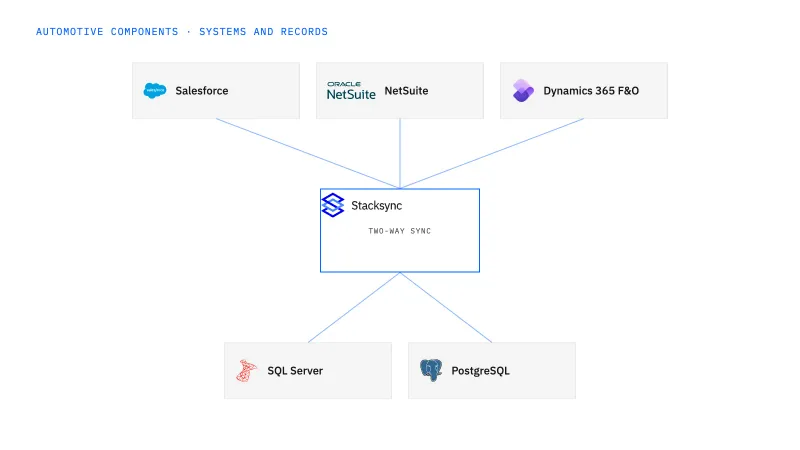
Keep customer program commitments, release schedules, lot records and engineering cutovers traceable across business systems.
Commercial forecasts, firm releases and engineering revisions are copied between teams as if they authorize the same production decision.
Explore your process in a demo, or get our shared two-way sync architecture guide.
The platform, in operating order
Keep shared customer, order, and operational records aligned, with clear field ownership.
Explore two-way sync 02Move approved work between systems, assign exceptions, and confirm the result.
Explore workflows 03Investigate cross-system questions, assemble the evidence, and prepare the next action.
Explore ai agents (genies) 04Connect trading-partner documents to operational records and exception handling.
Explore ediBuilt around your operations
Supply-chain, quality and IT teams at US automotive component suppliers with 100–1,000 employees.
Find open demand and inventory affected by an approved change and collect each owner’s disposition.
Explore workflows ↗Map a component delay to firm commitments before approving expedited supply or revised dates.
Explore workflows ↗Assemble evidence when customer releases differ from approved production commitments.
Explore Genies ↗Your systems and records
| Record | Owner | Operating rule |
|---|---|---|
| Program award | Commercial operations | Keep estimated lifetime demand separate from an approved order or firm customer release. |
| Customer release | Production planning | Preserve customer, plant, part, period and revision in the demand identity. |
| Engineering cutover | Engineering and quality | Retain effective dates or serial/lot boundaries and the authorizing decision. |
| Shipment lot | Shipping and quality | Trace shipped quantities back to the relevant lot and revision without inferring acceptance from dispatch. |
Use the partner’s agreed 850/860 process for orders and changes; treat forecasting and shipping schedules as separate message families.
Evaluate your next process
Connect selected Dynamics records to an operational SQL Server view that keeps forecasts and firm releases distinguishable.
Connect NetSuite shipments and orders with the lot and revision evidence maintained in your operational Postgres application.
Coordinate approved component revisions across open demand, existing stock and work in progress.
Connect agreed automotive EDI order and change processes to reviewable ERP demand.
Implementation and operating guides
Program identity can tie a Salesforce award to NetSuite customer, plant and part records while estimates, forecasts and accepted releases keep their own meaning.
A planning view that shows forecast, requested and accepted quantities side by side, with the accepted total explained from documented customer rules rather than a SQL sum.
Shipment evidence that answers which recorded lots supplied one NetSuite shipment line, reconciled by quantity and open about gaps in the Postgres record.
A cutover case shows the approved boundary, which releases and material fall inside it, and each owner’s disposition before the item master changes revision.
A recovery case sizes the shortage against firm releases only, checks transfers and expedites already in place, and closes a quantity once it is usable.
The Genie assembles quantity, date and revision differences between a customer release update and current commitments so a planner can decide the next step.
When a late release file carries an old plant alias or a superseded part reference, the Genie shows which facts conflict and who has to confirm them.
Original 850 orders, 860 change requests and partner responses stay traceable through replays, retries and engineering cutovers under the customer agreement.
Production planning should own it, since planning is the team that has to decide which Customer release is actionable. Commercial operations keeps the Program award and its lifetime estimate; engineering and quality keep the Engineering cutover and its effective boundary. Bring in the Dynamics 365 or NetSuite administrator before write permissions are granted. Two-way sync can carry each record to the team that needs it, but a forecast stays a forecast until planning accepts it as demand.
A cutover is ready when the Engineering cutover record carries an effective date or lot boundary and an authorizing decision, so the workflow can find the open demand and inventory it touches and ask each owner for a disposition. A supplier delay is ready when firm commitments are separate from forecasts, so the workflow can map the delay onto real Customer release lines. In both cases the workflow collects dispositions; expedited supply and revised dates are approved by planning, not by the workflow.
Send a customer 850, an 860 change against it, and a forecast or shipping schedule from a different message family, then replay the 850. The demo should show two Customer release lines that stay separate, a change applied only to its target release, the forecast held as planning context rather than demand, and no duplicate after the replay. The release exception Genie prepares the planner’s review of any quantity or date difference; planning accepts or rejects the schedule. Two-way sync is a separate scope from EDI transport.
Bring one real process
Bring the systems, record types, and exceptions your team handles today. We’ll scope the connections and actions, then walk through the path to a confirmed result.
Explore your process in a demo, or get our shared two-way sync architecture guide.


