Automotive component suppliers: connect Salesforce program awards and NetSuite demand
Program identity can tie a Salesforce award to NetSuite customer, plant and part records while estimates, forecasts and accepted releases keep their own meaning.
- Author
- Ruben Burdin · Founder & CEO
- Published
- Read time
- 4 min read

The operating decision
Automotive suppliers should connect Salesforce program context to NetSuite customer and order records without converting estimated program volume into firm production demand. Preserve the distinction between a commercial award, a forecast and an accepted release. Two-way sync can make those records visible across teams while their owners retain authority. The useful handoff tells planning which demand is actionable and tells sales which commitments operations has accepted for the applicable customer, plant and part.
Explore the complete automotive components integration and automation hub for the systems and processes around this guide.
What this looks like in automotive components
A component supplier wins a multi-year customer program. Sales records an estimated annual volume and expected launch timing, while operations receives separate production releases for specific customer plants. The launch estimate later changes, but several firm releases remain in place. If the integration treats the opportunity quantity as another order, it doubles demand; if it overwrites accepted releases with the new estimate, it loses actual commitments. Program identity should link the records as context while preserving the business meaning of each quantity.
Records, ownership, and update rules
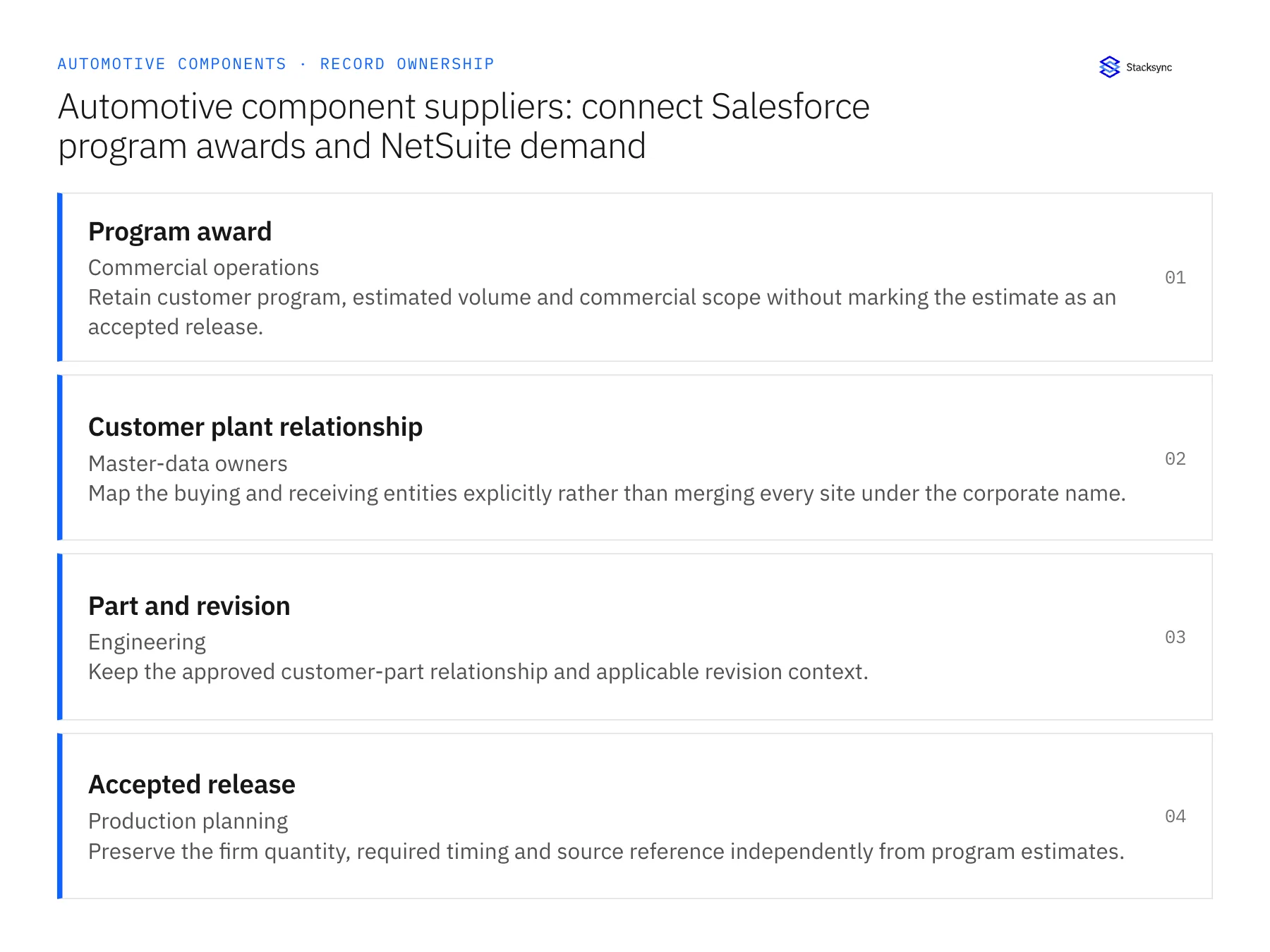
| Record | Owner | Operating rule |
|---|---|---|
| Program award | Commercial operations | Retain customer program, estimated volume and commercial scope without marking the estimate as an accepted release. |
| Customer plant relationship | Master-data owners | Map the buying and receiving entities explicitly rather than merging every site under the corporate name. |
| Part and revision | Engineering | Keep the approved customer-part relationship and applicable revision context. |
| Accepted release | Production planning | Preserve the firm quantity, required timing and source reference independently from program estimates. |
Work through the process
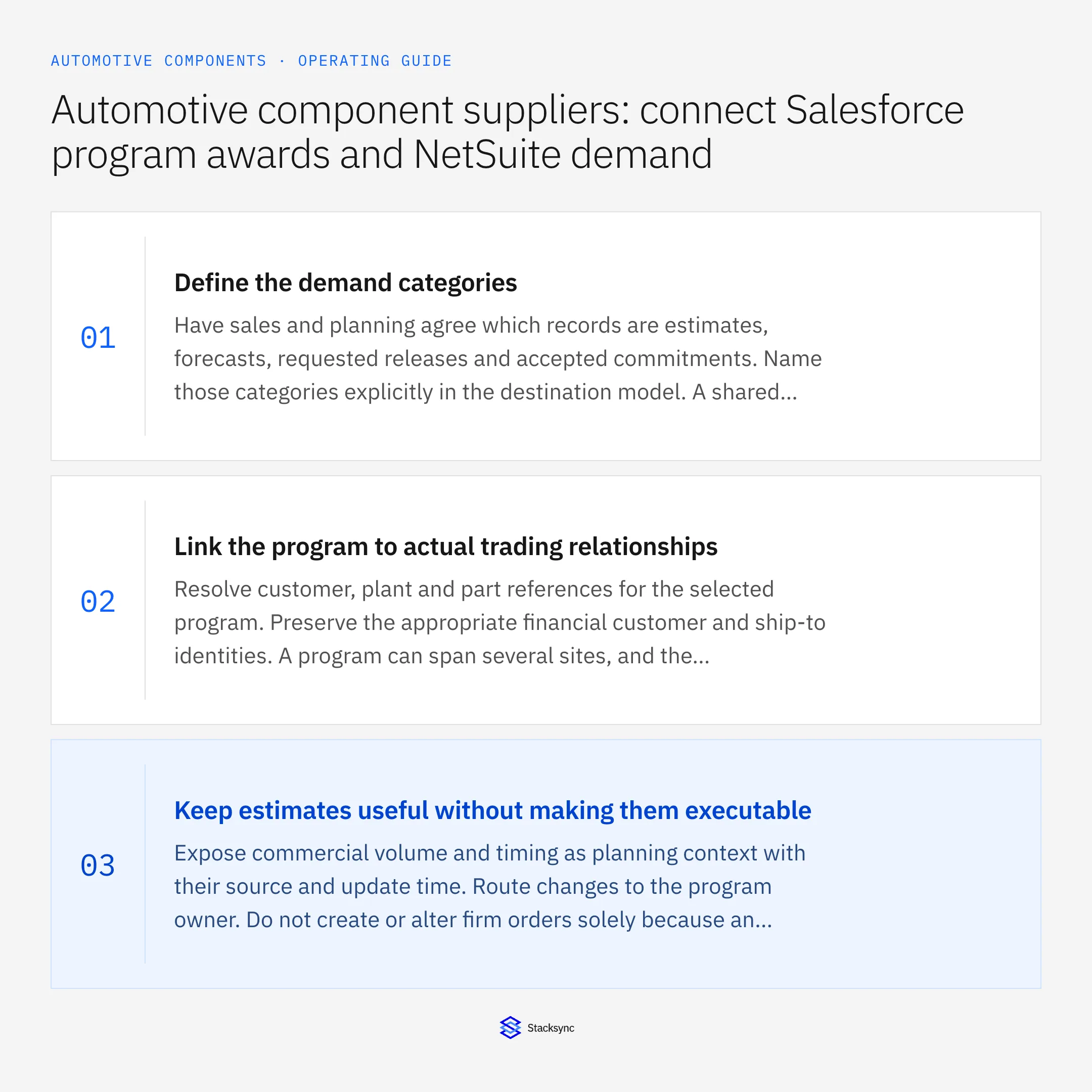
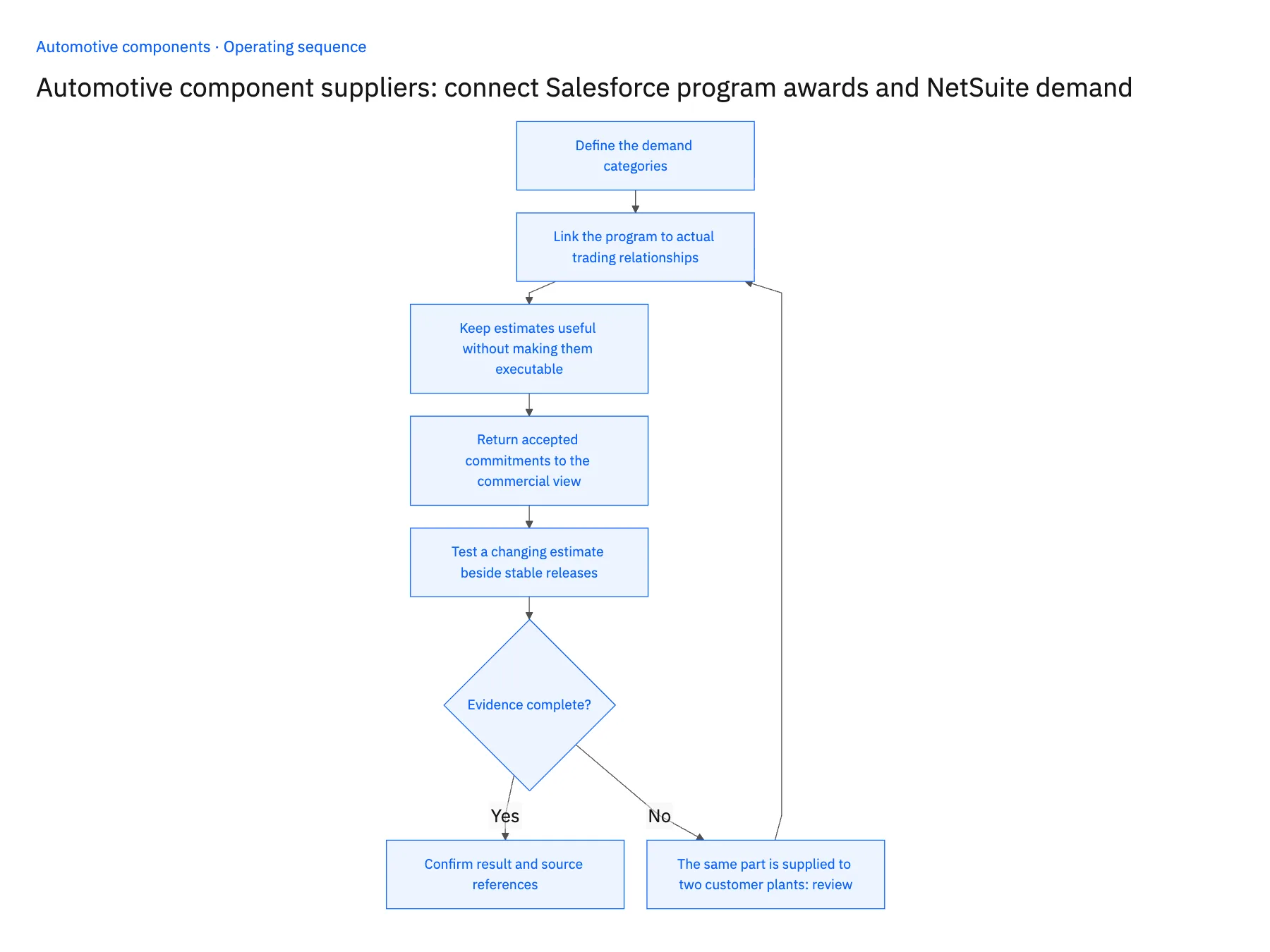
- 01Define the demand categoriesHave sales and planning agree which records are estimates, forecasts, requested releases and accepted commitments. Name those categories explicitly in the destination model. A shared quantity field cannot safely represent all of them.
- 02Link the program to actual trading relationshipsResolve customer, plant and part references for the selected program. Preserve the appropriate financial customer and ship-to identities. A program can span several sites, and the corporate relationship should not choose a receiving plant automatically.
- 03Keep estimates useful without making them executableExpose commercial volume and timing as planning context with their source and update time. Route changes to the program owner. Do not create or alter firm orders solely because an opportunity forecast changes unless the business has a separate approved process for that action.
- 04Return accepted commitments to the commercial viewPublish the relevant release and order status so account managers can distinguish expected program growth from current execution. Keep the customer’s requested timing separate from the supplier’s accepted promise.
- 05Test a changing estimate beside stable releasesChange the program volume while leaving firm releases unchanged, then revise one actual release. Verify that each update affects only the intended record meaning and that a repeated award update creates no production demand.
Handle the exceptions explicitly
The same part is supplied to two customer plants
Keep plant context in the release identity and destination mapping. A common part number does not make their commitments interchangeable.
The launch estimate moves while orders remain firm
Show the discrepancy for program review without cancelling accepted releases automatically.
A new revision joins an existing program
Retain the engineering-approved applicability and avoid assigning it to every historical order under the program.
What to verify before expanding
- Changing an estimated program quantity cannot create additional firm demand.
- Each accepted release retains customer plant and part context.
- Sales can distinguish program estimates from accepted operational commitments.
- Repeated synchronization preserves one program relationship and the existing order links.

Connect this process to the rest of your operation
Explore Stacksync two-way sync and scope the records and actions against your actual systems. Book a demo with a real program award example and the exception your team handles most often, for example the same part is supplied to two customer plants.
- Dynamics 365 Finance and SQL Server two-way sync for automotive suppliers
- NetSuite and Postgres two-way sync for automotive component evidence
- Automotive suppliers: separate firm releases and forecasts in Dynamics and SQL Server
- Automotive components: connect NetSuite shipments to Postgres lot evidence
- Automotive component engineering cutovers: coordinate open demand and existing inventory
- EDI for Automotive Suppliers and OEMs: Powering Real-Time Manufacturing Communication
- Keeping Dynamics 365 Finance & Operations and PostgreSQL in Step
The shared architecture guide covers record matching, ownership, and recovery across systems.
Technical references
FAQ
Frequently asked questions










Related articles