







Assemble the affected work
Bring open demand, inventory and production state into a reviewable impact list.
 Salesforce
  HubSpot
  NetSuite
  Zendesk
  Microsoft Dynamics 365 Sales
  Dynamics 365 F&O
  Attio
Attio  Pipedrive
  Zoho CRM
  Campfire
  Rillet
  Front
Front  Shopify
  Amazon Seller Central
  SendGrid
 Automotive components
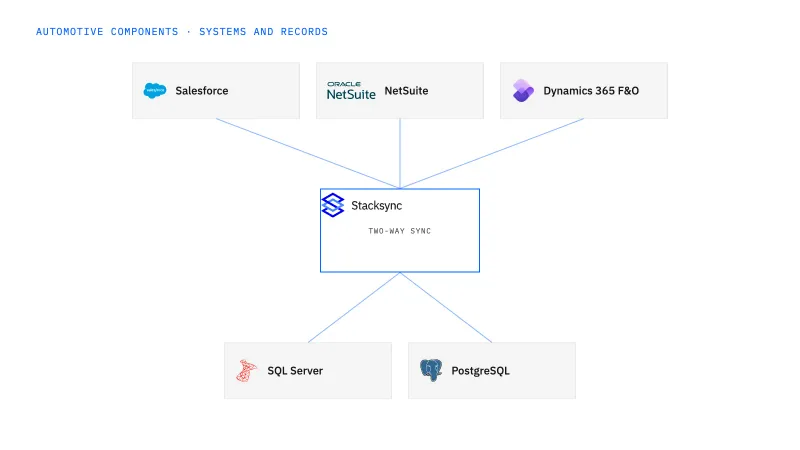
Coordinate approved component revisions across open demand, existing stock and work in progress. Stacksync fits automotive suppliers that assemble engineering-change impacts manually before planning can apply a cutover. The workflow preserves the authorizing instruction and routes material disposition without assuming every old revision must immediately be replaced.
Engineering has approved a change, but planning cannot quickly establish which releases, lots and existing commitments fall inside its applicability.
Explore your process in a demo, or get our shared two-way sync architecture guide.
When this fits
Supply-chain, quality and IT teams at US automotive component suppliers with 100–1,000 employees.
Bring open demand, inventory and production state into a reviewable impact list.
Separate technical acceptability, customer scope and planning treatment of existing quantities.
Track approved execution and unresolved exceptions while preserving prior revision history.
The process, end to end
a supplier needs to introduce a revision while using some older stock under a restricted customer allowance. The evaluation should show the affected population, the approved boundary and how the exception stays limited to the authorized release.
Scope your implementation
Review current platform pricing alongside the records, volume, and actions in your process. Use your own operating baseline to evaluate the economics.
Explore your process in a demo, or get our shared two-way sync architecture guide.
From foundation to action
Keep shared customer, order, and operational records aligned, with clear field ownership.
Explore two-way sync 02Move approved work between systems, assign exceptions, and confirm the result.
Explore workflows 03Investigate cross-system questions, assemble the evidence, and prepare the next action.
Explore ai agents (genies) 04Connect trading-partner documents to operational records and exception handling.
Explore ediGo deeper
A cutover case shows the approved boundary, which releases and material fall inside it, and each owner’s disposition before the item master changes revision.
A recovery case sizes the shortage against firm releases only, checks transfers and expedites already in place, and closes a quantity once it is usable.
Explore all automotive components integration and automation guides ↗
Quality and planning record that decision; the workflow only asks for it. Engineering supplies the revision and its applicability instruction, the customer process sets the boundary, and each owner answers for the material state in front of them: finished stock, work in progress or incoming material. The workflow records the disposition against the specific release or lot it covers, so an allowance given for one release cannot be reused on the next one without a new decision.
An existing-stock allowance restricted to one release and material whose revision evidence is missing.
Stop when the affected orders and quantities reconcile to the approved plan and every open disposition has an owner and a date. Compare the impact list the workflow assembled with the one planning built by hand for the same change; an item on either list that the other missed is the finding to chase before the scope widens. Measure disposition age from the day engineering approved the change, not from the day the workflow ran, so the evaluation shows how long earlier-revision material waited for a decision.
Not as a product requirement, but it is the right first layer. Two-way sync between NetSuite and Postgres gives the workflow a current picture of the approved engineering change, affected inventory and work in progress, and open customer demand without hand-built extracts. The workflow then collects each owner's disposition and records execution against the approved boundary; planning applies the accepted cutover through its normal controlled process with the approval reference attached. Genies come after that, when quality or planning wants the impacted population assembled and summarized before review. EDI matters when a requested revision arrives through a customer's agreed order-change documents; applicability still routes to engineering.


