Automotive components: connect NetSuite shipments to Postgres lot evidence
Shipment evidence that answers which recorded lots supplied one NetSuite shipment line, reconciled by quantity and open about gaps in the Postgres record.
- Author
- Ruben Burdin · Founder & CEO
- Published
- Read time
- 4 min read

The operating decision
A NetSuite–Postgres shipment-evidence model for automotive components should link accepted order lines, shipped quantities and the recorded lots or revisions supplying them. Keep shipment identity separate from customer acknowledgment or acceptance. Two-way sync can make approved records available across teams, while quality and shipping retain authority over their evidence. The model should help answer which recorded material fulfilled which commitment without inventing traceability where source identifiers are missing.
Explore the complete automotive components integration and automation hub for the systems and processes around this guide.
What this looks like in automotive components
A component supplier ships one customer release from two production lots and later receives a question about a specific revision. The ERP contains the shipment, while a Postgres application holds detailed production and quality references. A join using only item number returns every lot produced that week, which looks comprehensive but does not identify the lots actually shipped. The integration needs the real allocation or shipment relationship, with quantities that reconcile to the customer line. Missing links should become review tasks rather than inferred matches.
Records, ownership, and update rules
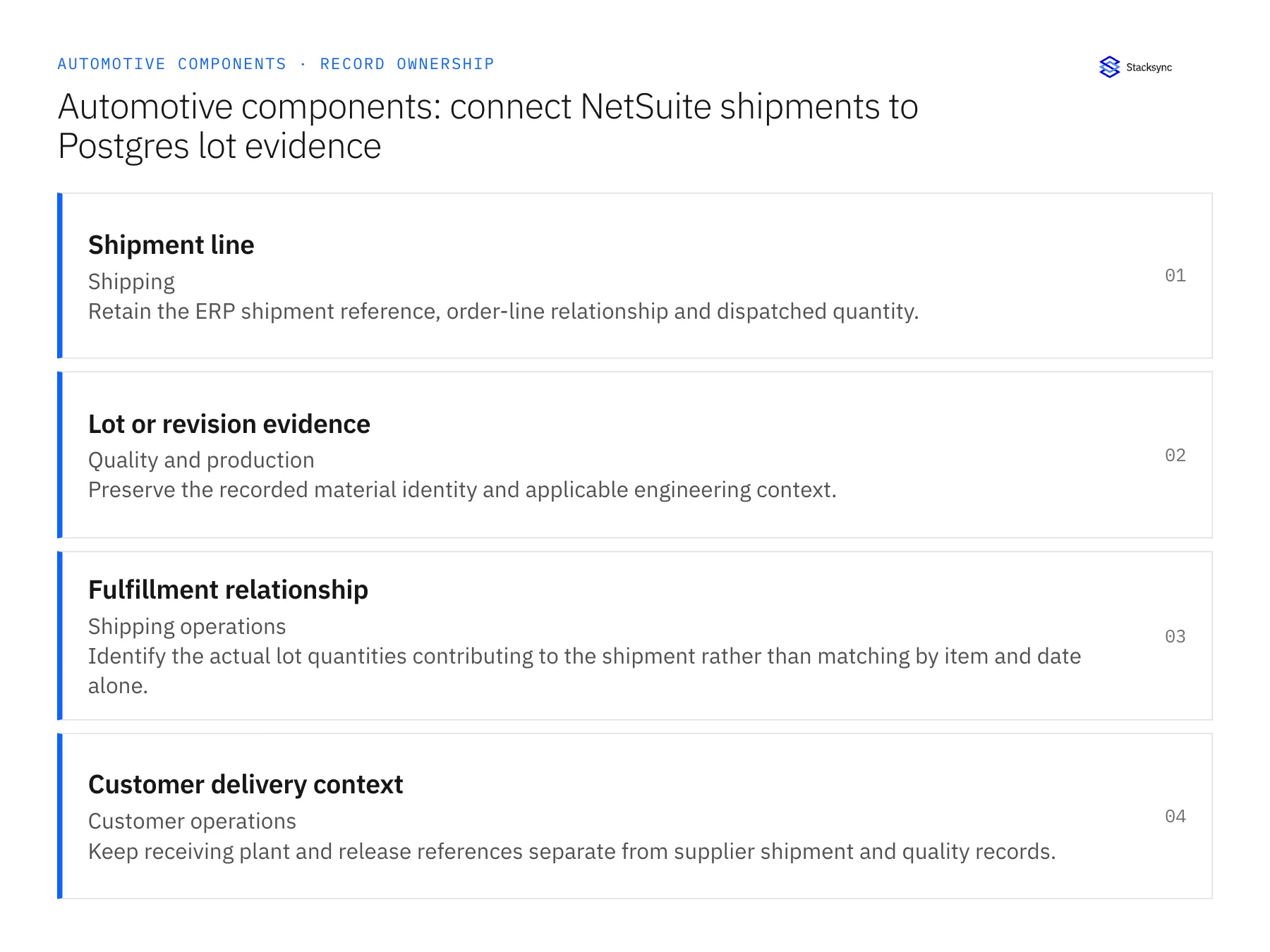
| Record | Owner | Operating rule |
|---|---|---|
| Shipment line | Shipping | Retain the ERP shipment reference, order-line relationship and dispatched quantity. |
| Lot or revision evidence | Quality and production | Preserve the recorded material identity and applicable engineering context. |
| Fulfillment relationship | Shipping operations | Identify the actual lot quantities contributing to the shipment rather than matching by item and date alone. |
| Customer delivery context | Customer operations | Keep receiving plant and release references separate from supplier shipment and quality records. |
Work through the process
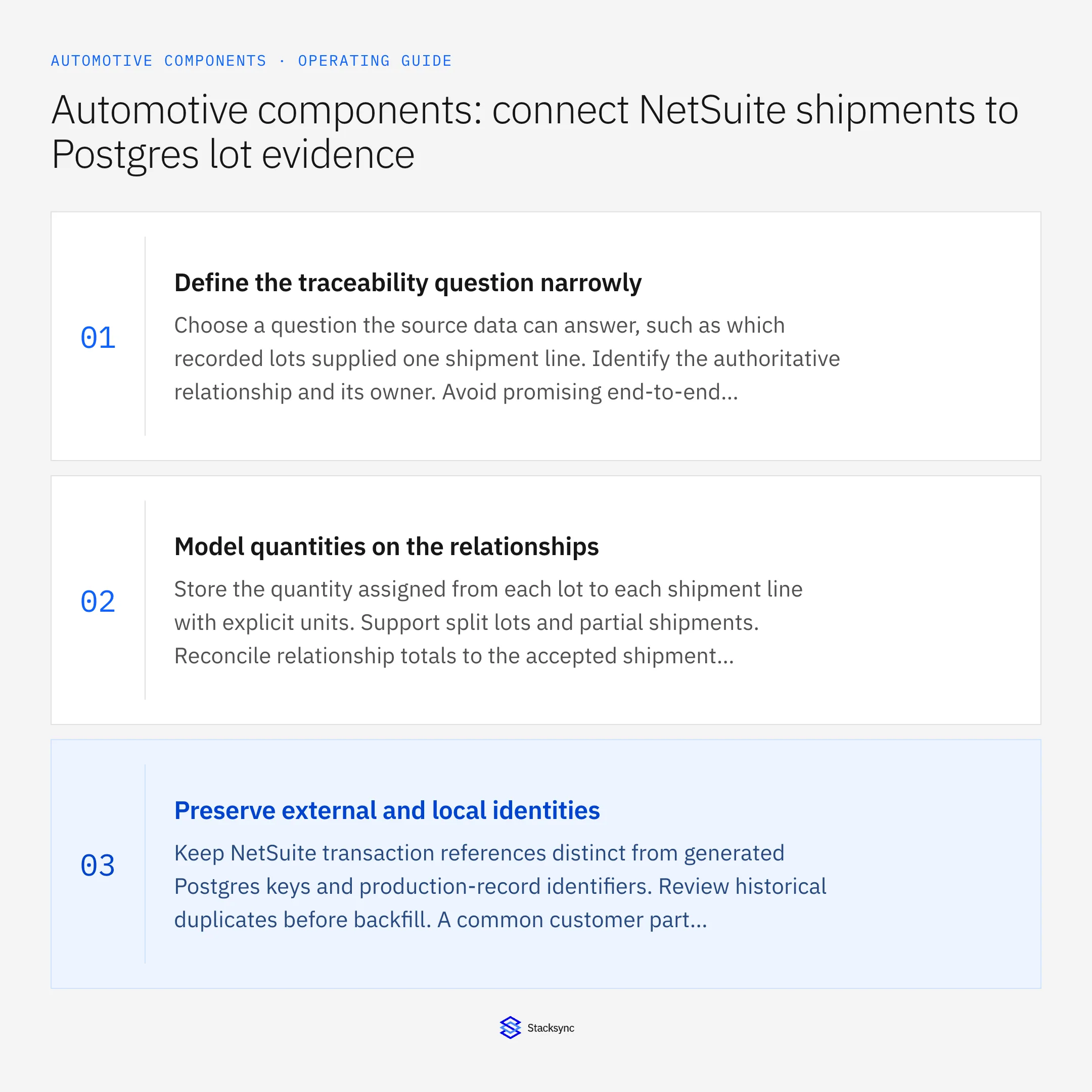
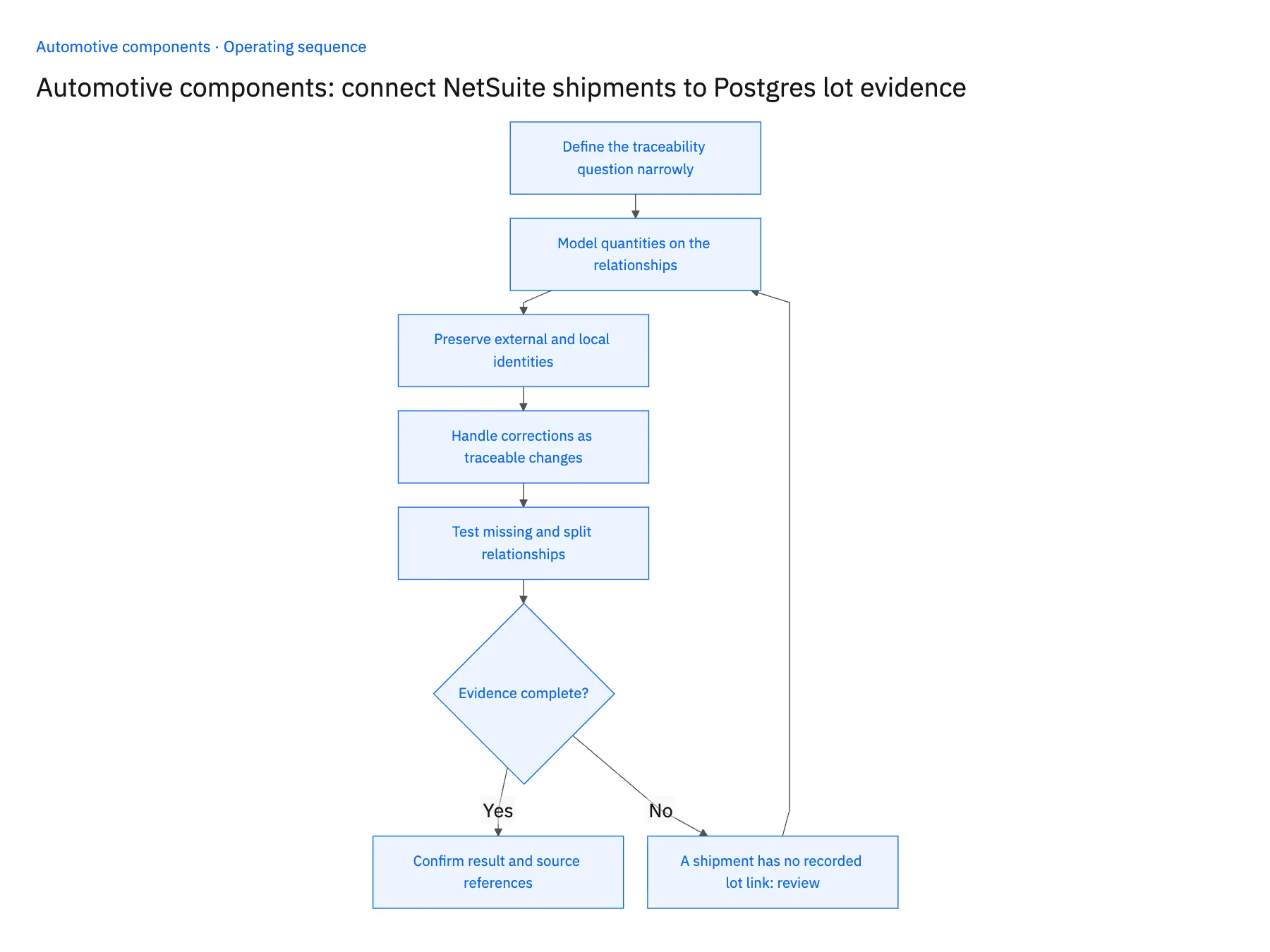
- 01Define the traceability question narrowlyChoose a question the source data can answer, such as which recorded lots supplied one shipment line. Identify the authoritative relationship and its owner. Avoid promising end-to-end genealogy when the available records cover only part of the chain.
- 02Model quantities on the relationshipsStore the quantity assigned from each lot to each shipment line with explicit units. Support split lots and partial shipments. Reconcile relationship totals to the accepted shipment so a many-to-many join cannot inflate shipped quantity.
- 03Preserve external and local identitiesKeep NetSuite transaction references distinct from generated Postgres keys and production-record identifiers. Review historical duplicates before backfill. A common customer part description is useful for display but should not become the linking key.
- 04Handle corrections as traceable changesIf shipping or quality corrects a recorded lot relationship, retain the prior value and accepted reason according to the process. Recompute the current evidence view without hiding that a correction occurred after dispatch.
- 05Test missing and split relationshipsUse a shipment containing two lots and another with an incomplete source link. The first should reconcile exactly; the second should remain visibly unresolved. Any return update into ERP must follow the verified operation and owner approval.
Handle the exceptions explicitly
A shipment has no recorded lot link
Route the gap to shipping or quality. Do not infer the lot from the nearest production date.
One lot supplies several customer releases
Track the allocated quantities separately so the full lot is not counted on every release.
The customer reports a different receiving reference
Preserve the discrepancy and reconcile the commercial identifiers before merging shipment evidence.
What to verify before expanding
- Lot quantities reconcile to the selected shipment line in the same unit.
- Missing relationships remain explicit rather than being filled by approximate joins.
- A corrected relationship retains the accepted correction context.
- Supplier dispatch is not displayed as proof of customer acceptance.

Connect this process to the rest of your operation
Explore Stacksync two-way sync and scope the records and actions against your actual systems. Book a demo with a real shipment line example and the exception your team handles most often, for example A shipment has no recorded lot link.
- Dynamics 365 Finance and SQL Server two-way sync for automotive suppliers
- NetSuite and Postgres two-way sync for automotive component evidence
- Automotive component suppliers: connect Salesforce program awards and NetSuite demand
- Automotive component engineering cutovers: coordinate open demand and existing inventory
- Automotive supplier delays: build recovery plans around firm customer releases
- Bi-Directional Sync vs CDC Duplicates: Reliability Guide
- EDI for Automotive Suppliers and OEMs: Powering Real-Time Manufacturing Communication
The shared architecture guide covers record matching, ownership, and recovery across systems.
Technical references
FAQ
Frequently asked questions










Related articles