







Preserve order identity through changes
Keep original lines, approved revisions and destination references linked so replays cannot duplicate demand.
 Salesforce
  HubSpot
  NetSuite
  Zendesk
  Microsoft Dynamics 365 Sales
  Dynamics 365 F&O
  Attio
Attio  Pipedrive
  Zoho CRM
  Campfire
  Rillet
  Front
Front  Shopify
  Amazon Seller Central
  SendGrid
 Automotive components
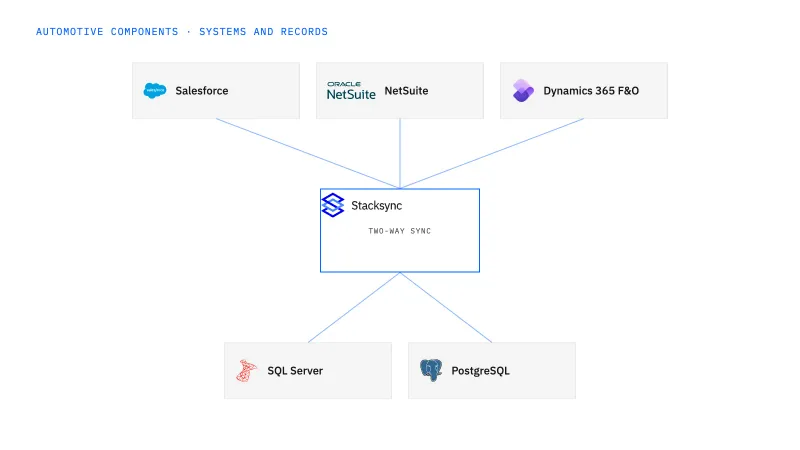
Connect agreed automotive EDI order and change processes to reviewable ERP demand. Stacksync fits suppliers that need purchase-order identity, engineering applicability and partner responses to remain traceable through revisions and retries. Separate forecasting or scheduling feeds from firm orders according to the actual customer agreement.
A technically accepted EDI file can still carry the wrong plant mapping, an unresolved revision or a quantity already represented in another planning source.
Explore your process in a demo, or get our shared two-way sync architecture guide.
When this fits
Supply-chain, quality and IT teams at US automotive component suppliers with 100–1,000 employees.
Keep original lines, approved revisions and destination references linked so replays cannot duplicate demand.
Route plant, part and production-impacting exceptions to the owners who can accept them.
Track receipt, validation, application and response delivery separately so a response retry does not reapply the order.
The process, end to end
a supplier wants to automate an agreed 850/860 process for one customer. Evaluate an original order, a part-reference change, an older replay and a failed response transmission. Ask to see accepted demand and the partner-response state separately.
Scope your implementation
Review current platform pricing alongside the records, volume, and actions in your process. Use your own operating baseline to evaluate the economics.
Explore your process in a demo, or get our shared two-way sync architecture guide.
From foundation to action
Keep shared customer, order, and operational records aligned, with clear field ownership.
Explore two-way sync 02Move approved work between systems, assign exceptions, and confirm the result.
Explore workflows 03Investigate cross-system questions, assemble the evidence, and prepare the next action.
Explore ai agents (genies) 04Connect trading-partner documents to operational records and exception handling.
Explore ediGo deeper
Original 850 orders, 860 change requests and partner responses stay traceable through replays, retries and engineering cutovers under the customer agreement.
Explore all automotive components integration and automation guides ↗
No. Scope the actual partner’s documents and business conventions, including how separate forecast or schedule sources are interpreted.
Technical receipt and business acceptance are different states. Follow the agreed response process and keep each state visible.
Track unresolved exceptions, duplicate application attempts and time to a correct business response, using the same partner and document types.
Start with two-way sync between NetSuite and Postgres, even when the documents already arrive over EDI, so the original customer order and the processing and response ledger keep one identity across both systems. Workflows come next to route each buyer change request and engineering applicability question to the owner who can accept it. Genies follow, comparing a requested change with the accepted order state before review. EDI application into NetSuite then runs against those controls; a received document is not an accepted schedule.


