Automotive component engineering cutovers: coordinate open demand and existing inventory
A cutover case shows the approved boundary, which releases and material fall inside it, and each owner’s disposition before the item master changes revision.
- Author
- Ignacio Malpartida · GTM Engineer
- Published
- Read time
- 4 min read

The operating decision
An automotive engineering-cutover workflow should connect the approved change to affected parts, open demand, existing stock and work in progress. Preserve the applicability boundary supplied by engineering and the customer process. Automation can assemble impact and follow up on dispositions, but it should not replace every old revision with the newest one. Planning, quality and commercial owners must decide what happens to existing commitments and material under the approved cutover.
Explore the complete automotive components integration and automation hub for the systems and processes around this guide.
What this looks like in automotive components
A supplier receives approval for a revised component but has finished stock and released work under the earlier revision. The customer’s instruction applies from a specific release boundary, while sales asks whether older stock can still fulfill an open commitment. A shared cutover case can show the applicable instruction, affected quantities and unresolved dispositions. Without that scope, updating the item master to the new revision could make old stock appear obsolete or, conversely, cause the earlier revision to be supplied where the new one is required.
Records, ownership, and update rules
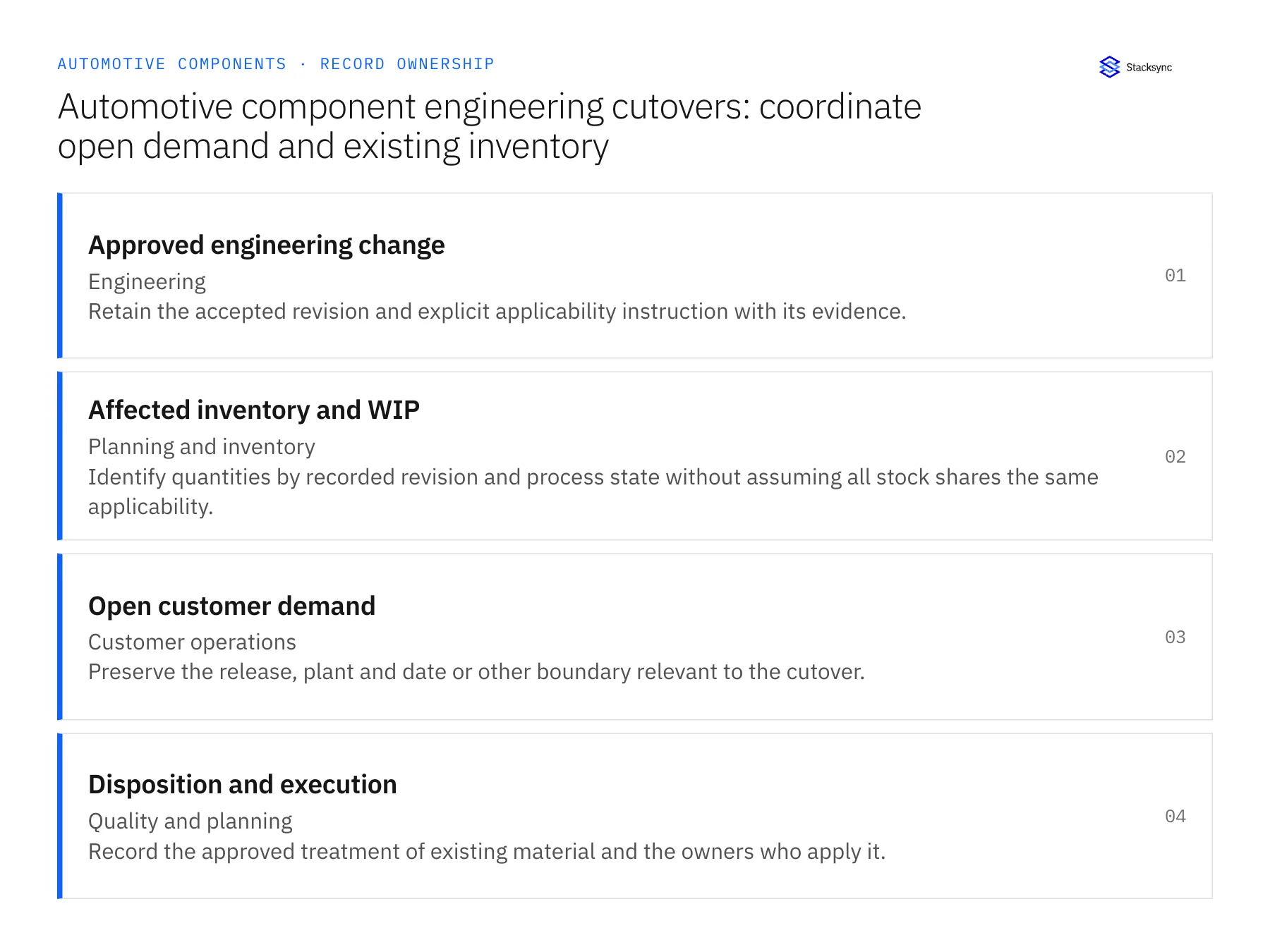
| Record | Owner | Operating rule |
|---|---|---|
| Approved engineering change | Engineering | Retain the accepted revision and explicit applicability instruction with its evidence. |
| Affected inventory and WIP | Planning and inventory | Identify quantities by recorded revision and process state without assuming all stock shares the same applicability. |
| Open customer demand | Customer operations | Preserve the release, plant and date or other boundary relevant to the cutover. |
| Disposition and execution | Quality and planning | Record the approved treatment of existing material and the owners who apply it. |
Work through the process
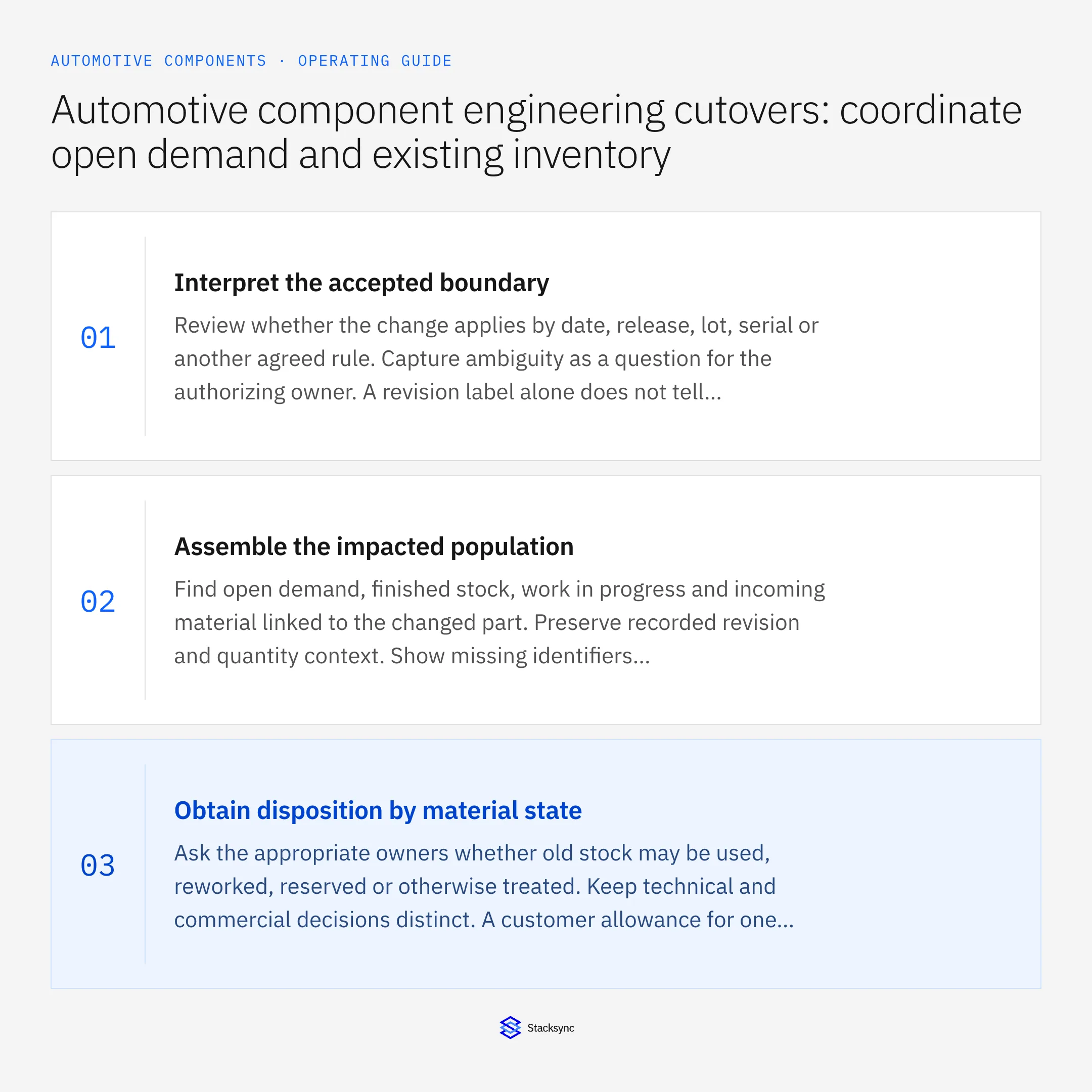
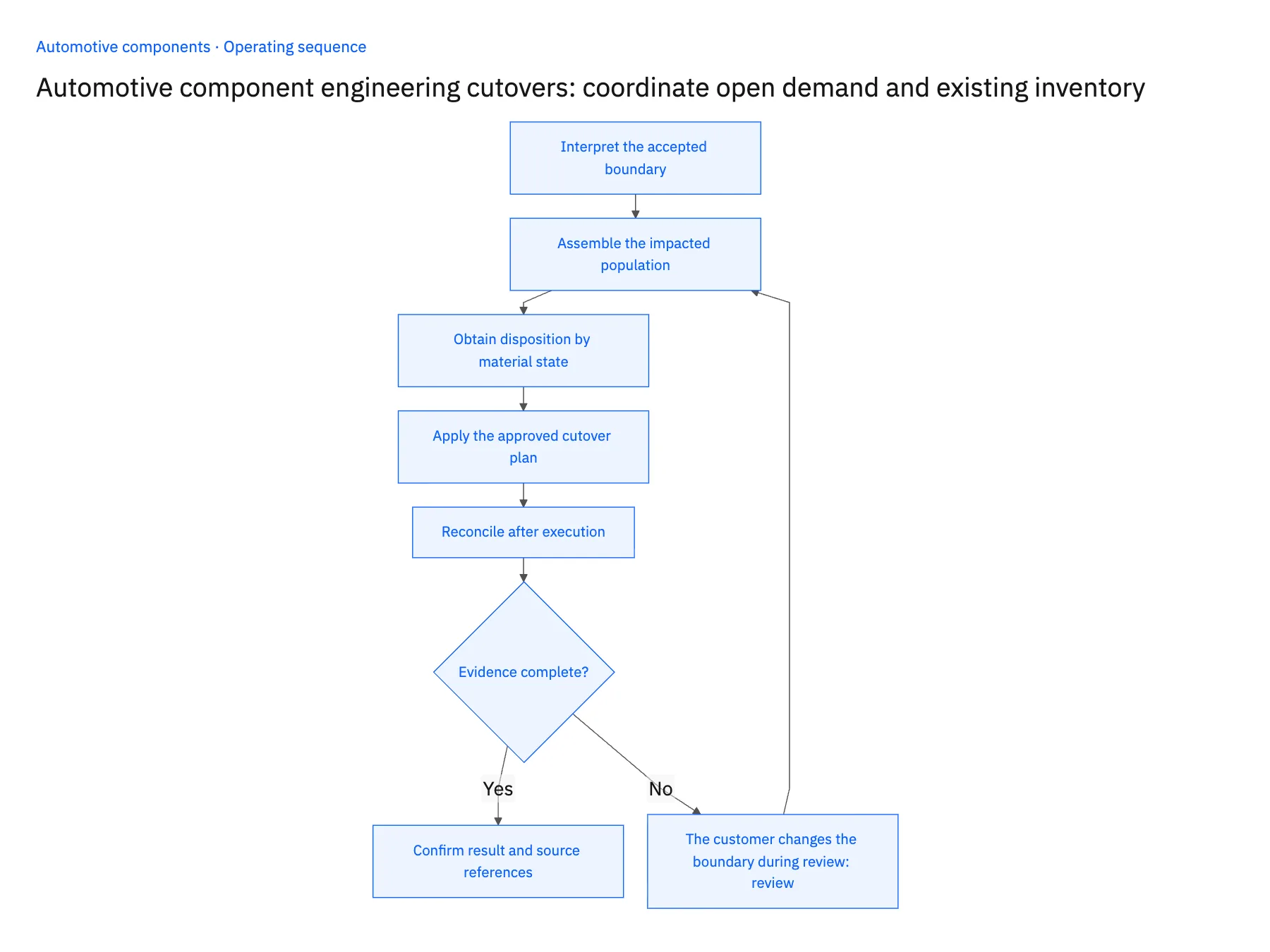
- 01Interpret the accepted boundaryReview whether the change applies by date, release, lot, serial or another agreed rule. Capture ambiguity as a question for the authorizing owner. A revision label alone does not tell planning which existing work is affected.
- 02Assemble the impacted populationFind open demand, finished stock, work in progress and incoming material linked to the changed part. Preserve recorded revision and quantity context. Show missing identifiers separately so reviewers understand where the impact list may be incomplete.
- 03Obtain disposition by material stateAsk the appropriate owners whether old stock may be used, reworked, reserved or otherwise treated. Keep technical and commercial decisions distinct. A customer allowance for one release should not automatically authorize use on all future demand.
- 04Apply the approved cutover planUpdate the relevant instructions and records through the normal controlled process. Keep a reference to the approval and effective scope. Confirm that scheduling, inventory and customer-facing teams share the same accepted interpretation.
- 05Reconcile after executionCheck that affected orders and quantities now reflect the approved plan. Follow unresolved exceptions to their owners. Preserve the prior revision history so later shipment questions can be answered from the instruction applicable at the time.
Handle the exceptions explicitly
The customer changes the boundary during review
Version the request and reassess dispositions that relied on the earlier instruction.
Some inventory lacks revision evidence
Route it to identification or quality review rather than assigning the current revision automatically.
Old stock is approved for one release only
Record that restricted allocation and prevent the approval from becoming a general interchangeability rule.
What to verify before expanding
- Every cutover decision identifies its applicable demand or material boundary.
- Old and new revision quantities remain distinguishable during review.
- Restricted use approvals stay scoped to the authorized commitment.
- Execution closes only after affected records reconcile to the accepted plan.

Connect this process to the rest of your operation
Explore Stacksync workflows and scope the records and actions against your actual systems. Book a demo with a real approved engineering change example and the exception your team handles most often, for example the customer changes the boundary during review.
- Engineering-cutover workflows for automotive component suppliers
- Automotive supplier delays: build recovery plans around firm customer releases
- AI agents for automotive release review: assemble quantity, date and revision differences
- Automotive release AI exceptions: stale versions, plant mappings and part changes
- EDI for Automotive Suppliers and OEMs: Powering Real-Time Manufacturing Communication
- Keeping Dynamics 365 Finance & Operations and PostgreSQL in Step
The shared architecture guide covers record matching, ownership, and recovery across systems.
Technical references
FAQ
Frequently asked questions










Related articles