







Connect actual evidence
Link shipment lines to recorded lots and revision context using the authoritative relationships.
 Salesforce
  HubSpot
  NetSuite
  Zendesk
  Microsoft Dynamics 365 Sales
  Dynamics 365 F&O
  Attio
Attio  Pipedrive
  Zoho CRM
  Campfire
  Rillet
  Front
Front  Shopify
  Amazon Seller Central
  SendGrid
 Automotive components
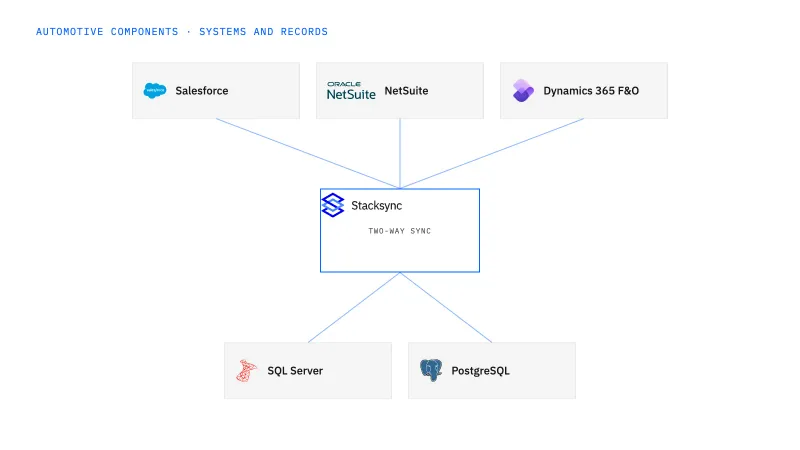
Connect NetSuite shipments and orders with the lot and revision evidence maintained in your operational Postgres application. Stacksync fits suppliers that repeatedly assemble shipment traceability packets from separate systems. The first scope should preserve actual relationships and quantity reconciliation while making missing evidence visible.
The shipment is in the ERP, but the team must search production records to establish which recorded lots actually supplied it.
Explore your process in a demo, or get our shared two-way sync architecture guide.
When this fits
Supply-chain, quality and IT teams at US automotive component suppliers with 100–1,000 employees.
Link shipment lines to recorded lots and revision context using the authoritative relationships.
Preserve split and partial relationships without multiplying shipped quantities in the operational view.
Missing source links remain reviewable gaps; synchronization does not create traceability the business never recorded.
The process, end to end
a quality or operations leader needs to answer customer questions about split-lot shipments. Evaluate one shipment supplied by two lots and another with a missing relationship. A useful result reconciles the first and exposes the second without inventing a link.
Scope your implementation
Review current platform pricing alongside the records, volume, and actions in your process. Use your own operating baseline to evaluate the economics.
Explore your process in a demo, or get our shared two-way sync architecture guide.
From foundation to action
Keep shared customer, order, and operational records aligned, with clear field ownership.
Explore two-way sync 02Move approved work between systems, assign exceptions, and confirm the result.
Explore workflows 03Investigate cross-system questions, assemble the evidence, and prepare the next action.
Explore ai agents (genies) 04Connect trading-partner documents to operational records and exception handling.
Explore ediGo deeper
Program identity can tie a Salesforce award to NetSuite customer, plant and part records while estimates, forecasts and accepted releases keep their own meaning.
A planning view that shows forecast, requested and accepted quantities side by side, with the accepted total explained from documented customer rules rather than a SQL sum.
Shipment evidence that answers which recorded lots supplied one NetSuite shipment line, reconciled by quantity and open about gaps in the Postgres record.
Explore all automotive components integration and automation guides ↗
Yes. Stacksync's Postgres connector syncs tables that carry a single-column, auto-generated primary key, so a fulfillment relationship keyed only on shipment line plus lot needs a surrogate key column before it is mapped. Keep the NetSuite transaction reference and the lot identifier as ordinary columns on that row, with the allocated quantity and its unit beside them. Logical replication (wal_level set to logical) is the other precondition; confirm both with the database owner before the sync is scoped.
It stays in the evidence view as a dispatched quantity with no recorded lot, and it remains a review item for shipping or quality until one of them records the relationship. The sync carries the NetSuite shipment line into Postgres and carries back only the fields shipping has approved; it does not select the nearest production lot by date or borrow an allocation from another shipment of the same item. Count these lines during the evaluation, because they show where the operating process records less than the customer question asks for.
No. Reconciliation shows which recorded lots supplied the dispatched quantity; it says nothing about receipt or acceptance at the customer plant. Keep the customer's receiving reference and release number on the delivery context record rather than on the lot evidence, and when the customer quotes a receiving reference that does not match the supplier's records, reconcile the commercial identifiers first and merge the shipment evidence afterwards. A packet that mixes dispatch with acceptance reads as a claim the supplier cannot support.
Begin with two-way sync between NetSuite and Postgres covering the shipment line, lot or revision evidence and fulfillment relationship records, with NetSuite writes limited to the objects shipping has approved. Workflows follow when a shipment with no recorded lot link should open a review task for shipping or quality. Genies fit later, assembling the evidence packet behind a customer question about a specific revision. EDI enters only when the customer’s orders or shipping schedules move through an agreed partner process; that transport stays separate from the evidence sync.


