







Tester requests
Approve samples and testers, resolve the recipient, and reconcile actual warehouse fulfillment.
Explore workflows ↗ Salesforce
  HubSpot
  NetSuite
  Zendesk
  Microsoft Dynamics 365 Sales
  Dynamics 365 F&O
  Attio
Attio  Pipedrive
  Zoho CRM
  Campfire
  Rillet
  Front
Front  Shopify
  Amazon Seller Central
  SendGrid
 Personal care
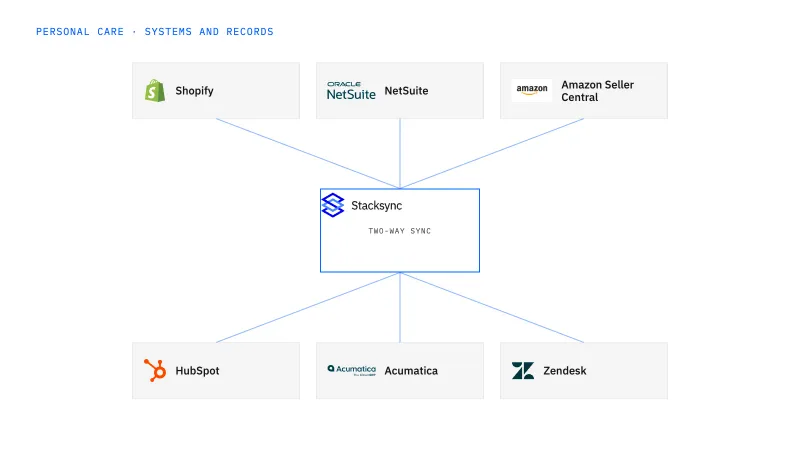
Connect personal-care product variants, salon wholesale, tester fulfillment, returns, and retailer onboarding documents.
Shade, size, set, tester, and retailer item identities differ across commercial and fulfillment systems.
Explore your process in a demo, or get our shared two-way sync architecture guide.
The platform, in operating order
Keep shared customer, order, and operational records aligned, with clear field ownership.
Explore two-way sync 02Move approved work between systems, assign exceptions, and confirm the result.
Explore workflows 03Investigate cross-system questions, assemble the evidence, and prepare the next action.
Explore ai agents (genies) 04Connect trading-partner documents to operational records and exception handling.
Explore ediBuilt around your operations
Personal-care and beauty brands combining product manufacturing, ecommerce, salons, and retail distribution.
Approve samples and testers, resolve the recipient, and reconcile actual warehouse fulfillment.
Explore workflows ↗Connect support requests to the original shade, size, and set before deciding a remedy.
Explore workflows ↗A configurable Genie job that gathers approved product sheets and packaging information for a retailer request.
Explore Genies ↗Your systems and records
| Record | Owner | Operating rule |
|---|---|---|
| Consumer variant | Product operations | Keep shade, size, product line, and sellable set identity separate. |
| Tester item | Commercial operations | Distinguish nonstandard sample or tester allocation from a retail sale. |
| Salon account | Sales operations | Resolve location, buyer, and legal payer before assigning terms. |
| Retailer document | Product team | Own approved product-sheet and packaging-data versions for the requested item. |
Retailer item mappings across shades, sizes, gift sets, and case configurations.
Evaluate your next process
Connect personal-care ecommerce orders to the exact shade, size, and set represented in the ERP.
Bring beauty marketplace order evidence into ERP reconciliation at the exact sellable-offer level.
Coordinate personal-care sample and tester requests through approved allocation and actual warehouse fulfillment.
Configure a Genie to assemble approved product sheets and packaging data for a retailer’s exact personal-care assortment.
Implementation and operating guides
Travel sizes, full sizes and seasonal sets stay separate NetSuite items, so a Shopify order or a partial set return still resolves to what the customer bought.
Read-only Amazon order evidence keeps seller SKU, marketplace and child offer intact, so finance and support can identify the exact shade and size a shopper bought.
Sales works salon groups and stylists in HubSpot while finance keeps the billing identity and terms in Acumatica, so no tester contact turns into a duplicate customer.
Reps ask for retail shades, operations stocks tester SKUs, and the workflow holds the request until the recipient, item mapping and quantity are approved.
Support, warehouse receipt, disposition and refund stay as separate states with separate owners, so a closed ticket never stands in for a completed return.
The onboarding Genie assembles a reviewable packet from approved sources, labels each dimension by packaging level, and hands open gaps to the product owner instead of guessing.
Conflicting product sheets, unlabeled packaging levels and absent specs halt the onboarding job with both candidates visible until a product owner names the authoritative source.
Each retailer item code carries an effective set definition, so a reused seasonal code or a warehouse shade swap cannot rewrite what the retailer ordered.
No. A tester item is recorded as a nonstandard allocation, and commercial operations owns that distinction from a retail sale. The tester requests workflow carries an approved request, resolves who receives it, and reconciles what the warehouse shipped against the approved quantity. In the ERP, the allocation stays distinct from a consumer variant sale. Commercial operations approves each request before fulfillment; the workflow does not create a tester shipment on its own.
It cannot. The Genie assembles the retailer document the product team has approved for each item, matching shade, size, set, packaging revision, and sharing permission, and it reports any field that is missing or conflicts between sources. It does not estimate a dimension, invent a specification, or state that an item meets a retailer's compliance requirement. The product team owns each document version, and someone on that team completes or corrects the packet before it goes to the retailer.
By keeping the consumer variant as the shared identity, with product operations owning shade, size, product line, and set as separate attributes. Two-way sync relates each Shopify variant to the matching NetSuite or Acumatica item through that record, so a gift set is not confused with the single shade it contains. Amazon Seller Central is connected with read-only access: the connector imports marketplace evidence and does not update listings, cancel Amazon orders, or issue marketplace refunds. Any warehouse or commerce action is scoped separately.
Bring one real process
Bring the systems, record types, and exceptions your team handles today. We’ll scope the connections and actions, then walk through the path to a confirmed result.
Explore your process in a demo, or get our shared two-way sync architecture guide.


