







Preserve sellable detail
Map stable Shopify variants to the exact approved ERP item and keep shades and sizes distinct.
 Salesforce
  HubSpot
  NetSuite
  Zendesk
  Microsoft Dynamics 365 Sales
  Dynamics 365 F&O
  Attio
Attio  Pipedrive
  Zoho CRM
  Campfire
  Rillet
  Front
Front  Shopify
  Amazon Seller Central
  SendGrid
 Personal care
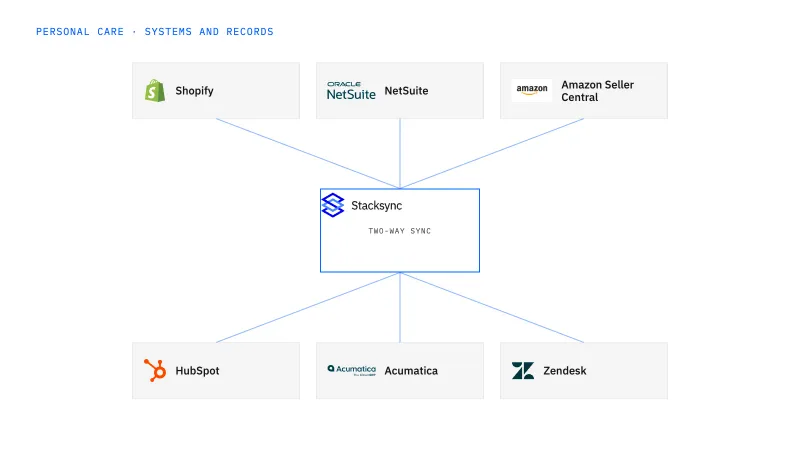
Connect personal-care ecommerce orders to the exact shade, size, and set represented in the ERP. This fits brands selling DTC and wholesale when catalog variants and seasonal sets create repeated reconciliation work. Preserve stable identities and historical configurations while keeping product and finance ownership explicit.
Product-family names obscure the shade, size, or gift-set component actually purchased and fulfilled.
Explore your process in a demo, or get our shared two-way sync architecture guide.
When this fits
Personal-care and beauty brands combining product manufacturing, ecommerce, salons, and retail distribution.
Map stable Shopify variants to the exact approved ERP item and keep shades and sizes distinct.
Keep the purchased gift-set revision and component relationships available for fulfillment and later return review.
Two-way sync covers Shopify product variants, orders, and customers and maps each variant to the NetSuite item that product operations approves. Writes on either side are limited to the objects and fields you enable. Inventory levels and fulfillment actions sit outside that scope, so confirm them as separate steps with their own permissions before anyone treats a synced variant as available stock.
The process, end to end
A beauty brand offers travel sizes, full sizes, and seasonal gift sets under similar names. Support needs the original purchase, operations needs the correct items, and finance needs a consistent order trail. A useful demo includes two sizes of one shade and a partial-set return to prove that the relationships remain intact.
Scope your implementation
Review current platform pricing alongside the records, volume, and actions in your process. Use your own operating baseline to evaluate the economics.
Explore your process in a demo, or get our shared two-way sync architecture guide.
From foundation to action
Keep shared customer, order, and operational records aligned, with clear field ownership.
Explore two-way sync 02Move approved work between systems, assign exceptions, and confirm the result.
Explore workflows 03Investigate cross-system questions, assemble the evidence, and prepare the next action.
Explore ai agents (genies) 04Connect trading-partner documents to operational records and exception handling.
Explore ediGo deeper
Travel sizes, full sizes and seasonal sets stay separate NetSuite items, so a Shopify order or a partial set return still resolves to what the customer bought.
Read-only Amazon order evidence keeps seller SKU, marketplace and child offer intact, so finance and support can identify the exact shade and size a shopper bought.
Sales works salon groups and stylists in HubSpot while finance keeps the billing identity and terms in Acumatica, so no tester contact turns into a duplicate customer.
Explore all personal care integration and automation guides ↗
Only where the approved ERP model still preserves the exact sellable item. A generic family match must not erase the shade and size needed for operations.
The gift-set recipe is versioned, so the original order still resolves to the components that shipped, not to whatever the set contains today. Support sees the return context with the purchased shade, size, and set revision, then applies your partial-return policy to that configuration. The sync preserves the relationship; it does not rewrite the original sale to match the current catalog, and it does not decide the remedy. If the returned component was a limited edition with no approved ERP match, the line stays unresolved for review.
Start with two-way sync between Shopify product variants, orders, and customers and the NetSuite items and set structure that product operations owns. Add workflows once a partial-set return or a set-content change needs a reviewed handoff between support, operations, and finance. Genies come later, when a reviewer needs evidence gathered across historical set revisions before deciding a remedy. EDI applies only when retailers order the same shades and sets under their own item numbers as partner documents.


