







Keep variations distinct
Use the actual sellable identity and approved item crosswalk while retaining family context as supporting evidence.
 Salesforce
  HubSpot
  NetSuite
  Zendesk
  Microsoft Dynamics 365 Sales
  Dynamics 365 F&O
  Attio
Attio  Pipedrive
  Zoho CRM
  Campfire
  Rillet
  Front
Front  Shopify
  Amazon Seller Central
  SendGrid
 Personal care
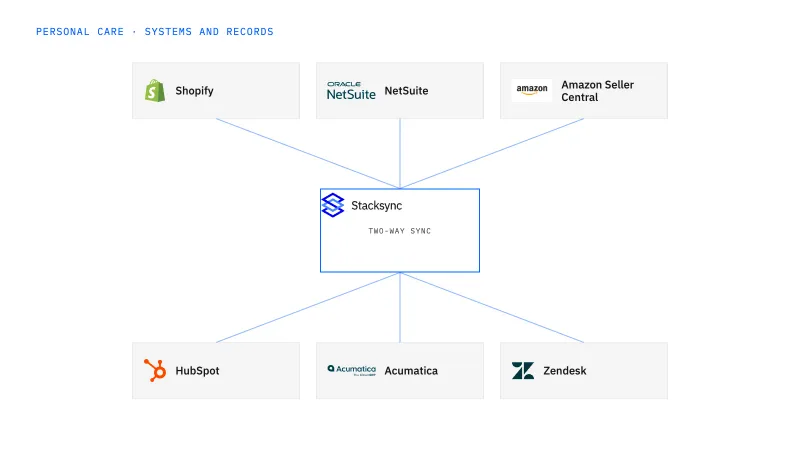
Bring beauty marketplace order evidence into ERP reconciliation at the exact sellable-offer level. This fits brands whose variation families contain many shades, sizes, or packs that must remain distinct in finance and operations. The documented Amazon sync access is read-only and supports downstream evidence gathering.
A parent variation or familiar product name gets treated as the identity of every child offer.
Explore your process in a demo, or get our shared two-way sync architecture guide.
When this fits
Personal-care and beauty brands combining product manufacturing, ecommerce, salons, and retail distribution.
Use the actual sellable identity and approved item crosswalk while retaining family context as supporting evidence.
Connect returns and finance events to the original line and mapping revision after the catalog changes.
Stacksync reads Amazon Seller Central with read-only access: seller offers and order lines flow into NetSuite as evidence, scoped by seller account and marketplace. Nothing is written back to Amazon. Listing changes, order cancellations, and marketplace refunds happen inside Amazon under separate authorization. Product operations owns the ERP crosswalk that ties each child offer to the exact shade and size.
The process, end to end
A beauty brand groups several shades and bottle sizes under one marketplace family. Finance receives sales evidence while support investigates a return. The evaluation should demonstrate that each original order line retains the seller-scoped offer and exact ERP item rather than collapsing into one family-level record.
Scope your implementation
Review current platform pricing alongside the records, volume, and actions in your process. Use your own operating baseline to evaluate the economics.
Explore your process in a demo, or get our shared two-way sync architecture guide.
From foundation to action
Keep shared customer, order, and operational records aligned, with clear field ownership.
Explore two-way sync 02Move approved work between systems, assign exceptions, and confirm the result.
Explore workflows 03Investigate cross-system questions, assemble the evidence, and prepare the next action.
Explore ai agents (genies) 04Connect trading-partner documents to operational records and exception handling.
Explore ediGo deeper
Travel sizes, full sizes and seasonal sets stay separate NetSuite items, so a Shopify order or a partial set return still resolves to what the customer bought.
Read-only Amazon order evidence keeps seller SKU, marketplace and child offer intact, so finance and support can identify the exact shade and size a shopper bought.
Sales works salon groups and stylists in HubSpot while finance keeps the billing identity and terms in Acumatica, so no tester contact turns into a duplicate customer.
Explore all personal care integration and automation guides ↗
The sync connector imports Amazon evidence. Listing or variation mutations require a separately verified action and authorization.
Hold it until the original order line is found. The sync keeps each Amazon order line with its seller-scoped child offer and quantity, so support can retrieve the exact shade, size, and pack that shipped instead of guessing from the family title. A return that cannot be tied to a line stays unmatched and goes to review. Because Amazon access is read-only, the refund itself is issued in Seller Central by whoever holds that authority, and finance reconciles it against the original line in NetSuite.
Begin with two-way sync, connecting Amazon Seller Central read-only, so order lines and seller offers land in NetSuite against the approved ERP crosswalk. Workflows follow when a child offer disappears from the catalog and new unmatched orders need routing to product operations. Genies help when a return names only a family and someone must gather the original line, offer, and mapping revision before a person decides. EDI is separate from marketplace sales; it enters when retailers send purchase orders for the same shades.


