







Approve the right goods
Resolve tester and sample equivalents and route unusual quantities or substitutions to the responsible owner.
 Salesforce
  HubSpot
  NetSuite
  Zendesk
  Microsoft Dynamics 365 Sales
  Dynamics 365 F&O
  Attio
Attio  Pipedrive
  Zoho CRM
  Campfire
  Rillet
  Front
Front  Shopify
  Amazon Seller Central
  SendGrid
 Personal care
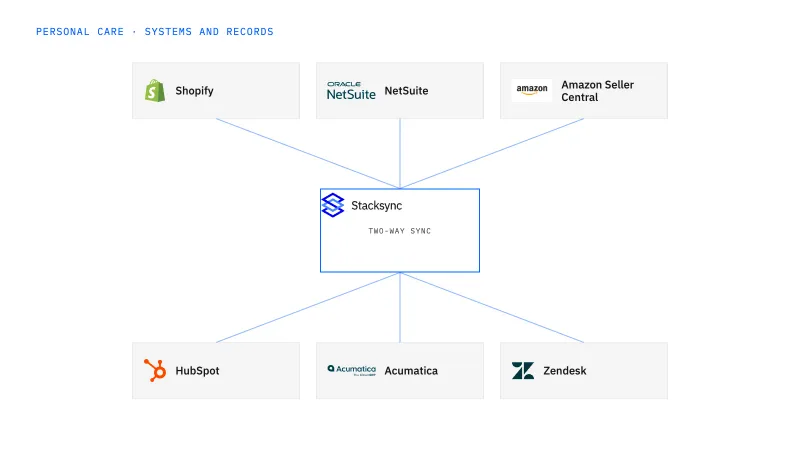
Coordinate personal-care sample and tester requests through approved allocation and actual warehouse fulfillment. This fits brands whose sales teams serve salons or retailers and need to know what was authorized, substituted, and shipped. Keep tester items and commercial sales distinct throughout the process.
Reps request retail shades while operations stocks separate tester items, and nobody sees the accepted assortment in one place.
Explore your process in a demo, or get our shared two-way sync architecture guide.
When this fits
Personal-care and beauty brands combining product manufacturing, ecommerce, salons, and retail distribution.
Resolve tester and sample equivalents and route unusual quantities or substitutions to the responsible owner.
Store the accepted warehouse reference and communicate actual shipment evidence, including remaining items.
HubSpot holds the tester request that sales writes, NetSuite holds the tester and retail items that product operations maps, and the commercial owner authorizes the allocation. Only the approved list is submitted to Extensiv through a verified warehouse action, and the workflow reads back the accepted reference. The workflow does not substitute retail stock for a missing tester unless the responsible owner approves that specific swap.
The process, end to end
A salon requests a tester display for a new line. The account owner proposes shades, product operations resolves tester equivalents, and a manager approves the allocation. A demo should show the final authorized list, a partial shipment, and the actual result returned to sales for follow-up.
Scope your implementation
Review current platform pricing alongside the records, volume, and actions in your process. Use your own operating baseline to evaluate the economics.
Explore your process in a demo, or get our shared two-way sync architecture guide.
From foundation to action
Keep shared customer, order, and operational records aligned, with clear field ownership.
Explore two-way sync 02Move approved work between systems, assign exceptions, and confirm the result.
Explore workflows 03Investigate cross-system questions, assemble the evidence, and prepare the next action.
Explore ai agents (genies) 04Connect trading-partner documents to operational records and exception handling.
Explore ediGo deeper
Reps ask for retail shades, operations stocks tester SKUs, and the workflow holds the request until the recipient, item mapping and quantity are approved.
Support, warehouse receipt, disposition and refund stay as separate states with separate owners, so a closed ticket never stands in for a completed return.
Explore all personal care integration and automation guides ↗
Only an explicit approved policy could allow that substitution. The default process should ask the authorized owner and preserve what was approved.
The workflow checks the salon account's history before anything is allocated. A second request for the same location and shades is held and shown to the commercial owner alongside the first, rather than creating a second allocation. The owner decides whether the repeat is legitimate, for example a second display for a stylist who joined after the first shipment, and authorizes the quantity. Whatever ships, Extensiv returns the accepted reference and the actual assortment, and both reps see that single result in HubSpot instead of two competing wish lists.
Usually yes. Two-way sync between HubSpot companies and NetSuite customers and items gives the workflow a resolved salon account and approved tester items to work from. The workflow then carries each tester request through mapping, allocation approval, and the Extensiv fulfillment result. Genies come in when a repeated or unusual request needs account history and prior shipments gathered for the commercial owner to judge. EDI does not touch tester allocation; it matters only when retailers begin ordering the same products as partner documents.


