







Outside-processing return follow-up
Track late coating, plating or heat-treatment operations and show the affected downstream jobs.
Explore workflows ↗ Salesforce
  HubSpot
  NetSuite
  Zendesk
  Microsoft Dynamics 365 Sales
  Dynamics 365 F&O
  Attio
Attio  Pipedrive
  Zoho CRM
  Campfire
  Rillet
  Front
Front  Shopify
  Amazon Seller Central
  SendGrid
 Metal fabrication and machining
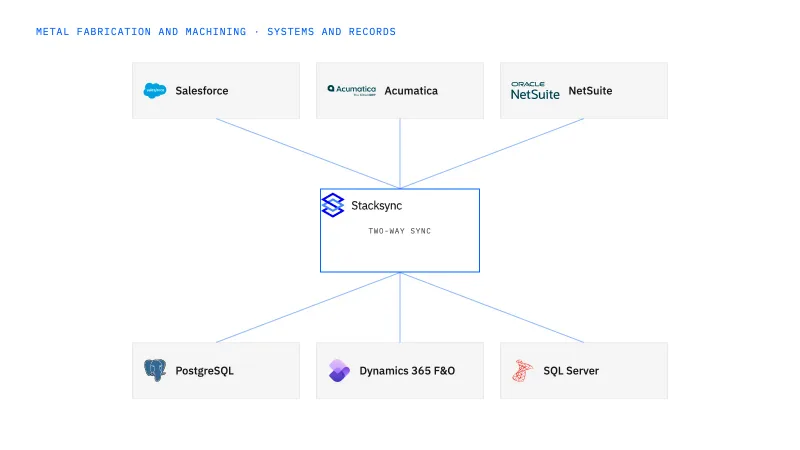
Connect estimates, job revisions, outside processing and material evidence without turning a revised drawing into an unapproved shop-floor instruction.
Estimators, schedulers and subcontract buyers work from different revisions while customer updates still depend on a planner opening the job record.
Explore your process in a demo, or get our shared two-way sync architecture guide.
The platform, in operating order
Keep shared customer, order, and operational records aligned, with clear field ownership.
Explore two-way sync 02Move approved work between systems, assign exceptions, and confirm the result.
Explore workflows 03Investigate cross-system questions, assemble the evidence, and prepare the next action.
Explore ai agents (genies) 04Connect trading-partner documents to operational records and exception handling.
Explore ediBuilt around your operations
Operations leaders, production planners and IT teams at US metal fabricators and machine shops with 100–1,000 employees.
Track late coating, plating or heat-treatment operations and show the affected downstream jobs.
Explore workflows ↗Collect the proposed revision and production impact before engineering and planning approve a cutover.
Explore workflows ↗Prepare a structured estimate request from customer drawings and email without guessing missing tolerances.
Explore Genies ↗Your systems and records
| Record | Owner | Operating rule |
|---|---|---|
| Quote revision | Estimating | Retain quantity breaks and drawing revision before a quote becomes an order. |
| Job operation | Production planning | Expose readiness and completion independently from customer-requested dates. |
| Outside-process lot | Subcontract purchasing | Track quantity sent, due back, received and rejected for each operation. |
| Material certificate | Quality | Link a reviewed certificate to the actual heat or lot; an attachment alone does not release material. |
Translate customer PO lines without losing drawing revision, unit conventions or the distinction between a release and a repeat transmission.
Evaluate your next process
Connect accepted fabrication quotes to ERP orders and return the job-readiness information sales needs.
Connect NetSuite order context with the Postgres records your shop uses for jobs and outside processing.
Coordinate late coating, plating, heat-treatment and other outsourced operations around the jobs they affect.
Use a Genie to turn fabrication RFQs into estimating packets with source evidence, approved part history and explicit missing questions.
Implementation and operating guides
A fabricator's Salesforce win should reach Acumatica as one order line carrying the chosen quantity break and drawing revision, with job readiness reported back separately.
Machine shops that track coating and plating batches in Postgres can keep NetSuite order context attached to each sent, returned and inspected quantity.
A material-evidence view tells planners which received heat each certificate covers and which order demand uses it, so a file on record never stands in for a quality decision.
When a processor returns heat-treated parts late or in a split shipment, one shared case shows the unresolved quantity, the affected next operation and who decides the allocation.
A customer's revision D arriving mid-run should open a review of the pieces at each stage, not overwrite the revision C the shop and its processor are working to.
Estimators get one reviewable packet with the customer's drawings, quantity breaks and finish question, plus the prior quotes and unknowns that decide whether pricing can start.
Readable documents that disagree about the same part should block the quote packet until an estimator or engineer settles which source governs revision, material and quantities.
Repeat orders for a machined housing arrive as releases against one blanket PO; intake must tell releases, changes and retransmissions apart before any line reaches the ERP.
Start with the planner who currently opens the job record to answer customer status questions, because that person already reconciles the Quote revision, the Job operation and the Outside-process lot by hand. Give them a named counterpart in estimating and subcontract purchasing, and bring in your Acumatica or NetSuite administrator before any write permission is granted. Two-way sync exposes each record to its owner; it does not move ownership of the quote from estimating to the shop floor.
A good fit has a record that changes hands more than once and an owner who can say which version is approved. Drawing changes on released jobs qualify when engineering can state which Job operation the new revision affects and planning can approve the cutover. Late coating or plating returns qualify when subcontract purchasing tracks each Outside-process lot by quantity sent and due back. The workflow gathers the evidence and routes it; engineering and planning still make the release decision.
Ask for three cases run end to end: a repeat order against an existing Quote revision, a customer PO that arrives with a newer drawing, and the same release transmitted twice. In each case, look at the Material certificate state and the Outside-process lot balance alongside the order, and confirm the replay created no second job. The RFQ Genie may prepare the estimating packet, but estimating approves the quote and quality releases the material.
Bring one real process
Bring the systems, record types, and exceptions your team handles today. We’ll scope the connections and actions, then walk through the path to a confirmed result.
Explore your process in a demo, or get our shared two-way sync architecture guide.


