







Make the accepted scope visible
Keep the selected quantity break, part and drawing reference connected to the order so sales and operations can discuss the same commitment.
 Salesforce
  HubSpot
  NetSuite
  Zendesk
  Microsoft Dynamics 365 Sales
  Dynamics 365 F&O
  Attio
Attio  Pipedrive
  Zoho CRM
  Campfire
  Rillet
  Front
Front  Shopify
  Amazon Seller Central
  SendGrid
 Metal fabrication and machining
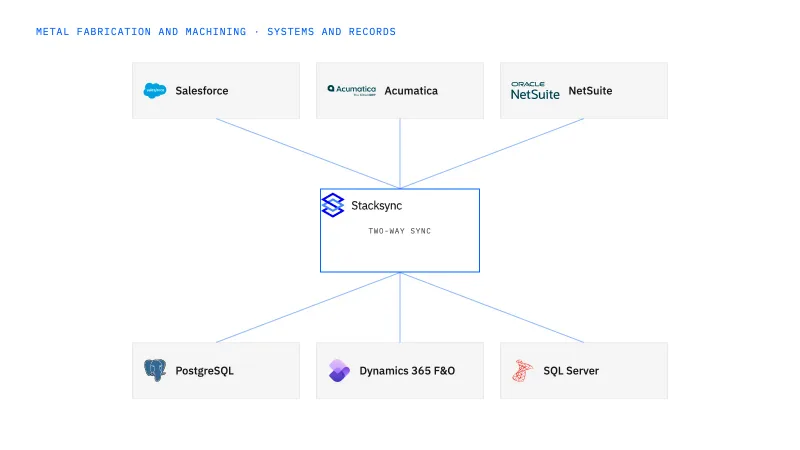
Connect accepted fabrication quotes to ERP orders and return the job-readiness information sales needs. Stacksync fits teams that repeatedly copy customer, quote-revision and order-status details between Salesforce and Acumatica. Scope the first connection around a reviewed quote-to-order handoff, with explicit ownership for engineering, credit and production decisions.
Estimators and account managers keep asking whether the quote they sold is the same revision the shop is preparing to run.
Explore your process in a demo, or get our shared two-way sync architecture guide.
When this fits
Operations leaders, production planners and IT teams at US metal fabricators and machine shops with 100–1,000 employees.
Keep the selected quantity break, part and drawing reference connected to the order so sales and operations can discuss the same commitment.
Show the accepted order state and unresolved conditions without treating a closed-won opportunity as production release.
Route revised scope to its owner and preserve the accepted version. Exact ERP create and update operations are validated during scoping.
The process, end to end
a fabricator serves repeat OEM customers but still checks each new PO against quantity breaks and drawing revisions manually. The buyer should ask to see one approved quote, one changed drawing and the operational status returned to sales before expanding the connection.
Scope your implementation
Review current platform pricing alongside the records, volume, and actions in your process. Use your own operating baseline to evaluate the economics.
Explore your process in a demo, or get our shared two-way sync architecture guide.
From foundation to action
Keep shared customer, order, and operational records aligned, with clear field ownership.
Explore two-way sync 02Move approved work between systems, assign exceptions, and confirm the result.
Explore workflows 03Investigate cross-system questions, assemble the evidence, and prepare the next action.
Explore ai agents (genies) 04Connect trading-partner documents to operational records and exception handling.
Explore ediGo deeper
A fabricator's Salesforce win should reach Acumatica as one order line carrying the chosen quantity break and drawing revision, with job readiness reported back separately.
Machine shops that track coating and plating batches in Postgres can keep NetSuite order context attached to each sent, returned and inspected quantity.
A material-evidence view tells planners which received heat each certificate covers and which order demand uses it, so a file on record never stands in for a quality decision.
Explore all metal fabrication and machining integration and automation guides ↗
Metal fabricators and machine shops with repeat order volume, Salesforce-based sales and an Acumatica order process that still needs manual reconciliation.
The order should not inherit whichever number appeared last. Two-way sync keeps the quantity the customer’s PO selected, the quote revision it came from and the price basis attached to the Acumatica handoff, and records the gap for estimating rather than choosing a value. Nobody prorates the quoted price on the shop’s behalf. Sales sees the open condition in Salesforce with its owner, and the order stays unreleased until estimating confirms the pricing and schedule effects.
Compare handoff preparation time, status-checking effort and scope corrections after acceptance. Use the shop’s own baseline rather than assuming a standard savings percentage.
Start with two-way sync between Salesforce and Acumatica so the accepted quote option, drawing revision and order line share one identity and readiness flows back to sales. Add workflows when a customer sends a new drawing against a released job and engineering, planning and the commercial owner need a routed decision. Genies come next, to assemble RFQ emails and drawings into an estimating packet before a quote exists. EDI is last, for customer PO lines and releases that must keep their drawing revision before they reach Acumatica.


