







Prepare an evidence-based packet
Organize customer part, revision, material, finish and quantity requests with their source references.
 Salesforce
  HubSpot
  NetSuite
  Zendesk
  Microsoft Dynamics 365 Sales
  Dynamics 365 F&O
  Attio
Attio  Pipedrive
  Zoho CRM
  Campfire
  Rillet
  Front
Front  Shopify
  Amazon Seller Central
  SendGrid
 Metal fabrication and machining
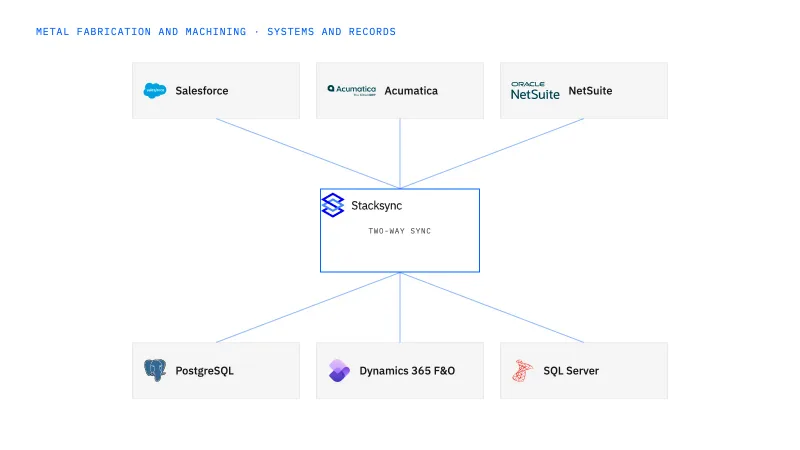
Use a Genie to turn fabrication RFQs into estimating packets with source evidence, approved part history and explicit missing questions. This fits shops where estimators spend substantial time organizing email, drawings and quantity breaks before they can evaluate the work. Pricing and engineering assumptions remain with their authorized owners.
The estimator starts each quote by hunting for attachments and clarifying which revision, material and quantity the customer actually wants.
Explore your process in a demo, or get our shared two-way sync architecture guide.
When this fits
Operations leaders, production planners and IT teams at US metal fabricators and machine shops with 100–1,000 employees.
Organize customer part, revision, material, finish and quantity requests with their source references.
Separate unreadable input from unresolved specification or commercial meaning so the right reviewer receives a focused request.
Historical quotes and candidate matches are context; the Genie does not infer tolerances, approve manufacturing scope or release a job.
The process, end to end
a sales operations leader receives repeat-part RFQs mixed with new drawings and changed finish requests. Ask the Genie to assemble the packet, show prior quote context and identify the one clarification that prevents estimating from starting. Judge the reviewed packet, not the speed of a generated answer.
Scope your implementation
Review current platform pricing alongside the records, volume, and actions in your process. Use your own operating baseline to evaluate the economics.
Explore your process in a demo, or get our shared two-way sync architecture guide.
From foundation to action
Keep shared customer, order, and operational records aligned, with clear field ownership.
Explore two-way sync 02Move approved work between systems, assign exceptions, and confirm the result.
Explore workflows 03Investigate cross-system questions, assemble the evidence, and prepare the next action.
Explore ai agents (genies) 04Connect trading-partner documents to operational records and exception handling.
Explore ediGo deeper
Estimators get one reviewable packet with the customer's drawings, quantity breaks and finish question, plus the prior quotes and unknowns that decide whether pricing can start.
Readable documents that disagree about the same part should block the quote packet until an estimator or engineer settles which source governs revision, material and quantities.
Explore all metal fabrication and machining integration and automation guides ↗
Final pricing requires the business’s approved estimating process. Start by demonstrating a complete, accurate packet and clear exceptions.
An estimator can begin review with the correct sources, relevant history and known missing questions instead of rebuilding the request.
Compare preparation and clarification effort, reviewer corrections and time to a usable packet, including the cost of reviewing Genie output.
Not by itself. Two-way sync between Salesforce and Acumatica comes first, so customer part, drawing revision and prior quote references agree in both systems before anything reads them. Workflows follow, routing a drawing change on a released job to engineering, planning and the commercial owner. Then the Genie assembles RFQ emails, drawings and quantity breaks into a packet, matches them against that approved history, marks open questions, and an estimator approves the result. EDI is last, for customer PO lines and releases after a quote has become an order.


