AI RFQ intake for metal fabricators: prepare a complete estimating packet
Estimators get one reviewable packet with the customer's drawings, quantity breaks and finish question, plus the prior quotes and unknowns that decide whether pricing can start.
- Author
- Ignacio Malpartida · GTM Engineer
- Published
- Read time
- 4 min read

The operating decision
A metal-fabrication RFQ Genie can turn customer email and drawing attachments into a structured estimating packet with traceable source references. Its job is to identify the requested part, revision, material, quantity breaks, finish and delivery expectation, then show what remains unknown. It should reuse approved customer and part references where they exist. Missing tolerances, conflicting documents and manufacturing assumptions belong with estimating or engineering, not in an agent-generated production instruction.
Explore the complete metal fabrication and machining integration and automation hub for the systems and processes around this guide.
What this looks like in metal fabrication and machining
A fabricator receives an RFQ containing two drawings, a spreadsheet of quantity breaks and an email asking for a faster finish option. An estimator spends the first part of the review locating prior quotes and discovering that one drawing supersedes a part already in the CRM. A Genie can collect those references and arrange the request into one reviewable packet. The estimator should immediately see the original request, the likely existing part, the changed finish question and any information needed before pricing can be responsibly prepared.
Records, ownership, and update rules
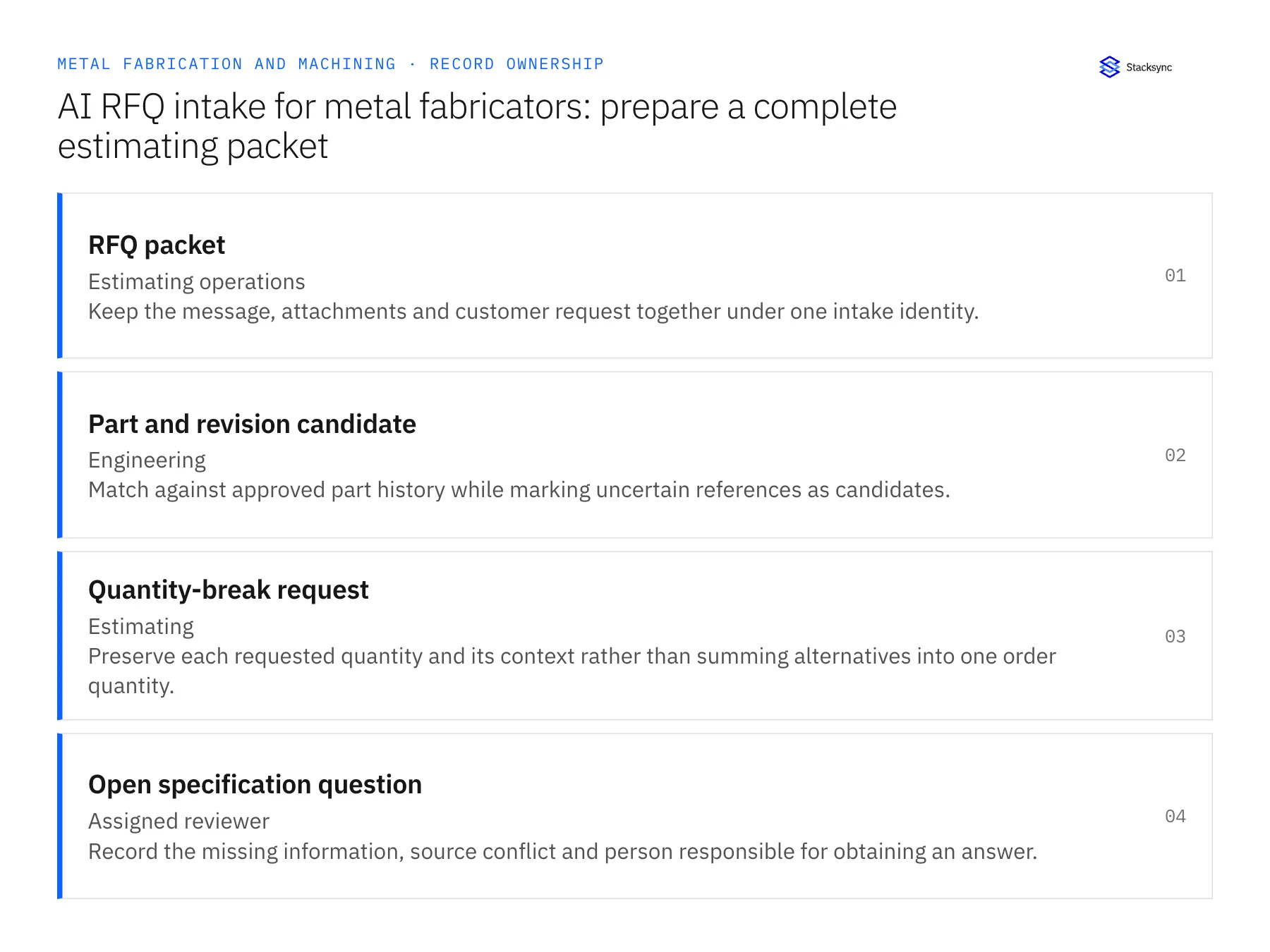
| Record | Owner | Operating rule |
|---|---|---|
| RFQ packet | Estimating operations | Keep the message, attachments and customer request together under one intake identity. |
| Part and revision candidate | Engineering | Match against approved part history while marking uncertain references as candidates. |
| Quantity-break request | Estimating | Preserve each requested quantity and its context rather than summing alternatives into one order quantity. |
| Open specification question | Assigned reviewer | Record the missing information, source conflict and person responsible for obtaining an answer. |
Work through the process
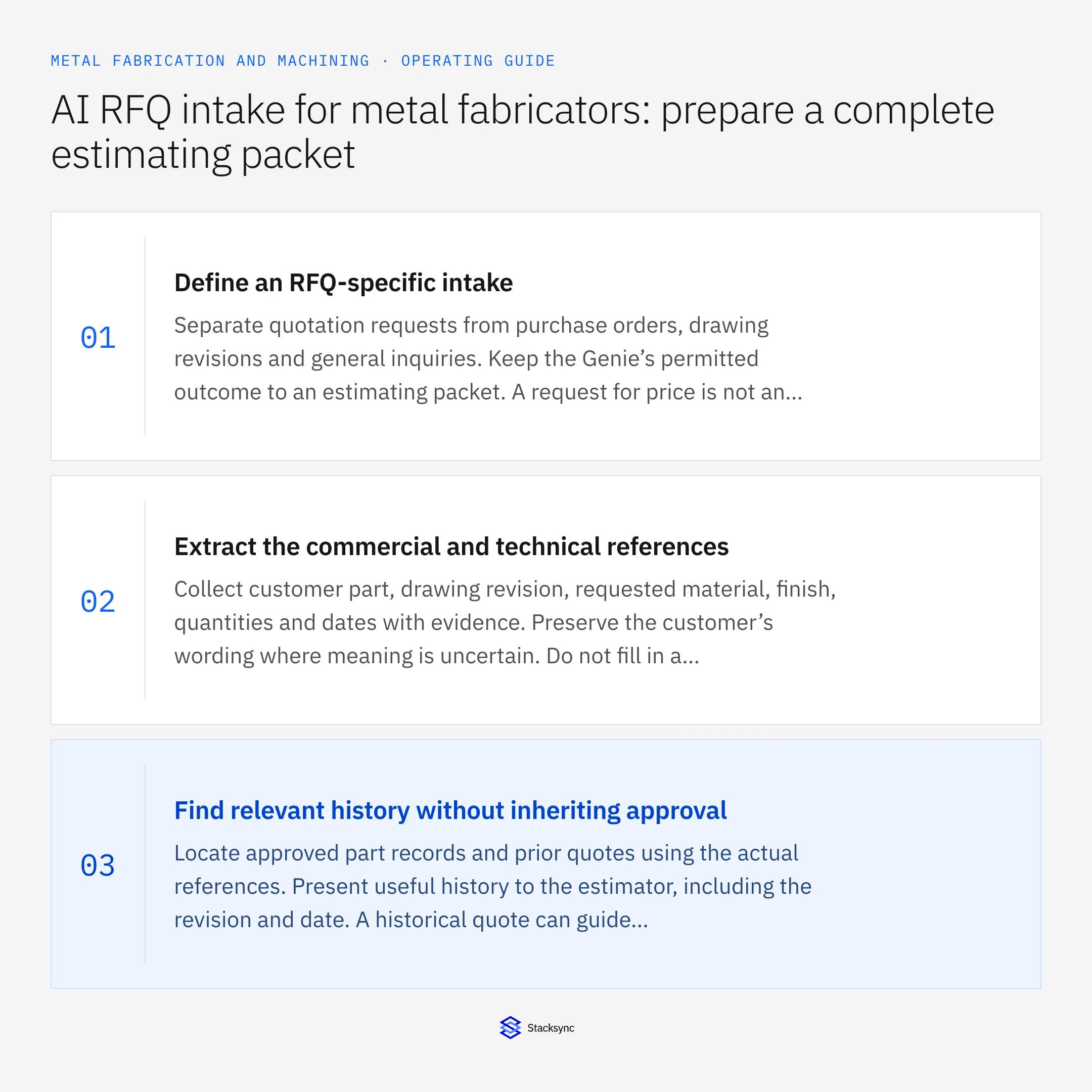
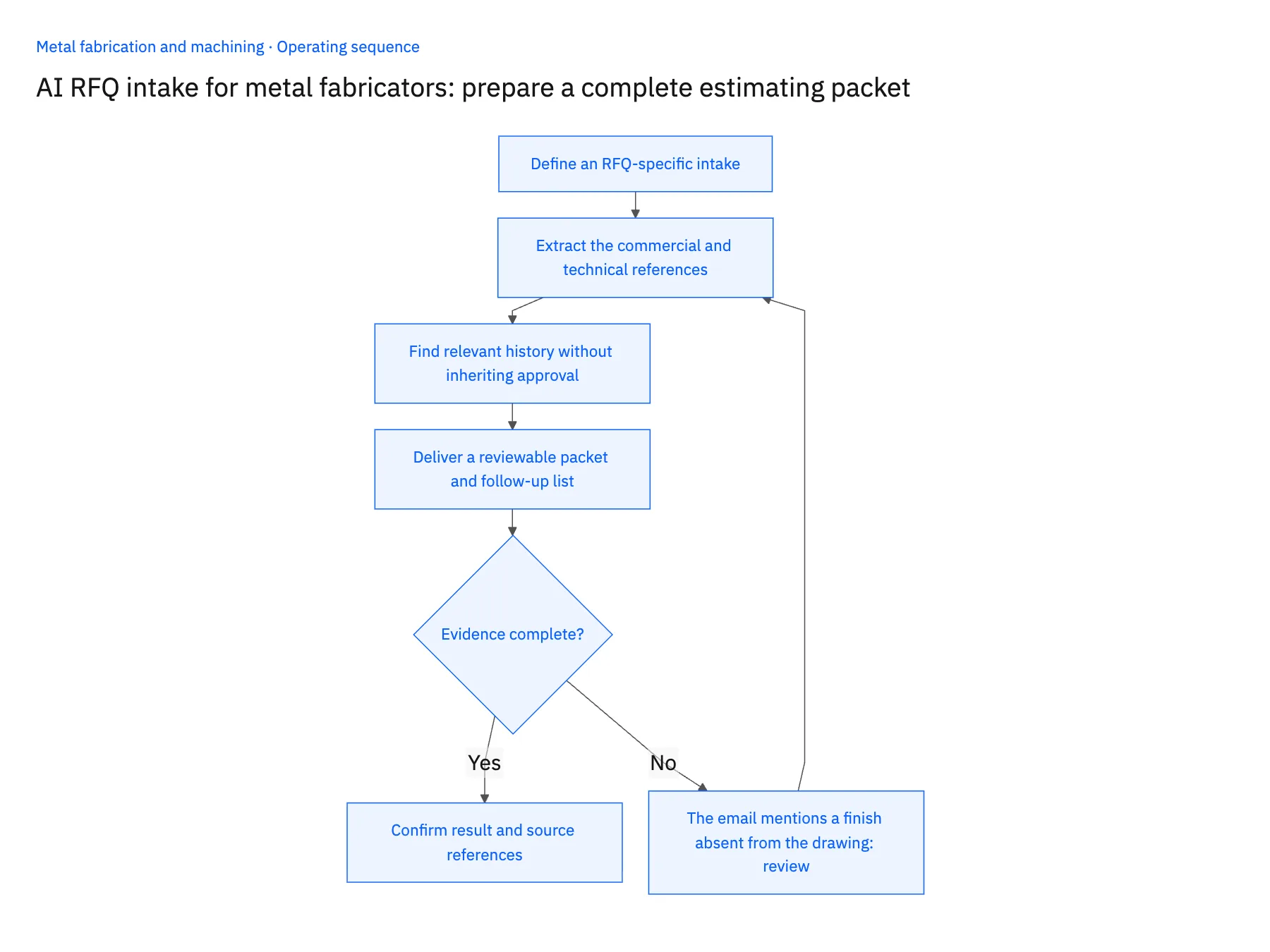
- 01Define an RFQ-specific intakeSeparate quotation requests from purchase orders, drawing revisions and general inquiries. Keep the Genie’s permitted outcome to an estimating packet. A request for price is not an accepted order and must not create production demand.
- 02Extract the commercial and technical referencesCollect customer part, drawing revision, requested material, finish, quantities and dates with evidence. Preserve the customer’s wording where meaning is uncertain. Do not fill in a tolerance, alloy condition or finish specification because a previous quote used one.
- 03Find relevant history without inheriting approvalLocate approved part records and prior quotes using the actual references. Present useful history to the estimator, including the revision and date. A historical quote can guide investigation but must not silently authorize today’s price or process assumptions.
- 04Deliver a reviewable packet and follow-up listShow the structured request, source documents, likely matches and unresolved questions together. Let the estimator approve the packet, request clarification or reject a misleading match. Record the accepted packet version before it becomes the basis of a quote.
Handle the exceptions explicitly
The email mentions a finish absent from the drawing
Show the discrepancy explicitly and request the governing instruction. Do not choose the more convenient finish automatically.
Quantity breaks appear in several documents
Preserve their source and identify inconsistent sets. Ask estimating which options should be quoted.
A familiar part has a new revision
Link the history as context while routing the new revision for review. Do not assume repeat-part economics still apply.
What to verify before expanding
- Every extracted specification has a source reference or a clearly marked missing state.
- Requested quantity alternatives remain separate from accepted demand.
- Prior quotes are labeled as historical context with their applicable revision.
- The estimator can approve a defined packet version without accepting unresolved assumptions.

Connect this process to the rest of your operation
Explore Stacksync AI agents (Genies) and scope the records and actions against your actual systems. Book a demo with a real RFQ packet example and the exception your team handles most often, for example the email mentions a finish absent from the drawing.
- AI RFQ intake for metal fabrication and machining
- AI RFQ exceptions in metal fabrication: resolve material, revision and quantity ambiguity
- Metal fabrication EDI orders: preserve drawing revision and release identity
- Metal fabrication: connect Salesforce quotes to Acumatica job-ready orders
- How to Parse EDI Files Into a SQL Database
- Acumatica API Integration: A Practical Guide
The shared architecture guide covers record matching, ownership, and recovery across systems.
Technical references
FAQ
Frequently asked questions










Related articles