AI RFQ exceptions in metal fabrication: resolve material, revision and quantity ambiguity
Readable documents that disagree about the same part should block the quote packet until an estimator or engineer settles which source governs revision, material and quantities.
- Author
- Ignacio Malpartida · GTM Engineer
- Published
- Read time
- 4 min read

The operating decision
Metal-fabrication RFQ exception handling should separate unreadable documents from unresolved engineering or commercial meaning. A Genie can compare drawing references, material descriptions and quantity requests, but it should expose conflicting evidence rather than blend it into a confident answer. Each exception needs a specific question, a responsible reviewer and a clear effect on the estimating packet. The aim is to help an estimator decide what can be quoted and what requires clarification.
Explore the complete metal fabrication and machining integration and automation hub for the systems and processes around this guide.
What this looks like in metal fabrication and machining
An RFQ includes a drawing labeled revision B, an email asking for revision C and an older spreadsheet listing a different material. A text-extraction system can read all three accurately and still produce a wrong quote packet if it selects values independently. The exception process must recognize that the documents disagree about the same part. It should present the conflict to the estimator or engineer, preserve the separate sources and keep the quote from inheriting an undocumented combination of revision, material and quantities.
Records, ownership, and update rules
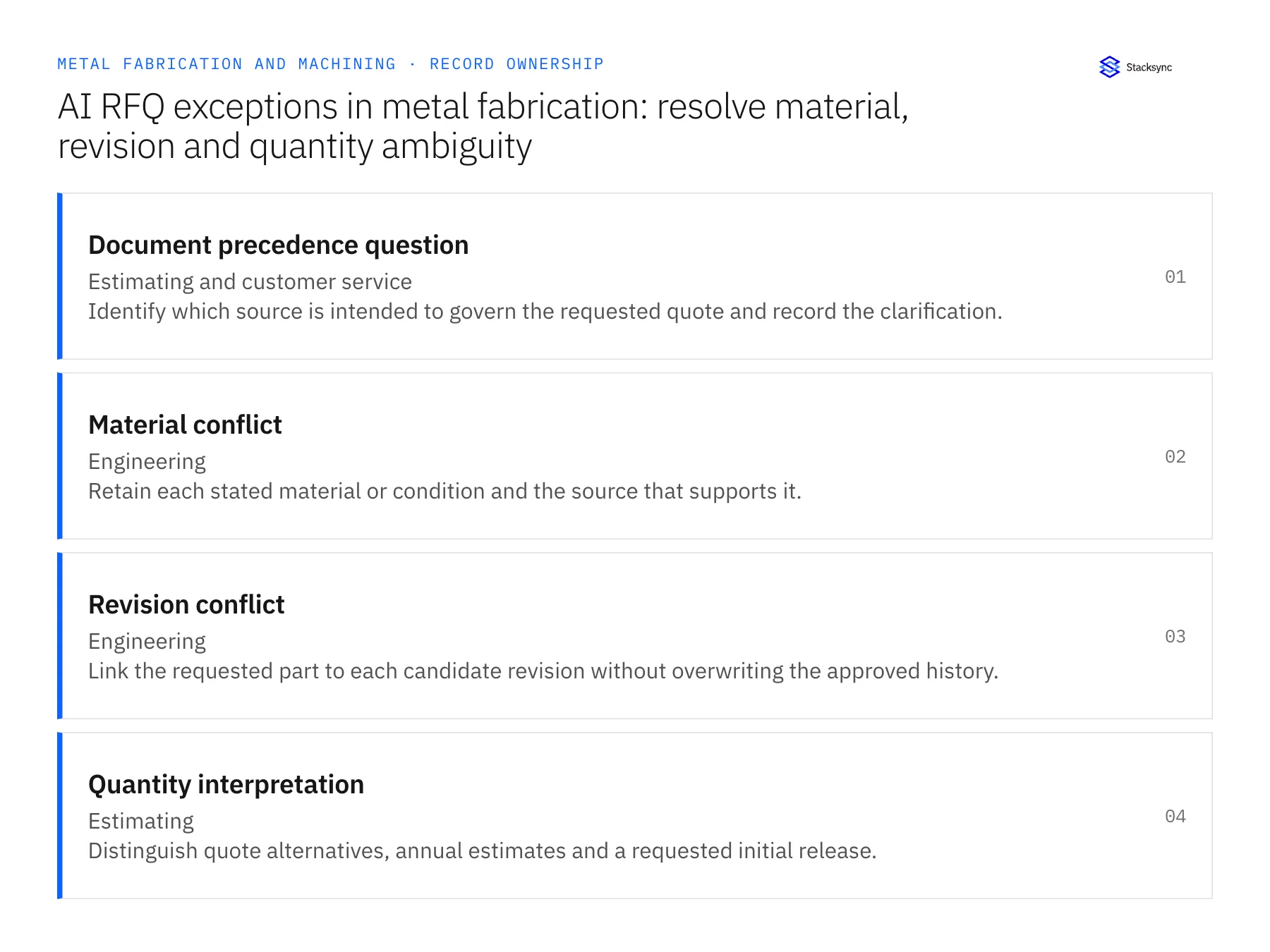
| Record | Owner | Operating rule |
|---|---|---|
| Document precedence question | Estimating and customer service | Identify which source is intended to govern the requested quote and record the clarification. |
| Material conflict | Engineering | Retain each stated material or condition and the source that supports it. |
| Revision conflict | Engineering | Link the requested part to each candidate revision without overwriting the approved history. |
| Quantity interpretation | Estimating | Distinguish quote alternatives, annual estimates and a requested initial release. |
Work through the process
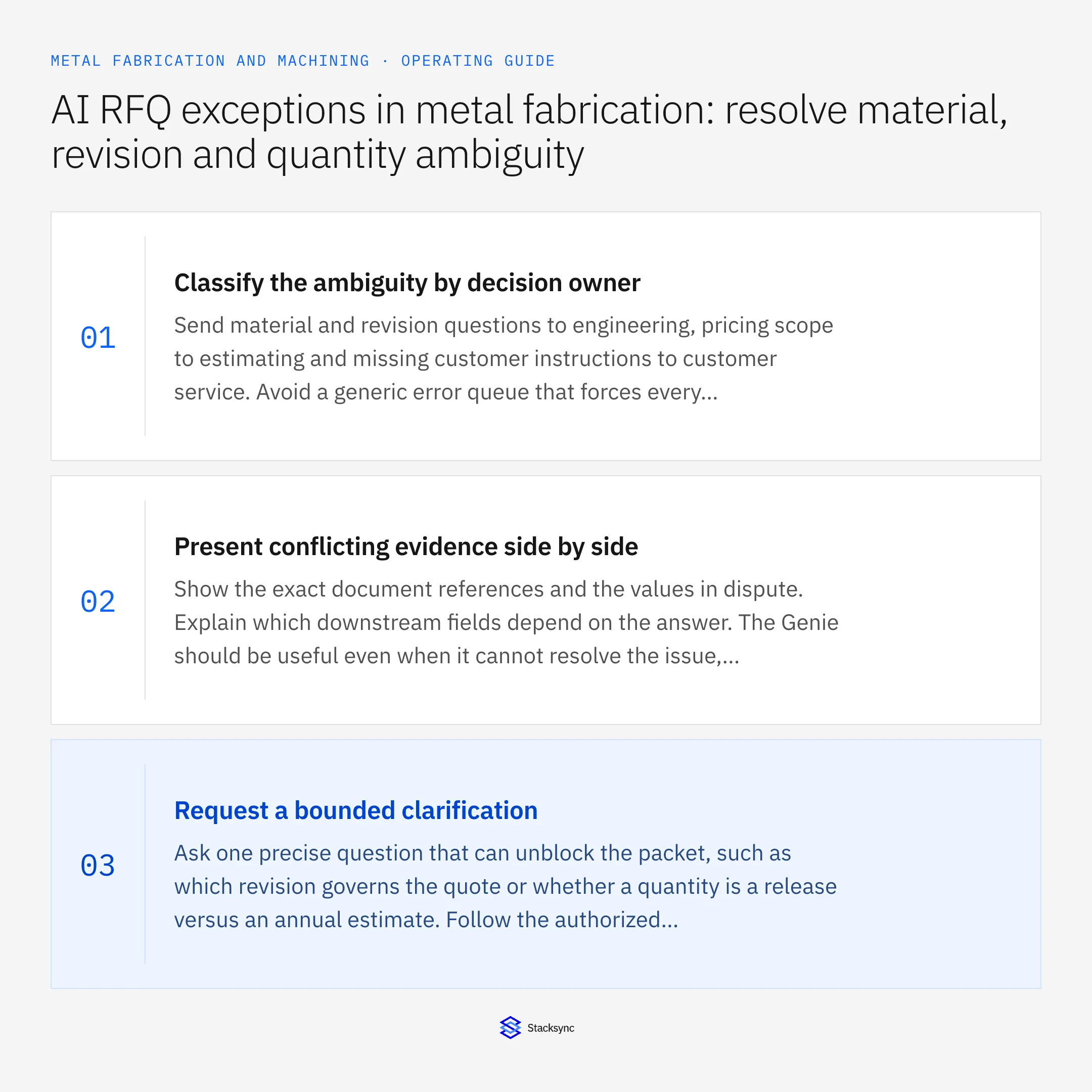
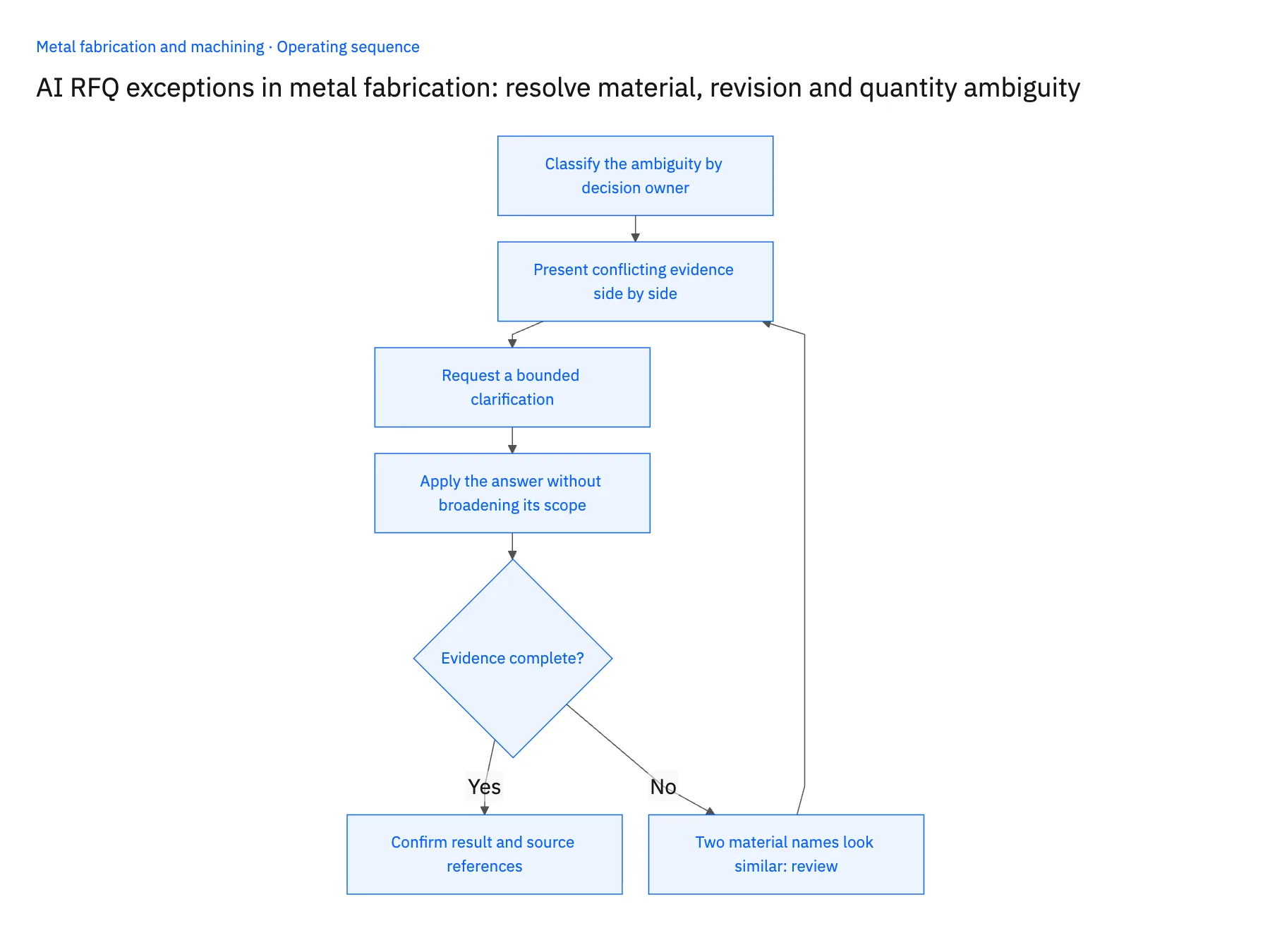
- 01Classify the ambiguity by decision ownerSend material and revision questions to engineering, pricing scope to estimating and missing customer instructions to customer service. Avoid a generic error queue that forces every reviewer to reread the entire RFQ before discovering the actual decision.
- 02Present conflicting evidence side by sideShow the exact document references and the values in dispute. Explain which downstream fields depend on the answer. The Genie should be useful even when it cannot resolve the issue, because it has reduced the reviewer’s search work.
- 03Request a bounded clarificationAsk one precise question that can unblock the packet, such as which revision governs the quote or whether a quantity is a release versus an annual estimate. Follow the authorized communication process and retain the response with the original request.
- 04Apply the answer without broadening its scopeUpdate only the RFQ or approved reference to which the clarification applies. Record who accepted the answer and whether it should change reusable master data. A customer’s one-time instruction must not rewrite unrelated part records.
Handle the exceptions explicitly
Two material names look similar
Treat similarity as a search aid, not interchangeability. Engineering decides whether the specifications are equivalent for this request.
The drawing cannot be read reliably
Ask for a usable source or manual review. Do not use a guessed value to remove the extraction error.
An annual forecast appears beside a trial quantity
Preserve both meanings and ask which quantities need price breaks. Do not convert the forecast into a committed order.
What to verify before expanding
- The exception identifies the actual conflicting sources and affected quote fields.
- A reviewer can resolve one question without losing unrelated extracted information.
- Clarification changes the current RFQ only unless a broader update is explicitly approved.
- A technically readable but contradictory document set remains blocked for the relevant decision.

Connect this process to the rest of your operation
Explore Stacksync AI agents (Genies) and scope the records and actions against your actual systems. Book a demo with a real document precedence question example and the exception your team handles most often, for example two material names look similar.
- AI RFQ intake for metal fabrication and machining
- AI RFQ intake for metal fabricators: prepare a complete estimating packet
- Metal fabrication EDI orders: preserve drawing revision and release identity
- Metal fabrication: connect Salesforce quotes to Acumatica job-ready orders
- Acumatica API Integration: A Practical Guide
- Real-Time NetSuite to Database Sync: Implementation Guide and Best Practices
The shared architecture guide covers record matching, ownership, and recovery across systems.
Technical references
FAQ
Frequently asked questions










Related articles