







Connect commercial and shop context
Link the customer order to jobs and outside operations without forcing every batch into a single header status.
 Salesforce
  HubSpot
  NetSuite
  Zendesk
  Microsoft Dynamics 365 Sales
  Dynamics 365 F&O
  Attio
Attio  Pipedrive
  Zoho CRM
  Campfire
  Rillet
  Front
Front  Shopify
  Amazon Seller Central
  SendGrid
 Metal fabrication and machining
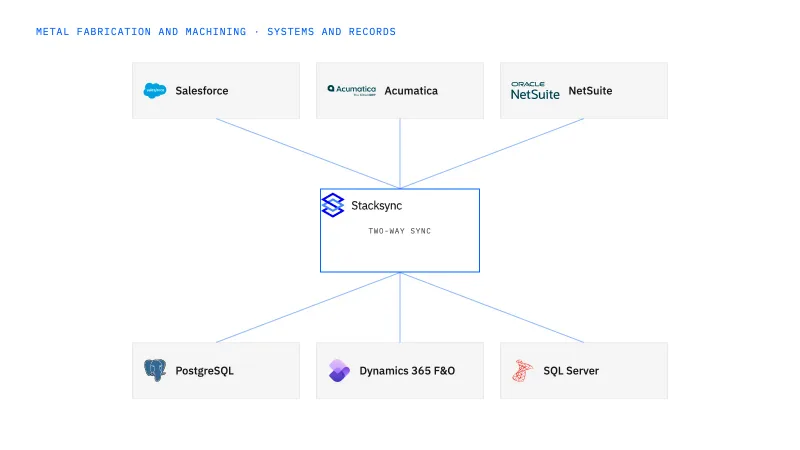
Connect NetSuite order context with the Postgres records your shop uses for jobs and outside processing. Stacksync fits manufacturers that need customer service and purchasing to see current batch progress without reconstructing it from spreadsheets. The first scope should preserve sent, received and accepted quantities while keeping ERP transaction authority explicit.
The tracker says a batch returned, but nobody can tell whether the full quantity passed inspection or which customer order it now supports.
Explore your process in a demo, or get our shared two-way sync architecture guide.
When this fits
Operations leaders, production planners and IT teams at US metal fabricators and machine shops with 100–1,000 employees.
Link the customer order to jobs and outside operations without forcing every batch into a single header status.
Keep returned and quality-accepted quantities distinguishable so planners do not schedule work against unusable parts.
Operational evidence can be synchronized while receipts or financial adjustments remain subject to verified ERP operations and approval.
The process, end to end
a machine shop tracks coating and heat-treatment milestones in an internal application while finance and orders stay in NetSuite. A useful evaluation follows a split return and a rejection through both views, showing the actual outstanding quantity and the owner of the next action.
Scope your implementation
Review current platform pricing alongside the records, volume, and actions in your process. Use your own operating baseline to evaluate the economics.
Explore your process in a demo, or get our shared two-way sync architecture guide.
From foundation to action
Keep shared customer, order, and operational records aligned, with clear field ownership.
Explore two-way sync 02Move approved work between systems, assign exceptions, and confirm the result.
Explore workflows 03Investigate cross-system questions, assemble the evidence, and prepare the next action.
Explore ai agents (genies) 04Connect trading-partner documents to operational records and exception handling.
Explore ediGo deeper
A fabricator's Salesforce win should reach Acumatica as one order line carrying the chosen quantity break and drawing revision, with job readiness reported back separately.
Machine shops that track coating and plating batches in Postgres can keep NetSuite order context attached to each sent, returned and inspected quantity.
A material-evidence view tells planners which received heat each certificate covers and which order demand uses it, so a file on record never stands in for a quality decision.
Explore all metal fabrication and machining integration and automation guides ↗
No. The initial use case connects the records and ownership already used by the shop, with explicit relationships and tested update behavior.
An operational tracker with no stable job or batch identity needs data-model work before dependable synchronization can be demonstrated.
Measure time spent finding batch status, unexplained quantity balances and readiness corrections caused by confusing receipt with quality acceptance.
Yes. Two-way sync between NetSuite and Postgres comes first, so the customer order, job, subcontract operation and sent batch share stable references and customer service reads returned, accepted and outstanding quantities against the right order. Workflows follow once purchasing wants a late batch tied to the next operation with one buyer owning the supplier conversation. Genies are next, when estimating wants RFQ drawings and quantity breaks assembled into a reviewable packet. EDI is last, for customer PO lines and releases that need their identity kept before they become demand.


