







Component substitution review
Gather specification and stock evidence for an engineering-approved alternative.
Explore workflows ↗ Salesforce
  HubSpot
  NetSuite
  Zendesk
  Microsoft Dynamics 365 Sales
  Dynamics 365 F&O
  Attio
Attio  Pipedrive
  Zoho CRM
  Campfire
  Rillet
  Front
Front  Shopify
  Amazon Seller Central
  SendGrid
 Electrical and electronic components
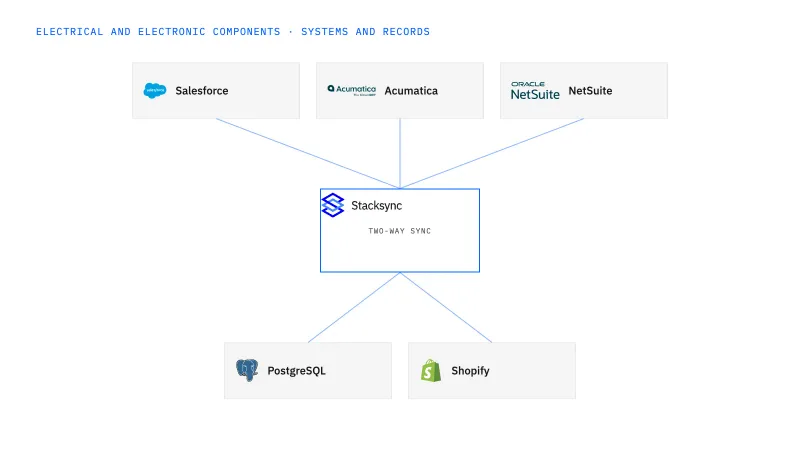
Connect configured assemblies, revision-sensitive component stock, distributor orders and substitution decisions across operational systems.
A component is available by part number but unsuitable for the required revision, approved manufacturer or customer configuration.
Explore your process in a demo, or get our shared two-way sync architecture guide.
The platform, in operating order
Keep shared customer, order, and operational records aligned, with clear field ownership.
Explore two-way sync 02Move approved work between systems, assign exceptions, and confirm the result.
Explore workflows 03Investigate cross-system questions, assemble the evidence, and prepare the next action.
Explore ai agents (genies) 04Connect trading-partner documents to operational records and exception handling.
Explore ediBuilt around your operations
Operations, supply-chain and IT leaders at US electrical and electronic component manufacturers with 100–1,000 employees.
Gather specification and stock evidence for an engineering-approved alternative.
Explore workflows ↗Match returned quantities, serials or lots and disposition evidence before finance approves a credit.
Explore workflows ↗Identify missing cross-references and candidate matches while keeping component approval with engineering.
Explore Genies ↗Your systems and records
| Record | Owner | Operating rule |
|---|---|---|
| Configured assembly | Application engineering | Keep approved options and customer requirements attached to the commercial order. |
| Component revision | Product engineering | Preserve the approved manufacturer part and permitted alternatives separately. |
| Allocation record | Supply-chain planning | Link committed stock to the demand line rather than relying on a pooled available quantity. |
| Distributor PO line | Customer service | Retain partner line identifiers, packaging units and requested dates across revisions. |
Validate distributor 850 orders and 860 changes against part cross-references, reel or tray units and revision-specific demand.
Evaluate your next process
Connect accepted assembly quotes and customer requirements to Acumatica orders while preserving engineering-approved configuration.
Connect component identity, approved applicability and demand allocation across NetSuite and your Postgres operational application.
Bring shortages, candidate components and affected assemblies into a controlled engineering-review handoff.
Connect distributor EDI orders and revisions to the approved product, packaging and ERP model.
Implementation and operating guides
Keep the accepted configuration version on the Acumatica order and treat an option changed after approval as a separate decision that sales can see.
Pooled item-family stock hides which orders are covered; link eligible supply to each demand line so planning sees the shortage on the restricted order.
Similar connector descriptions and a new pack size are where storefront orders go wrong; hold variant identity, item reference and conversion version per accepted order.
Purchasing finds an alternative and an old engineering note; the workflow shows which assembly revision that approval covers and asks engineering about the rest.
Customer service, receiving and finance each hold a different return quantity; reconcile packs, pieces and lot evidence before anyone prepares a credit.
Order lines with unknown customer part numbers get candidate matches, packaging notes and one precise open question instead of a guessed item.
A shortened manufacturer number and five reels look easy to a generic matcher; the exception packet names the suffix, unit and approval gap the reviewer must settle.
A revised part suffix and a reel unit with no conversion should stop a line for review, not become the closest item multiplied by a default count.
Supply-chain planning should own it, with product engineering as the approving partner. Planning holds the Allocation record and can show which stock is committed to which demand line; product engineering holds the Component revision and decides which manufacturer parts and alternatives are approved. Customer service joins for the Distributor PO line side. Two-way sync between NetSuite and Postgres can make the allocation and revision visible together, but approval of an alternative part stays with engineering.
Put substitution first when shortages are forcing planners to use an available part number without an engineering decision on the Component revision. The workflow gathers the specification and stock evidence and routes it to product engineering, which approves or rejects the alternative. Put returns first when credits are being approved before returned quantities, serials or lots have been matched to the original Distributor PO line. The workflow assembles that match and disposition evidence; finance keeps the credit decision.
Send a distributor 850 with a customer reference that has no cross-reference, a line ordered in reels, and an 860 that changes quantity on a revision-specific line. The part-reference Genie should show candidate matches with their source evidence and ask product operations to approve the cross-reference; a similar description is not treated as a match. The accepted line keeps its Distributor PO line identifiers and packaging unit, and the change touches only its target line. Treat two-way sync and EDI transport as separate scopes with separate checks.
Bring one real process
Bring the systems, record types, and exceptions your team handles today. We’ll scope the connections and actions, then walk through the path to a confirmed result.
Explore your process in a demo, or get our shared two-way sync architecture guide.


