AI agents for electronics order intake: resolve customer part references for review
Order lines with unknown customer part numbers get candidate matches, packaging notes and one precise open question instead of a guessed item.
- Author
- Ignacio Malpartida · GTM Engineer
- Published
- Read time
- 4 min read

The operating decision
An electronics part-reference Genie should compare incoming customer identifiers with approved internal and manufacturer references, then prepare a reviewable mapping proposal. It can collect product context, packaging units and applicable revision evidence, but must preserve uncertainty. A similar description or nearly matching manufacturer number is a search lead, not proof of interchangeability. Product operations and engineering approve the relationship before it affects an accepted order or reusable master-data rule.
Explore the complete electrical and electronic components integration and automation hub for the systems and processes around this guide.
What this looks like in electrical and electronic components
A manufacturer receives a distributor order using customer part numbers that are absent from the ERP cross-reference table. The descriptions resemble existing components, but some identifiers include packaging suffixes and one line refers to an older approved revision. An employee currently searches several sources and asks engineering about ambiguous matches. A Genie can assemble the candidate references and explain what distinguishes them. The reviewer should see the original line, likely approved mappings, packaging interpretation and the precise question preventing order acceptance.
Records, ownership, and update rules
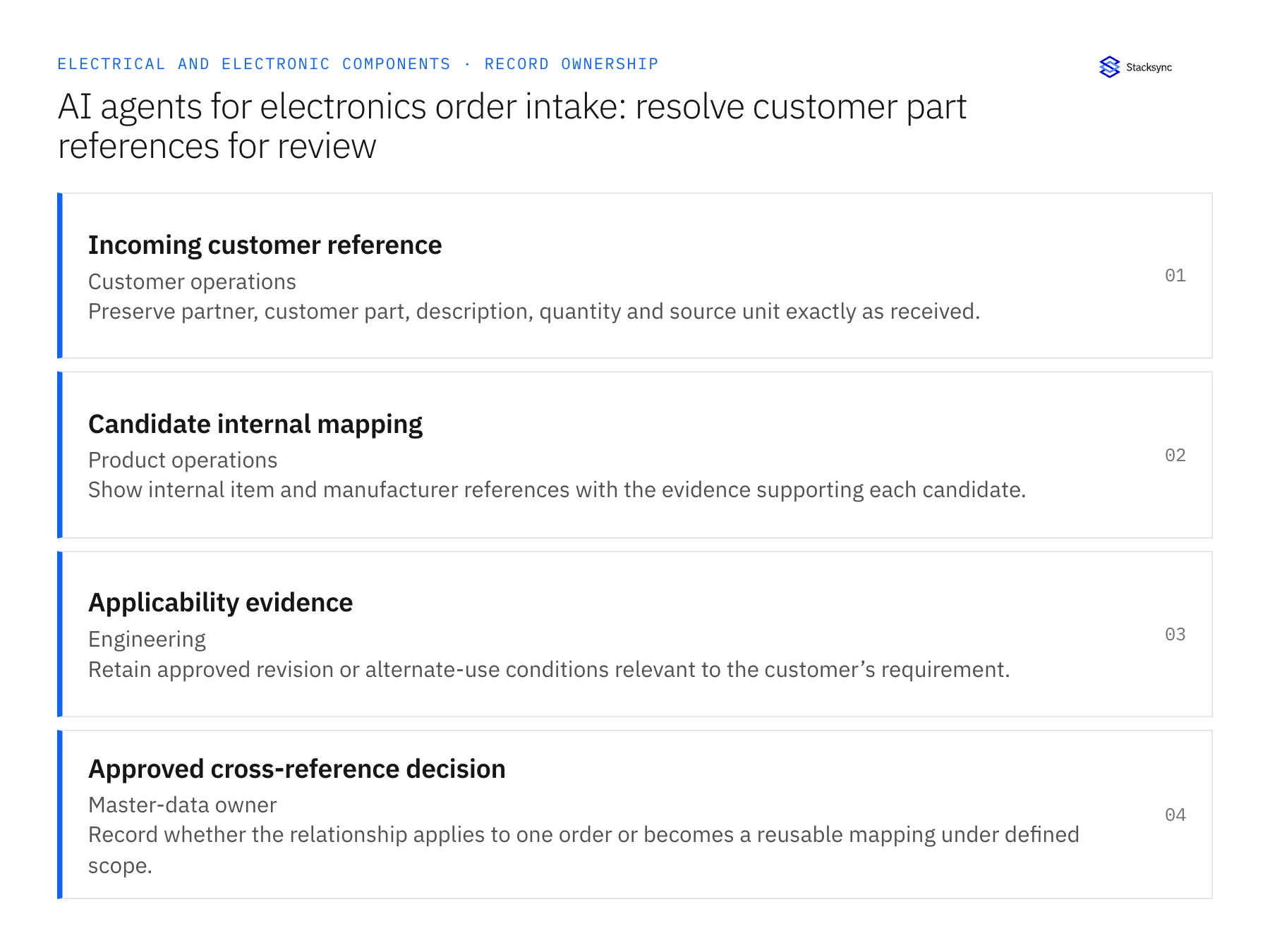
| Record | Owner | Operating rule |
|---|---|---|
| Incoming customer reference | Customer operations | Preserve partner, customer part, description, quantity and source unit exactly as received. |
| Candidate internal mapping | Product operations | Show internal item and manufacturer references with the evidence supporting each candidate. |
| Applicability evidence | Engineering | Retain approved revision or alternate-use conditions relevant to the customer’s requirement. |
| Approved cross-reference decision | Master-data owner | Record whether the relationship applies to one order or becomes a reusable mapping under defined scope. |
Work through the process
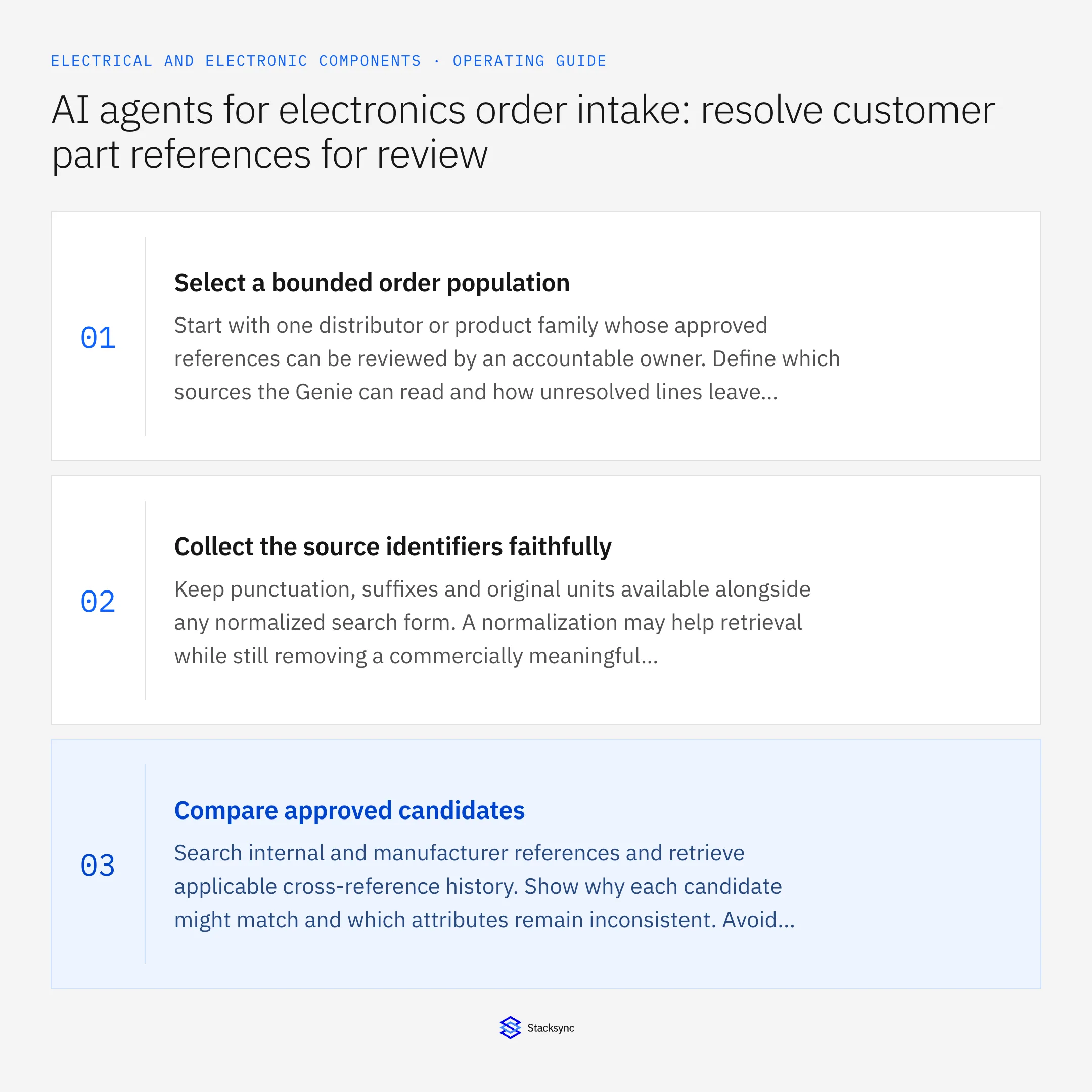
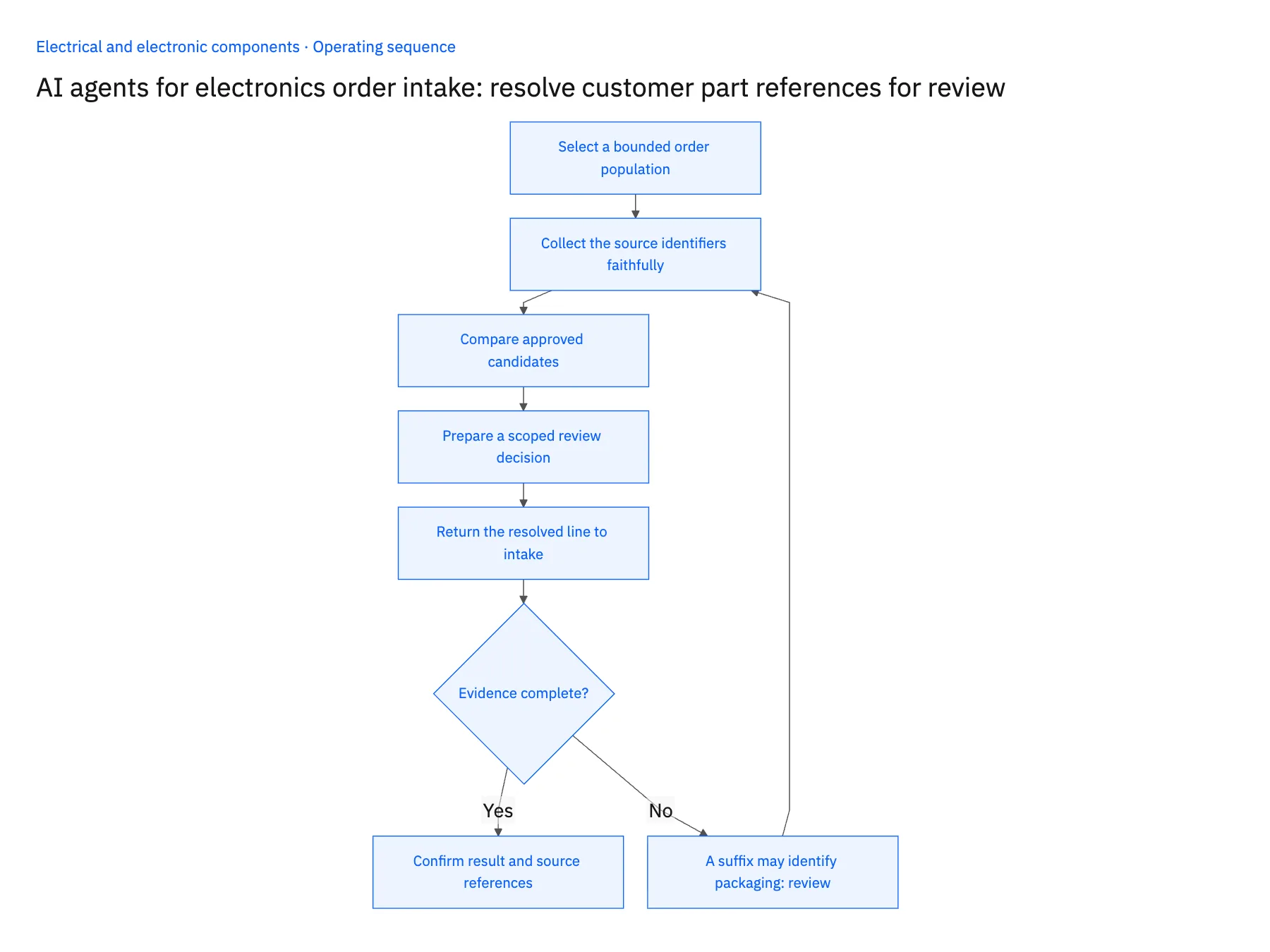
- 01Select a bounded order populationStart with one distributor or product family whose approved references can be reviewed by an accountable owner. Define which sources the Genie can read and how unresolved lines leave the automated path. Do not require the model to invent a mapping to complete a batch.
- 02Collect the source identifiers faithfullyKeep punctuation, suffixes and original units available alongside any normalized search form. A normalization may help retrieval while still removing a commercially meaningful distinction. Preserve the raw value so the reviewer can inspect the difference.
- 03Compare approved candidatesSearch internal and manufacturer references and retrieve applicable cross-reference history. Show why each candidate might match and which attributes remain inconsistent. Avoid describing a candidate as compatible unless the approved evidence establishes that relationship for this use.
- 04Prepare a scoped review decisionAsk product operations to confirm identity and engineering to resolve applicability where required. Separate an order-specific correction from a reusable master-data change. Retain the reviewer, evidence and effective conditions for the accepted decision.
- 05Return the resolved line to intakeRevalidate quantity, packaging and order context after the mapping is approved. A new item match can change the applicable unit conversion or commercial comparison. Apply only the reviewed outcome through the verified intake process and keep unresolved lines visible.
Handle the exceptions explicitly
A suffix may identify packaging
Show the alternate interpretations and request product-owner confirmation rather than stripping it automatically.
A candidate is an approved alternate only for one customer
Preserve that restriction and prevent the mapping from becoming a universal substitute.
The same customer reference maps to two historical items
Present the effective dates or scope evidence and route unresolved ambiguity to the master-data owner.
What to verify before expanding
- The proposal retains the exact original customer reference.
- Candidate matches show supporting evidence and unresolved differences.
- Order-specific corrections remain distinct from reusable master-data approvals.
- The resolved line is rechecked for units and commercial scope before acceptance.

Connect this process to the rest of your operation
Explore Stacksync AI agents (Genies) and scope the records and actions against your actual systems. Book a demo with a real incoming customer reference example and the exception your team handles most often, for example A suffix may identify packaging.
- Electronics AI mapping exceptions: part suffixes, packaging units and revision restrictions
- Electronic-component EDI 850 and 860: validate part references, reels and revisions
- Electrical manufacturers: connect Salesforce assembly quotes to Acumatica orders
- Acumatica Integrations: The Complete Guide
- Field-Level Change Detection: The Key to Efficient Real-Time Bidirectional CRM Sync
The shared architecture guide covers record matching, ownership, and recovery across systems.
Technical references
FAQ
Frequently asked questions










Related articles