







Keep configuration traceable
Retain the governing engineering reference and selected commercial lines on the accepted handoff.
 Salesforce
  HubSpot
  NetSuite
  Zendesk
  Microsoft Dynamics 365 Sales
  Dynamics 365 F&O
  Attio
Attio  Pipedrive
  Zoho CRM
  Campfire
  Rillet
  Front
Front  Shopify
  Amazon Seller Central
  SendGrid
 Electrical and electronic components
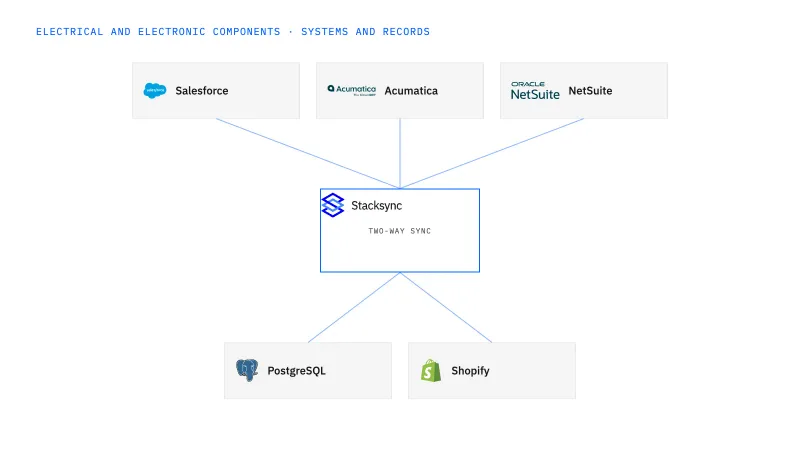
Connect accepted assembly quotes and customer requirements to Acumatica orders while preserving engineering-approved configuration. Stacksync fits electrical manufacturers whose sales and operations teams repeatedly compare changing quote descriptions with the build they accepted. Keep later option changes reviewable and return meaningful readiness to the commercial team.
The quote, customer email and engineering configuration can describe different versions of the assembly by the time order entry begins.
Explore your process in a demo, or get our shared two-way sync architecture guide.
When this fits
Operations, supply-chain and IT leaders at US electrical and electronic component manufacturers with 100–1,000 employees.
Retain the governing engineering reference and selected commercial lines on the accepted handoff.
Return the actual accepted or pending conditions without treating a won opportunity as a build instruction.
Route new technical requirements and validate the exact destination operations before execution.
The process, end to end
a manufacturer sells configured assemblies with optional enclosures or connection requirements. Evaluate an accepted quote followed by an option change, then inspect the approved configuration on the order and the unresolved decision visible to sales.
Scope your implementation
Review current platform pricing alongside the records, volume, and actions in your process. Use your own operating baseline to evaluate the economics.
Explore your process in a demo, or get our shared two-way sync architecture guide.
From foundation to action
Keep shared customer, order, and operational records aligned, with clear field ownership.
Explore two-way sync 02Move approved work between systems, assign exceptions, and confirm the result.
Explore workflows 03Investigate cross-system questions, assemble the evidence, and prepare the next action.
Explore ai agents (genies) 04Connect trading-partner documents to operational records and exception handling.
Explore ediGo deeper
Keep the accepted configuration version on the Acumatica order and treat an option changed after approval as a separate decision that sales can see.
Pooled item-family stock hides which orders are covered; link eligible supply to each demand line so planning sees the shortage on the restricted order.
Similar connector descriptions and a new pack size are where storefront orders go wrong; hold variant identity, item reference and conversion version per accepted order.
Explore all electrical and electronic components integration and automation guides ↗
No. It carries the result and pending questions of the process the manufacturer defines.
The Acumatica order keeps its reference to the approved assembly configuration and the accepted commercial quote lines. The later option arrives as a configuration change request tied to that order, not as an edit to its scope. Application engineering reviews the technical effect and the commercial owner confirms quantities and terms. Sales sees the order as pending engineering rather than released. Once both decisions are recorded, the order is updated through the Acumatica operations your team has verified.
Measure handoff preparation and configuration corrections after acceptance, separating administrative work from engineering design time.
Start with two-way sync between Salesforce and Acumatica. It links accepted quote lines to their Acumatica order reference, carries the approved assembly configuration as a reference rather than free text, and returns readiness state to the account manager. Add workflows when a configuration change request needs application engineering and the commercial owner to decide before the order moves. Genies come next, assembling the accepted configuration, the customer’s message and the open decision for the reviewer. EDI belongs last, where distributors send purchase orders as documents instead of through sales.


