Electronics AI mapping exceptions: part suffixes, packaging units and revision restrictions
A shortened manufacturer number and five reels look easy to a generic matcher; the exception packet names the suffix, unit and approval gap the reviewer must settle.
- Author
- Ignacio Malpartida · GTM Engineer
- Published
- Read time
- 4 min read

The operating decision
Electronics mapping exceptions should make meaningful differences in part references visible rather than normalizing them away. A Genie can compare customer aliases, manufacturer numbers, packaging descriptions and approved revision conditions. It should ask the owner to resolve the specific mismatch before the line affects demand. Keep candidate identity, technical applicability and quantity conversion as separate decisions; resolving one does not automatically resolve the others.
Explore the complete electrical and electronic components integration and automation hub for the systems and processes around this guide.
What this looks like in electrical and electronic components
A distributor order contains a shortened manufacturer number and asks for five reels. The approved product table contains two related references with different packaging and a revision restriction on one customer program. The text looks close enough for a generic matcher, but the base-unit quantity and permitted application remain uncertain. The exception packet should show which suffix or approval condition distinguishes the candidates and ask the reviewer for that fact, instead of returning a confident item and an invented reel count.
Records, ownership, and update rules
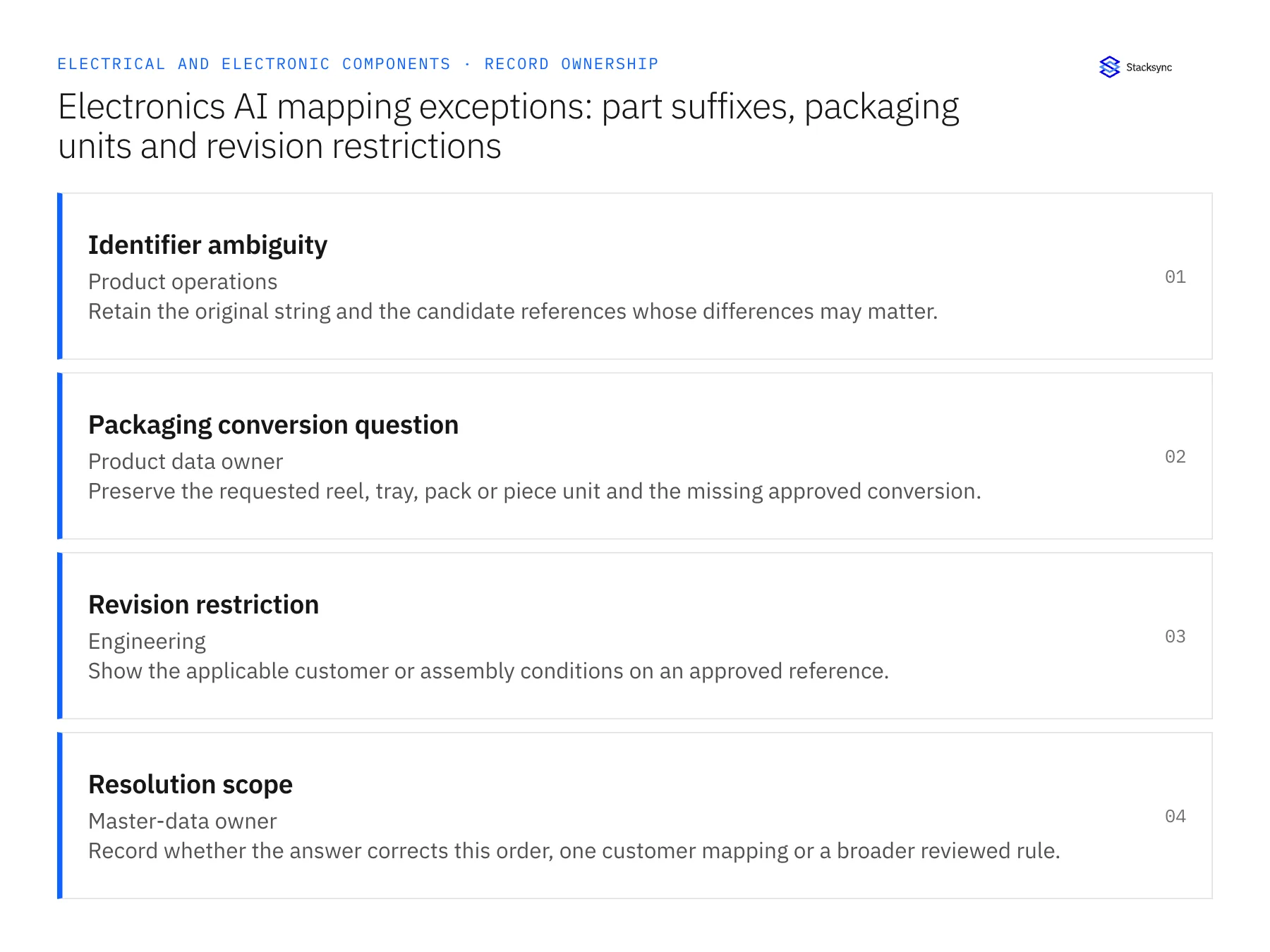
| Record | Owner | Operating rule |
|---|---|---|
| Identifier ambiguity | Product operations | Retain the original string and the candidate references whose differences may matter. |
| Packaging conversion question | Product data owner | Preserve the requested reel, tray, pack or piece unit and the missing approved conversion. |
| Revision restriction | Engineering | Show the applicable customer or assembly conditions on an approved reference. |
| Resolution scope | Master-data owner | Record whether the answer corrects this order, one customer mapping or a broader reviewed rule. |
Work through the process
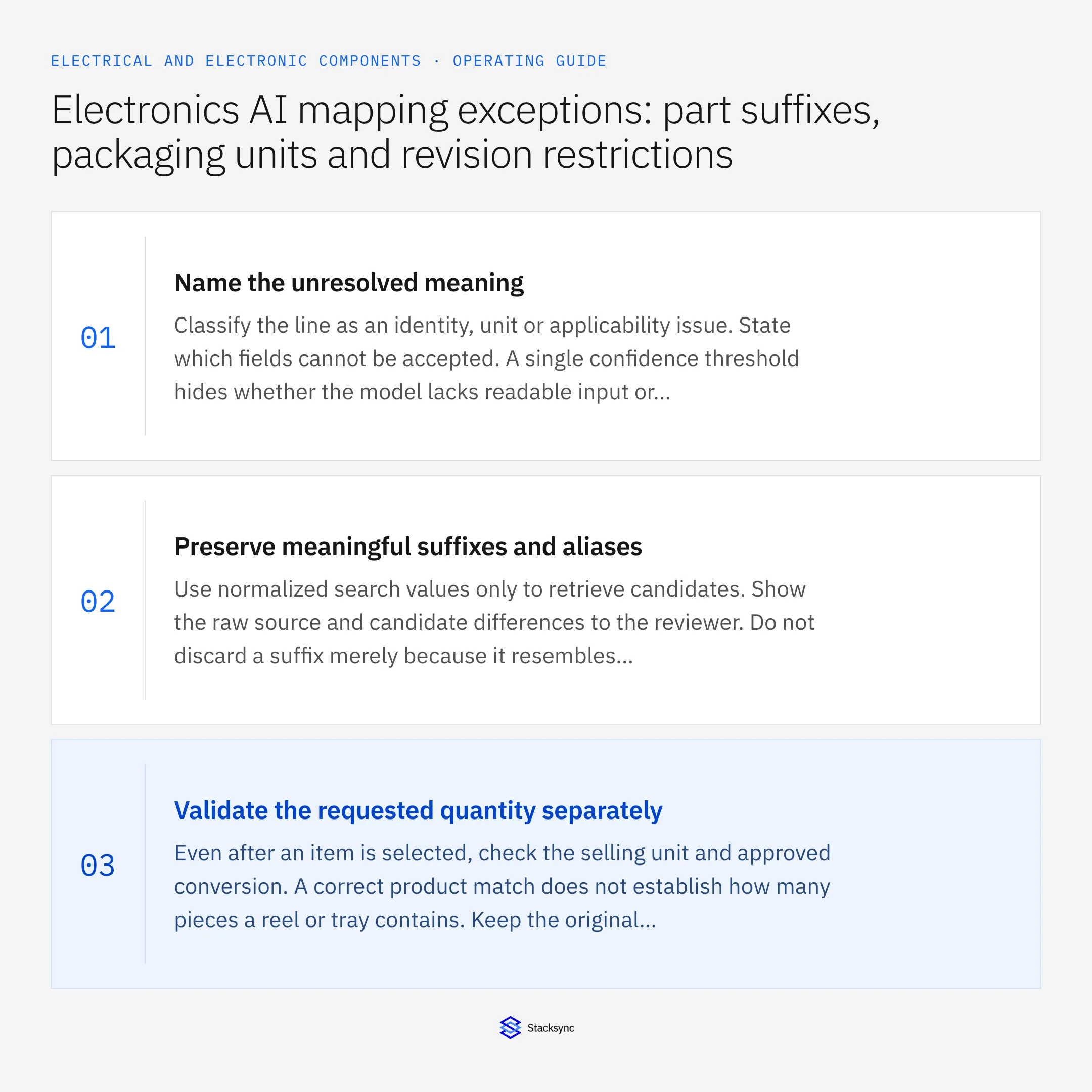
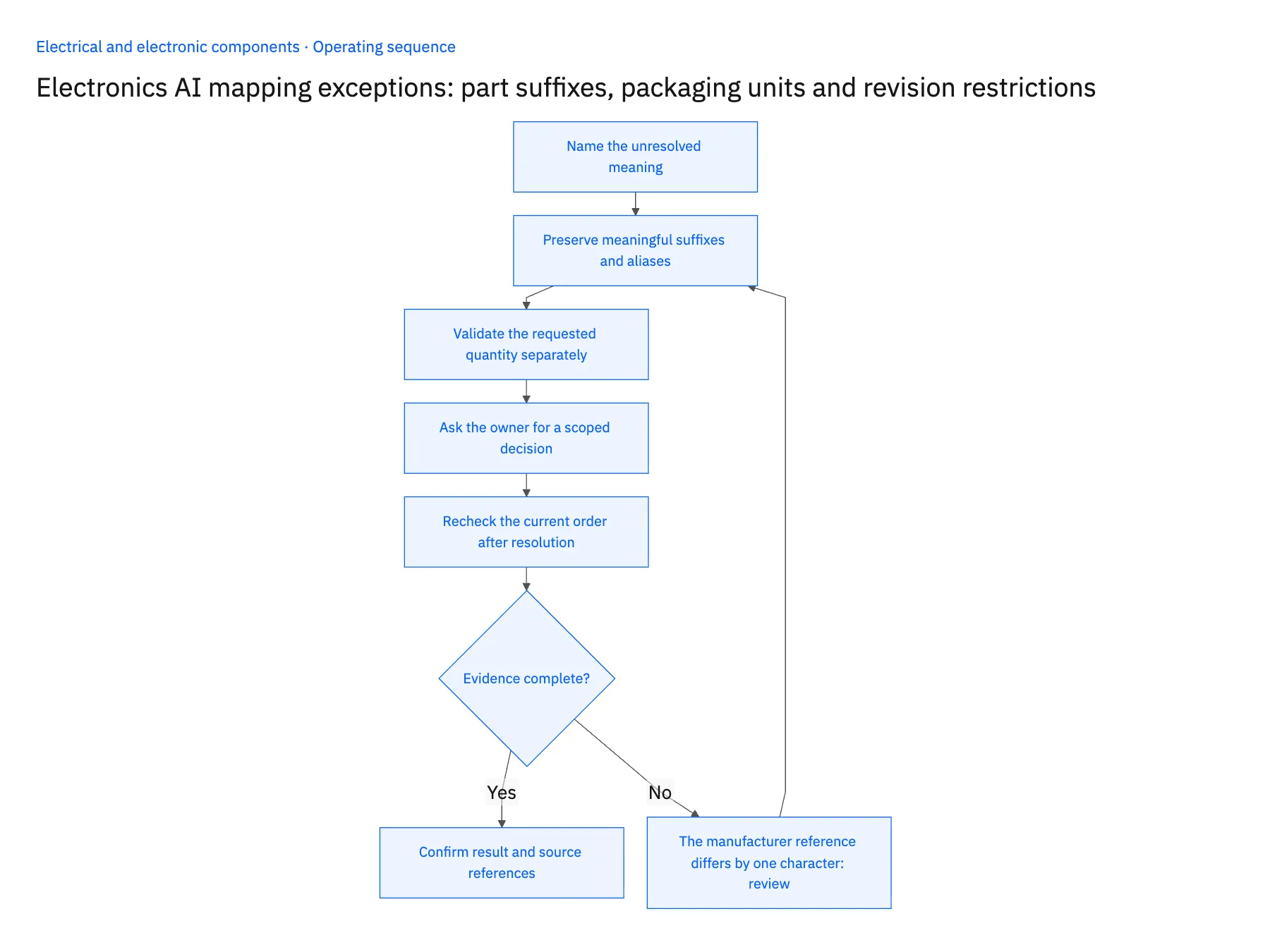
- 01Name the unresolved meaningClassify the line as an identity, unit or applicability issue. State which fields cannot be accepted. A single confidence threshold hides whether the model lacks readable input or whether the business has not defined the required relationship.
- 02Preserve meaningful suffixes and aliasesUse normalized search values only to retrieve candidates. Show the raw source and candidate differences to the reviewer. Do not discard a suffix merely because it resembles punctuation, packaging shorthand or a revision label.
- 03Validate the requested quantity separatelyEven after an item is selected, check the selling unit and approved conversion. A correct product match does not establish how many pieces a reel or tray contains. Keep the original request alongside the proposed base quantity.
- 04Ask the owner for a scoped decisionRoute identity to product operations and restricted applicability to engineering. Prepare a focused customer clarification when the source lacks the decisive fact. Record whether the answer may be reused and under what customer or effective conditions.
- 05Recheck the current order after resolutionCompare the corrected line with existing accepted orders and open drafts. A forwarded request may already have been resolved elsewhere. Apply the reviewed mapping to the intended line only, preserving the previous proposal and decision evidence.
Handle the exceptions explicitly
The manufacturer reference differs by one character
Treat the difference as potentially meaningful and obtain approved identity evidence rather than assuming a typographical error.
The packaging quantity is not recorded
Keep base quantity unresolved and request the reviewed pack definition.
The selected reference is approved only for a different revision
Route the applicability question and prevent the existing approval from being broadened automatically.
What to verify before expanding
- Raw part references remain available after search normalization.
- Identity, unit conversion and applicability have separate review outcomes.
- An unknown reel or tray count cannot become an accepted piece quantity.
- The accepted mapping retains its customer, revision and effective scope.

Connect this process to the rest of your operation
Explore Stacksync AI agents (Genies) and scope the records and actions against your actual systems. Book a demo with a real identifier ambiguity example and the exception your team handles most often, for example the manufacturer reference differs by one character.
- AI agents for electronics order intake: resolve customer part references for review
- Electronic-component EDI 850 and 860: validate part references, reels and revisions
- Electrical manufacturers: connect Salesforce assembly quotes to Acumatica orders
- Field-Level Change Detection: The Key to Efficient Real-Time Bidirectional CRM Sync
- Source of Truth: Should Your Warehouse or Your CRM Own Customer Data?
The shared architecture guide covers record matching, ownership, and recovery across systems.
Technical references
FAQ
Frequently asked questions










Explore these integrations and topics
- connectorNetSuite integrations
- connectorPostgreSQL integrations
- platformDatabase synchronization
- platformIntegration architecture
- platformAI agent operations
- Database synchronization guidesWork through database change capture, application writes, and reliable record reconciliation.
- Integration architecture guidesEvaluate integration methods and design for conflicts, retries, failures, and changing schemas.
- AI agent operations guidesExplore practical Genies workflows across industries, with source evidence, human approvals, and confirmed outcomes.
Related articles