







Keep component identity precise
Preserve internal, manufacturer and relevant revision references instead of matching by description.
 Salesforce
  HubSpot
  NetSuite
  Zendesk
  Microsoft Dynamics 365 Sales
  Dynamics 365 F&O
  Attio
Attio  Pipedrive
  Zoho CRM
  Campfire
  Rillet
  Front
Front  Shopify
  Amazon Seller Central
  SendGrid
 Electrical and electronic components
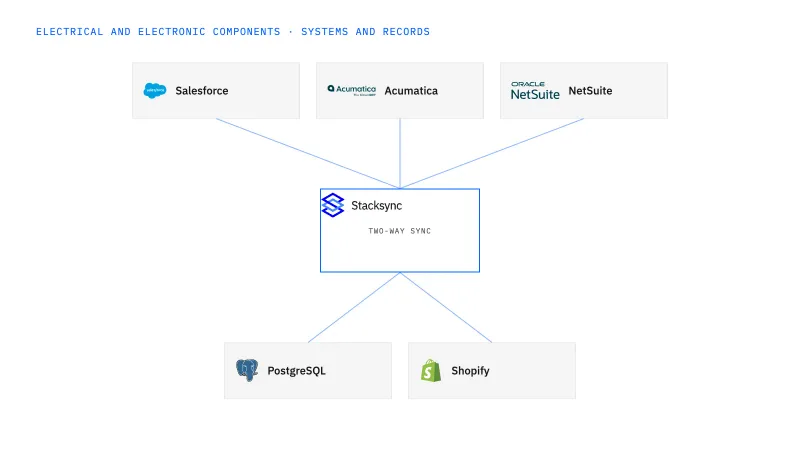
Connect component identity, approved applicability and demand allocation across NetSuite and your Postgres operational application. Stacksync fits electronics manufacturers whose planning views hide revision restrictions or double-count shared stock. Preserve the difference between an available component and supply approved for a particular assembly or customer requirement.
A positive stock total makes an order look covered even when the available revision is not approved for that application.
Explore your process in a demo, or get our shared two-way sync architecture guide.
When this fits
Operations, supply-chain and IT leaders at US electrical and electronic component manufacturers with 100–1,000 employees.
Preserve internal, manufacturer and relevant revision references instead of matching by description.
Connect approved applicability to the actual allocation and quantity for each demand line.
A planning proposal does not change accepted ERP allocation without the required owner and verified operation.
The process, end to end
a planning leader manages two assemblies with different revision restrictions against shared supply. Evaluate the allocation view and a proposed reallocation, showing which demand remains short and which owner must approve the change.
Scope your implementation
Review current platform pricing alongside the records, volume, and actions in your process. Use your own operating baseline to evaluate the economics.
Explore your process in a demo, or get our shared two-way sync architecture guide.
From foundation to action
Keep shared customer, order, and operational records aligned, with clear field ownership.
Explore two-way sync 02Move approved work between systems, assign exceptions, and confirm the result.
Explore workflows 03Investigate cross-system questions, assemble the evidence, and prepare the next action.
Explore ai agents (genies) 04Connect trading-partner documents to operational records and exception handling.
Explore ediGo deeper
Keep the accepted configuration version on the Acumatica order and treat an option changed after approval as a separate decision that sales can see.
Pooled item-family stock hides which orders are covered; link eligible supply to each demand line so planning sees the shortage on the restricted order.
Similar connector descriptions and a new pack size are where storefront orders go wrong; hold variant identity, item reference and conversion version per accepted order.
Explore all electrical and electronic components integration and automation guides ↗
It can assemble approved evidence and candidates. Engineering determines suitability for the actual application.
Shared stock cannot satisfy both orders independently, and restricted demand remains visibly constrained.
Track manual allocation reconciliation, false-ready cases and corrections caused by missing revision or applicability context.
Two-way sync between NetSuite and Postgres, first. It carries component identity, approved applicability and demand allocation into the Postgres planning application with internal item, manufacturer part and revision kept as separate fields, and it returns an accepted allocation change to NetSuite through writes scoped to the objects you approve. Workflows follow when a proposed reallocation needs planning’s sign-off before the commitment moves. Genies come after that, gathering the applicability evidence behind a constrained demand line for engineering. EDI enters last, where the demand originates as distributor 850 orders.


