Electronic component substitutions: route evidence to engineering before changing supply
Purchasing finds an alternative and an old engineering note; the workflow shows which assembly revision that approval covers and asks engineering about the rest.
- Author
- Ignacio Malpartida · GTM Engineer
- Published
- Read time
- 4 min read

The operating decision
A component-substitution workflow should connect the shortage, candidate replacement, affected assembly and customer requirements before any purchasing or production change. Automation can collect approved references, stock and supplier information, then route a complete decision packet. Engineering determines technical applicability; purchasing and planning decide the accepted supply action. A similar manufacturer part number, matching description or available quantity does not establish that a substitute is acceptable for the specific application.
Explore the complete electrical and electronic components integration and automation hub for the systems and processes around this guide.
What this looks like in electrical and electronic components
A manufacturer cannot obtain a component needed for several assemblies. A distributor offers an alternative, and purchasing finds a prior engineering note mentioning it. That note applies to one product revision, while another customer order has different requirements. The workflow should show the affected demand and the exact scope of the available approval. It can then ask engineering whether the candidate is permitted, keep unsupported applications blocked and prevent a broad item-master change from applying the substitute everywhere.
Records, ownership, and update rules
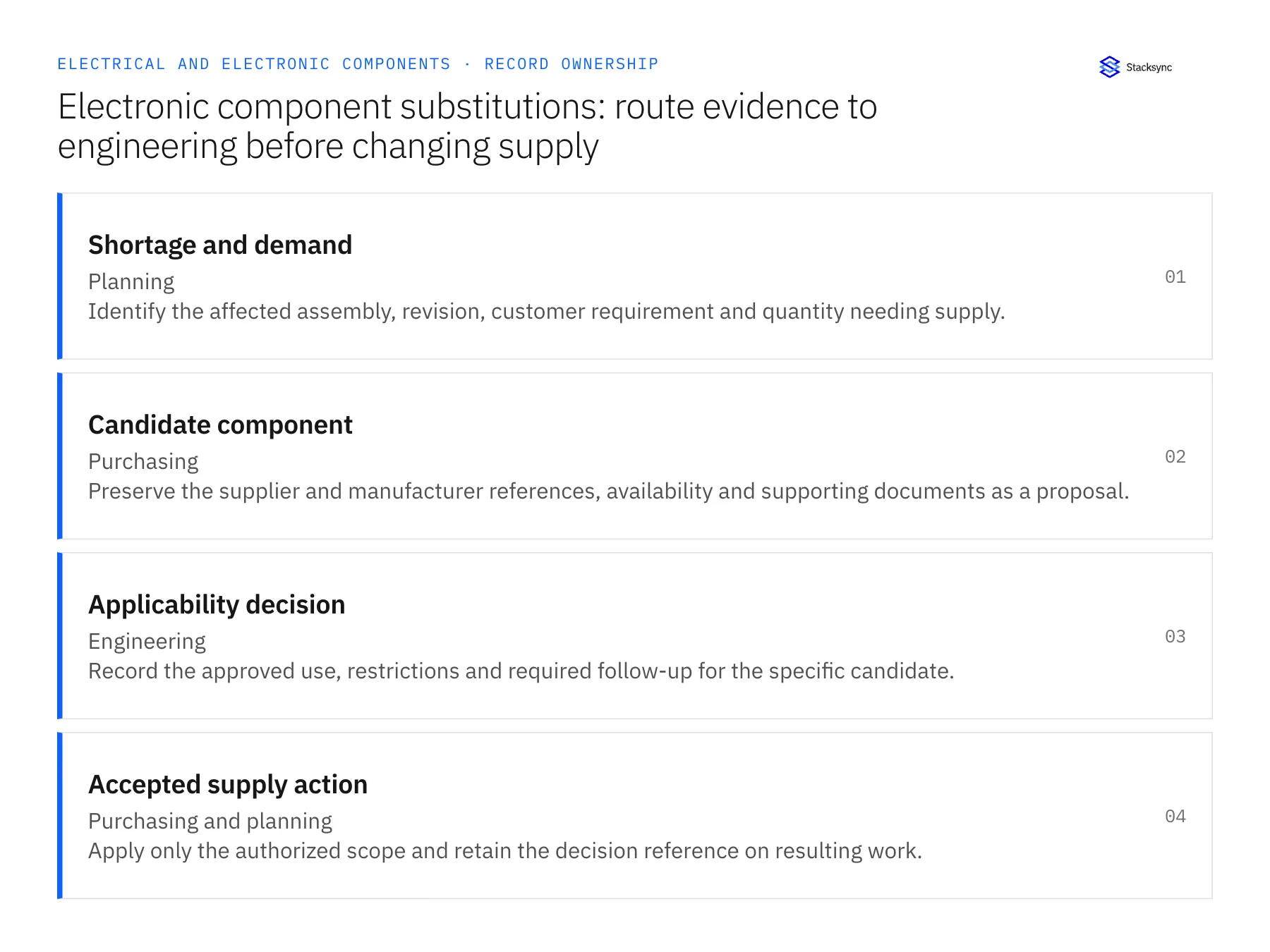
| Record | Owner | Operating rule |
|---|---|---|
| Shortage and demand | Planning | Identify the affected assembly, revision, customer requirement and quantity needing supply. |
| Candidate component | Purchasing | Preserve the supplier and manufacturer references, availability and supporting documents as a proposal. |
| Applicability decision | Engineering | Record the approved use, restrictions and required follow-up for the specific candidate. |
| Accepted supply action | Purchasing and planning | Apply only the authorized scope and retain the decision reference on resulting work. |
Work through the process
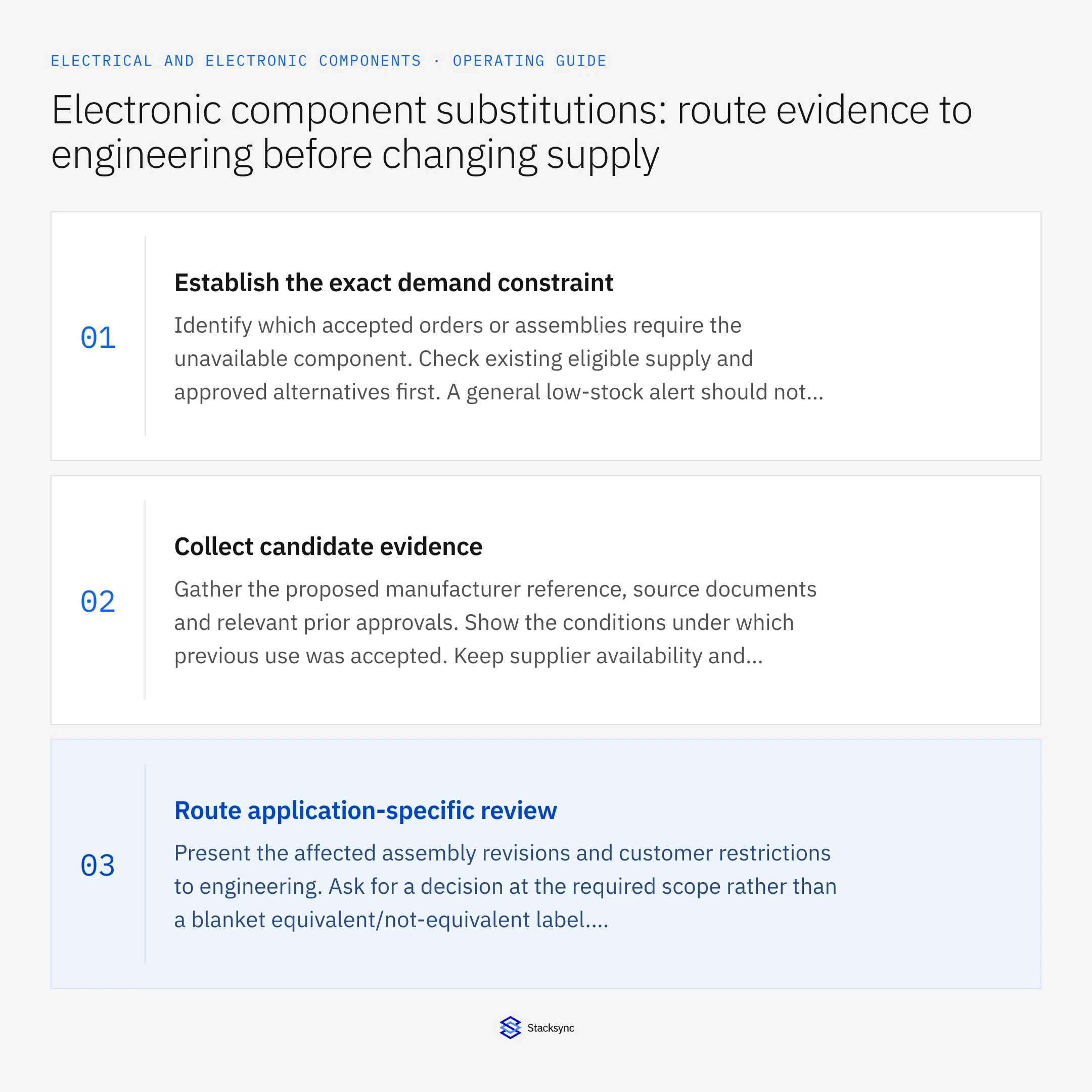
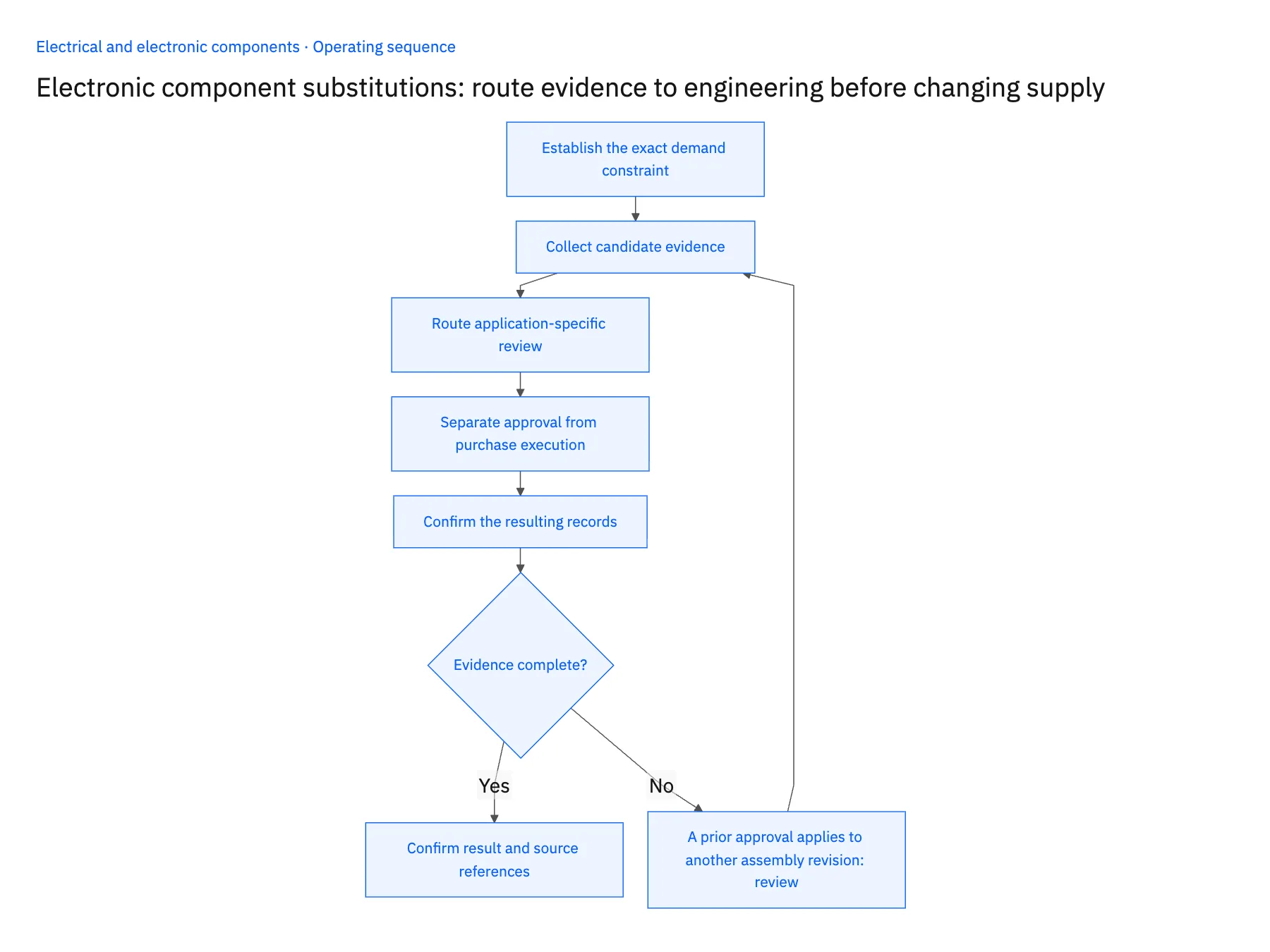
- 01Establish the exact demand constraintIdentify which accepted orders or assemblies require the unavailable component. Check existing eligible supply and approved alternatives first. A general low-stock alert should not cause a substitution review for demand already covered by the correct inventory.
- 02Collect candidate evidenceGather the proposed manufacturer reference, source documents and relevant prior approvals. Show the conditions under which previous use was accepted. Keep supplier availability and technical equivalence as separate facts requiring different owners.
- 03Route application-specific reviewPresent the affected assembly revisions and customer restrictions to engineering. Ask for a decision at the required scope rather than a blanket equivalent/not-equivalent label. Include any customer-consent or additional review step specified by the manufacturer’s process.
- 04Separate approval from purchase executionAfter technical approval, purchasing confirms terms and planning decides allocation. A suitable candidate may still be unavailable or commercially unacceptable. Keep the approved proposal distinct from an actual accepted purchase or production update.
- 05Confirm the resulting recordsApply the agreed action through the verified process and retain its identifiers. Check that only the approved demand uses the substitute. Follow any remaining validation or documentation obligations to their owner before closing the case.
Handle the exceptions explicitly
A prior approval applies to another assembly revision
Present it as context and require confirmation for the current scope.
Only a partial substitute quantity is available
Ask planning to allocate it to explicit approved demand and leave the remaining shortage visible.
The supplier changes the offered manufacturer
Reopen the candidate review; a similar commercial description does not preserve the original technical decision.
What to verify before expanding
- Every substitute proposal names the affected application and original component.
- Technical approval includes its scope and restrictions.
- A purchase or allocation cannot expand that approval silently.
- Completed action is linked to accepted records and outstanding review obligations remain visible.

Connect this process to the rest of your operation
Explore Stacksync workflows and scope the records and actions against your actual systems. Book a demo with a real shortage and demand example and the exception your team handles most often, for example A prior approval applies to another assembly revision.
- Component-substitution workflows for electronics manufacturers
- Electronic-component returns: reconcile distributor quantities, lots and credit decisions
- AI agents for electronics order intake: resolve customer part references for review
- Electronics AI mapping exceptions: part suffixes, packaging units and revision restrictions
- Source of Truth: Should Your Warehouse or Your CRM Own Customer Data?
- EDI vs API Integration for Supply Chain Data (2026 Guide)
The shared architecture guide covers record matching, ownership, and recovery across systems.
Technical references
FAQ
Frequently asked questions










Related articles