







Keep partner identity intact
Retain the exact customer part and line references through the internal item mapping.
 Salesforce
  HubSpot
  NetSuite
  Zendesk
  Microsoft Dynamics 365 Sales
  Dynamics 365 F&O
  Attio
Attio  Pipedrive
  Zoho CRM
  Campfire
  Rillet
  Front
Front  Shopify
  Amazon Seller Central
  SendGrid
 Electrical and electronic components
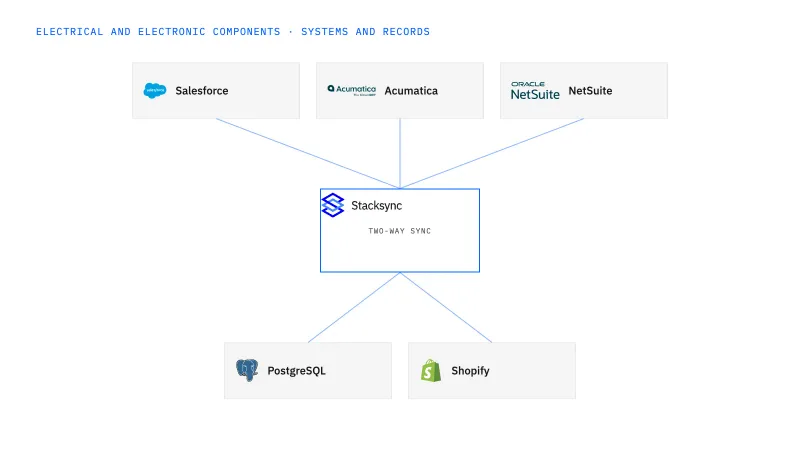
Connect distributor EDI orders and revisions to the approved product, packaging and ERP model. Stacksync fits component manufacturers that spend time resolving customer part references, reel or tray quantities and repeated documents. Preserve source meaning and route ambiguity before it becomes accepted demand.
An EDI line can pass format checks while a part suffix or unknown reel count still makes its product and quantity unsafe to accept.
Explore your process in a demo, or get our shared two-way sync architecture guide.
When this fits
Operations, supply-chain and IT leaders at US electrical and electronic component manufacturers with 100–1,000 employees.
Retain the exact customer part and line references through the internal item mapping.
Use approved scoped conversions and keep the original selling unit visible.
Separate review, ERP application and response delivery so retries do not duplicate or roll back demand.
The process, end to end
a distributor-order team wants to automate a defined 850/860 process while retaining review for uncertain packaging and revision restrictions. Evaluate an original order, a suffix change and a replay, then inspect the accepted quantities and response state.
Scope your implementation
Review current platform pricing alongside the records, volume, and actions in your process. Use your own operating baseline to evaluate the economics.
Explore your process in a demo, or get our shared two-way sync architecture guide.
From foundation to action
Keep shared customer, order, and operational records aligned, with clear field ownership.
Explore two-way sync 02Move approved work between systems, assign exceptions, and confirm the result.
Explore workflows 03Investigate cross-system questions, assemble the evidence, and prepare the next action.
Explore ai agents (genies) 04Connect trading-partner documents to operational records and exception handling.
Explore ediGo deeper
A revised part suffix and a reel unit with no conversion should stop a line for review, not become the closest item multiplied by a default count.
Explore all electrical and electronic components integration and automation guides ↗
No. It can apply approved mappings and flag exceptions; engineering owns technical applicability.
Include an unknown reel quantity, a meaningful part suffix, a partially committed line and a repeated original after an accepted change.
Measure correct accepted orders, exception resolution and response timeliness, rather than counting every received file as completed business.
Yes, when the demand arrives as distributor documents. EDI receives the 850 and 860, validates each line against the part cross-reference, packaging definition and order state, and applies the accepted line to NetSuite once, after review. Two-way sync is a different layer, keeping NetSuite and Postgres on the same cross-references, packaging definitions and partner order lines that validation reads. Workflows route a changed suffix to product operations and a reel with no conversion to the product data owner. Genies come afterward, proposing candidate matches for lines that fail item matching; product operations approves every cross-reference.


