







Prepare an application-specific packet
Connect the shortage and candidate to the demand that actually needs a decision.
 Salesforce
  HubSpot
  NetSuite
  Zendesk
  Microsoft Dynamics 365 Sales
  Dynamics 365 F&O
  Attio
Attio  Pipedrive
  Zoho CRM
  Campfire
  Rillet
  Front
Front  Shopify
  Amazon Seller Central
  SendGrid
 Electrical and electronic components
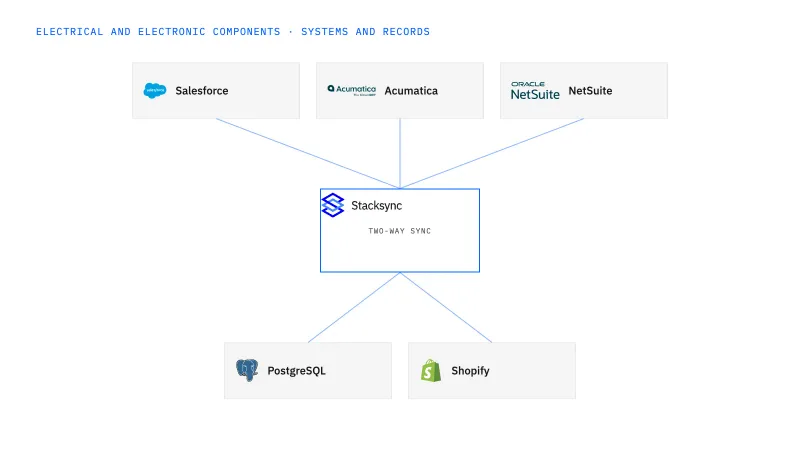
Bring shortages, candidate components and affected assemblies into a controlled engineering-review handoff. Stacksync fits electronics manufacturers where purchasing and planning repeatedly collect documents and clarify the scope of prior approvals. Keep technical applicability, supply terms and accepted allocation as separate decisions.
A supplier can offer an alternative quickly, but the team needs to establish whether its approval applies to this assembly revision and customer.
Explore your process in a demo, or get our shared two-way sync architecture guide.
When this fits
Operations, supply-chain and IT leaders at US electrical and electronic component manufacturers with 100–1,000 employees.
Connect the shortage and candidate to the demand that actually needs a decision.
Engineering decides applicability while purchasing and planning own the resulting supply action.
One-time or customer-specific approval does not silently become a universal alternate-part rule.
The process, end to end
a supply-chain director faces a shortage with an alternative previously used on another product. Evaluate the candidate evidence, application-specific review and restricted approved scope before any purchase or production record changes.
Scope your implementation
Review current platform pricing alongside the records, volume, and actions in your process. Use your own operating baseline to evaluate the economics.
Explore your process in a demo, or get our shared two-way sync architecture guide.
From foundation to action
Keep shared customer, order, and operational records aligned, with clear field ownership.
Explore two-way sync 02Move approved work between systems, assign exceptions, and confirm the result.
Explore workflows 03Investigate cross-system questions, assemble the evidence, and prepare the next action.
Explore ai agents (genies) 04Connect trading-partner documents to operational records and exception handling.
Explore ediGo deeper
Purchasing finds an alternative and an old engineering note; the workflow shows which assembly revision that approval covers and asks engineering about the rest.
Customer service, receiving and finance each hold a different return quantity; reconcile packs, pieces and lot evidence before anyone prepares a credit.
Explore all electrical and electronic components integration and automation guides ↗
It can collect and organize them for review. The consequential technical decision remains with engineering.
The packet opens with the shortage: affected assembly, revision, customer requirement and the quantity that needs supply. It then lists the candidate component with its supplier and manufacturer references and availability. The earlier approval appears as context, labeled with the revision it covered. Engineering is asked to confirm or refuse the candidate for the current scope. Until that answer is recorded, purchasing sees no accepted supply action and planning still sees the shortage.
Track time to a complete decision packet, clarification loops and actions reopened because approval scope was misunderstood.
Put two-way sync in first. Between NetSuite and Postgres it keeps the shortage, affected demand lines, candidate component references and eligible stock aligned, and returns the accepted supply action through a scoped NetSuite write once purchasing and planning approve it. Workflows sit on top, routing the candidate to engineering for the applicability decision and to purchasing and planning for the supply action. Genies follow, collecting supplier documents and prior approvals with their scope into the packet. EDI applies only where the shortage traces to distributor orders received as documents.


