







Distributor delivery review
Check approved freight thresholds and delivery windows before releasing a distributor order.
Explore workflows ↗ Salesforce
  HubSpot
  NetSuite
  Zendesk
  Microsoft Dynamics 365 Sales
  Dynamics 365 F&O
  Attio
Attio  Pipedrive
  Zoho CRM
  Campfire
  Rillet
  Front
Front  Shopify
  Amazon Seller Central
  SendGrid
 Beverages
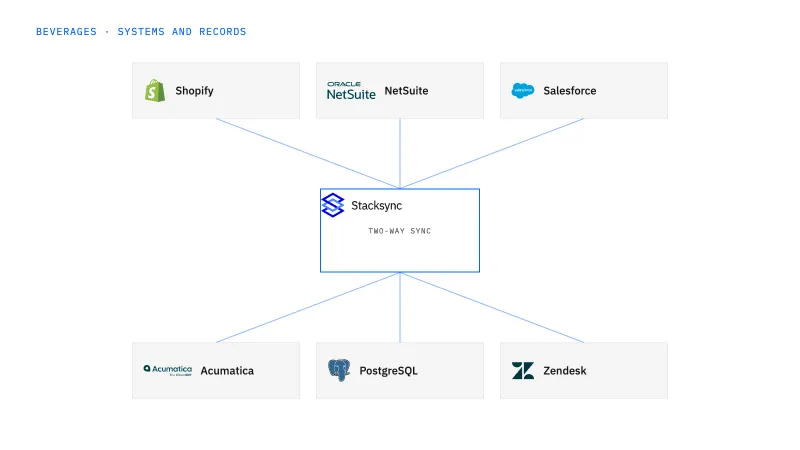
Connect beverage ecommerce, distributor accounts, case and pallet records, delivery exceptions, and EDI.
Bottle, case, and pallet quantities lose their meaning between sales, warehouses, carriers, and distributor receipts.
Explore your process in a demo, or get our shared two-way sync architecture guide.
The platform, in operating order
Keep shared customer, order, and operational records aligned, with clear field ownership.
Explore two-way sync 02Move approved work between systems, assign exceptions, and confirm the result.
Explore workflows 03Investigate cross-system questions, assemble the evidence, and prepare the next action.
Explore ai agents (genies) 04Connect trading-partner documents to operational records and exception handling.
Explore ediBuilt around your operations
Beverage brands combining production, DTC sales, distributor networks, and retail delivery.
Check approved freight thresholds and delivery windows before releasing a distributor order.
Explore workflows ↗Gather reported damage, receiving evidence, and the approved remedy for finance review.
Explore workflows ↗A customizable Genie job that compares distributor claims with shipment, appointment, and receiving evidence.
Explore Genies ↗Your systems and records
| Record | Owner | Operating rule |
|---|---|---|
| Sellable beverage pack | Product operations | Keep bottle, case, and variety-pack definitions explicit and versioned. |
| Distributor location | Account operations | Distinguish the legal payer from each receiving location and its instructions. |
| Delivery commitment | Logistics | Own the approved delivery window, freight conditions, and change history. |
| Breakage evidence | Customer operations | Connect reported damage to the actual order and shipment before a finance decision. |
Pallet shipments, advance ship notices, distributor locations, and receiving discrepancies.
Evaluate your next process
Connect beverage ecommerce orders to the ERP representation of bottles, cases, and variety packs.
Connect beverage distributor relationships to the correct payer and receiving locations.
Coordinate beverage order release around the accepted freight terms and distributor receiving window.
Connect beverage distributor documents to actual case and pallet contents.
Implementation and operating guides
Map each Shopify variant to an approved NetSuite item recipe with an effective date, so a twelve-bottle variety pack never turns into two cases of one flavor.
Sales manages the distributor relationship in Salesforce while NetSuite keeps the payer and every depot as separate records, so a new site never becomes a new customer.
A Postgres operations model that keeps a full pallet, a partial pallet, and a mixed pallet as different things, fed from the Acumatica entities the tenant exposes.
Under-threshold freight and unconfirmed depot windows go to a named approver in Slack, and the order leaves NetSuite for the warehouse only with both decisions attached.
Support logs the claim in Zendesk, logistics confirms which shipment broke, and finance approves one remedy in NetSuite with the damaged bottles counted, not assumed.
The Genie lines up the requested date, accepted appointment, and receipt timestamp in their original time zones, then hands logistics and finance a case with the gaps named.
One distributor claim, two uncertainties: the Genie resolves what the evidence supports, names who owns each missing fact, and leaves the rest visibly open.
The advance ship notice describes the mixed pallet the warehouse loaded, not the pallet count on the order, and a distributor receipt is matched to it rather than replaced by it.
No. A distributor location is a separate record from the legal payer, and account operations owns that distinction. Salesforce keeps the distributor relationship and NetSuite books the payer; two-way sync carries the account identity between them while each receiving location keeps its own delivery instructions. That way a distributor with several warehouses has one payer and several ship-to records, and a location change never edits the payer. Account operations approves new locations before an order can reference one.
The distributor delivery review workflow, which checks the delivery commitment before release. Logistics owns that commitment, including the approved window, freight conditions, and change history, so the workflow reads it rather than recalculating it. An order that misses the freight threshold or falls outside the window is held and routed to logistics with the reason attached. The sellable beverage pack version is checked at the same step so bottle, case, and pallet counts match what the distributor ordered. Release happens only after the hold is cleared.
It reads them as evidence and compares them with the distributor's claim. The Genie takes the pallet shipment and advance ship notice sent through EDI, the receiving discrepancy the distributor reported, and the breakage evidence customer operations logged in Zendesk, keeping bottle, case, and pallet units intact throughout. It cites each source record and flags what is missing. Approving a credit, amending a freight commitment, or contacting the distributor stays with the people who own those decisions; the Genie prepares the comparison for them.
Bring one real process
Bring the systems, record types, and exceptions your team handles today. We’ll scope the connections and actions, then walk through the path to a confirmed result.
Explore your process in a demo, or get our shared two-way sync architecture guide.


