AI Agents for Beverage Brands: Investigate Distributor Delivery Claims
The Genie lines up the requested date, accepted appointment, and receipt timestamp in their original time zones, then hands logistics and finance a case with the gaps named.
- Author
- Ignacio Malpartida · GTM Engineer
- Published
- Read time
- 5 min read
The operating decision
A beverage delivery-claim Genie should compare the distributor’s assertion with the agreed window, shipment timeline, and receiving evidence. It can assemble a clear case for logistics and finance, preserving time zones and quantities. It should not infer delivery from dispatch or decide a chargeback solely from an unverified appointment note.
Explore the complete beverages integration and automation hub for the systems and processes around this guide.
What this looks like in beverages
A distributor deducts a charge for a late delivery. The order shows a requested date, an email contains a revised appointment, and the receipt records arrival in a different time zone. The agent must establish which commitment was accepted and compare like timestamps before drafting any explanation.
Records, ownership, and update rules
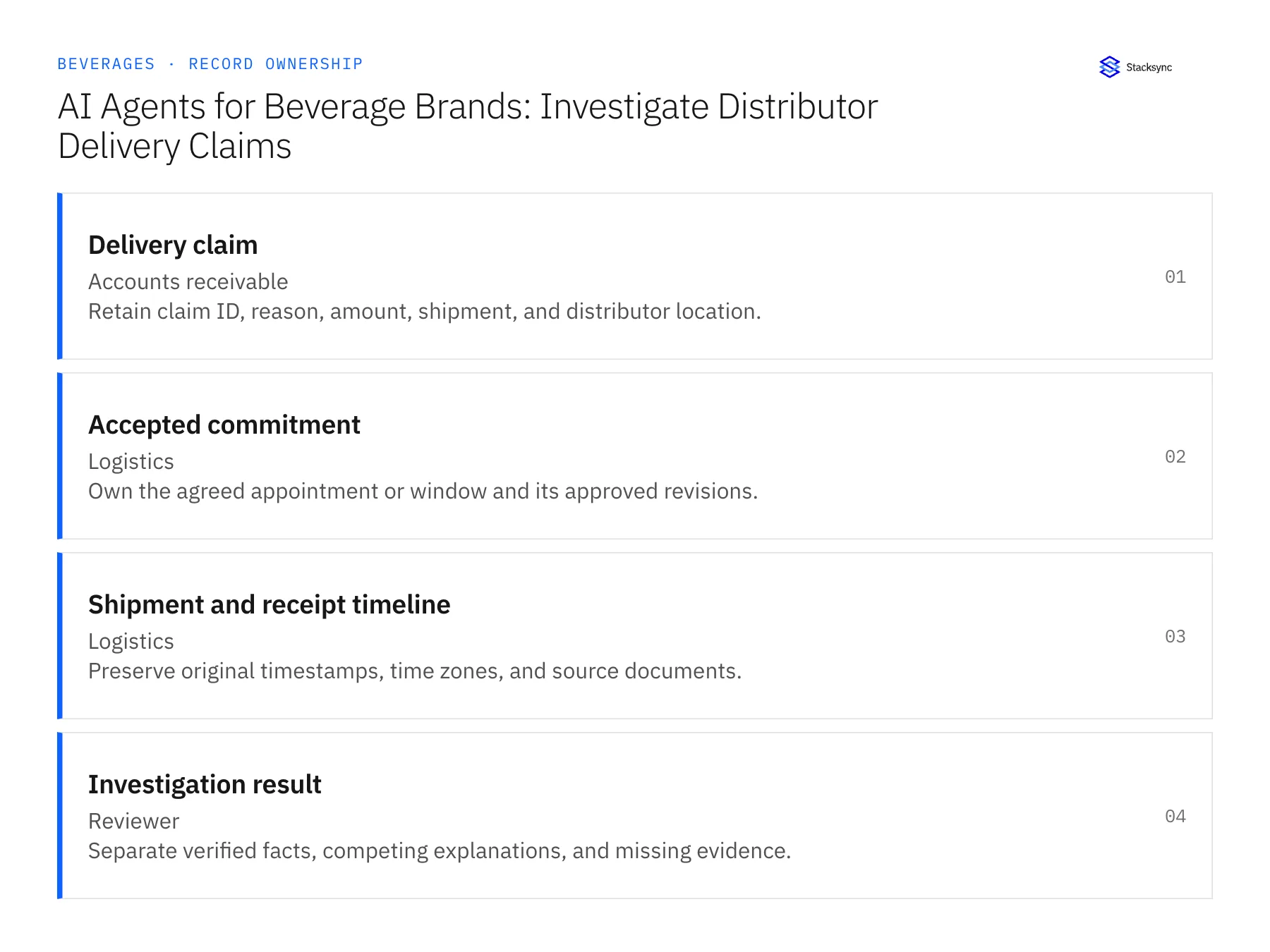
| Record | Owner | Operating rule |
|---|---|---|
| Delivery claim | Accounts receivable | Retain claim ID, reason, amount, shipment, and distributor location. |
| Accepted commitment | Logistics | Own the agreed appointment or window and its approved revisions. |
| Shipment and receipt timeline | Logistics | Preserve original timestamps, time zones, and source documents. |
| Investigation result | Reviewer | Separate verified facts, competing explanations, and missing evidence. |
Work through the process
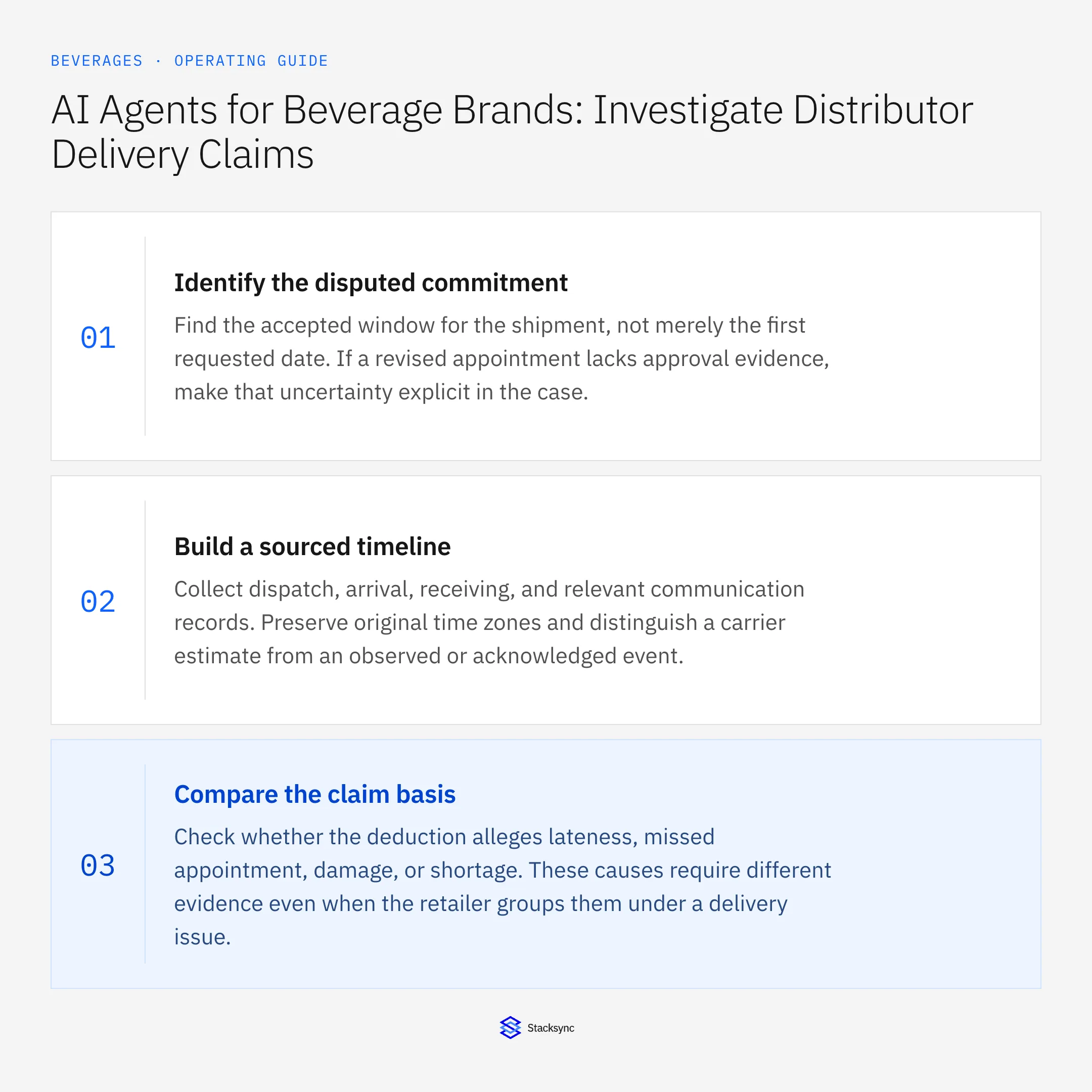
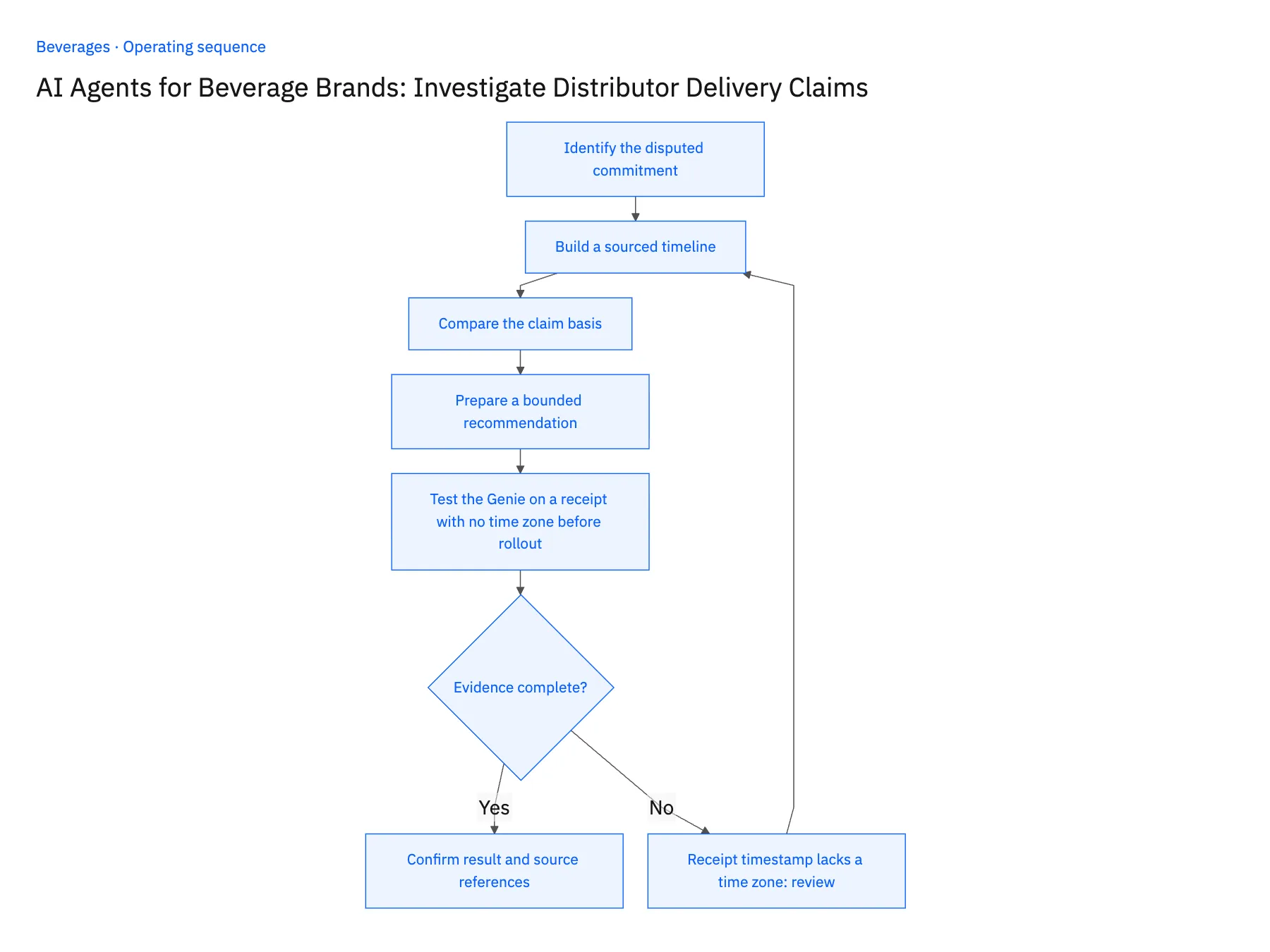
- 01Identify the disputed commitmentFind the accepted window for the shipment, not merely the first requested date. If a revised appointment lacks approval evidence, make that uncertainty explicit in the case.
- 02Build a sourced timelineCollect dispatch, arrival, receiving, and relevant communication records. Preserve original time zones and distinguish a carrier estimate from an observed or acknowledged event.
- 03Compare the claim basisCheck whether the deduction alleges lateness, missed appointment, damage, or shortage. These causes require different evidence even when the retailer groups them under a delivery issue.
- 04Prepare a bounded recommendationExplain what the evidence supports and which owner can decide the next step. Draft a precise missing-document request where the conclusion depends on an unverified fact.
- 05Test the Genie on a receipt with no time zone before rolloutHand the Genie one real deduction where the receipt row in Postgres records an arrival time with no zone, then read its packet. The timeline must label each event as requested, accepted, estimated, or observed and cite its source, and every timing comparison must show the original time on each side and the offset it used. For the zone-less receipt, the correct output is a request to the logistics owner naming the record and the missing field, with lateness left open. Stop the rollout if the packet calls the delivery late or on time from that receipt, if any event lacks its source, or if a timestamp was moved into another zone without its original time and the offset shown beside it.
Handle the exceptions explicitly
Receipt timestamp lacks a time zone
Ask the record owner to establish it before making a timing conclusion.
Appointment was changed informally
Find the authorized acceptance evidence or leave the commitment disputed.
Claim combines late and damaged goods
Separate the evidence and calculations for each asserted cause.
What to verify before expanding
- The timeline distinguishes requested, accepted, estimated, and observed events.
- Every timing comparison preserves its source time zone.
- A receiving timestamp without a confirmed time zone cannot support a late-delivery conclusion in the review packet.
- A claim combining lateness and breakage retains separate evidence and calculations for each cause rather than one inferred remedy.

Connect this process to the rest of your operation
Explore Stacksync AI agents (Genies) and scope the records and actions against your actual systems. Book a demo with a real delivery claim example and the exception your team handles most often, for example receipt timestamp lacks a time zone.
- Broken Cases and Disputed Delivery Windows: Exception Handling for Beverage Claim Agents
- Beverage EDI: Reconcile Pallet Shipments, Advance Ship Notices, and Distributor Receipts
- Shopify–NetSuite Sync for Beverage Brands: Align Bottles, Cases, and Variety Packs
- Investigate Freight Invoice Disputes Across NetSuite and Postgres
- Reconcile Freight Rates and Dwell Times Before Issuing Credits
The shared architecture guide covers record matching, ownership, and recovery across systems.
Technical references
FAQ
Frequently asked questions










Related articles