







Protect pack identity
Connect stable variants to approved bottle, case, and variety-pack definitions with effective versions.
 Salesforce
  HubSpot
  NetSuite
  Zendesk
  Microsoft Dynamics 365 Sales
  Dynamics 365 F&O
  Attio
Attio  Pipedrive
  Zoho CRM
  Campfire
  Rillet
  Front
Front  Shopify
  Amazon Seller Central
  SendGrid
 Beverages
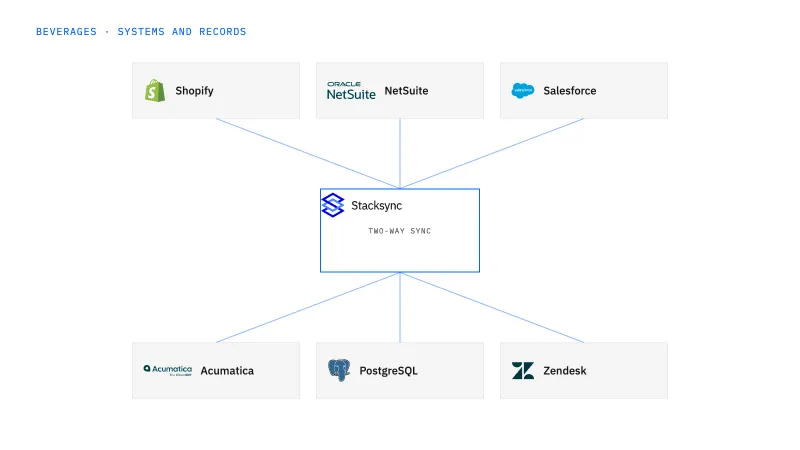
Connect beverage ecommerce orders to the ERP representation of bottles, cases, and variety packs. This fits brands combining DTC and distribution when teams repeatedly translate customer packs into physical quantities. Preserve the original purchase and approved component definitions before adding downstream fulfillment actions.
A storefront variety pack and an ERP case can look similar while containing different flavors and bottle counts.
Explore your process in a demo, or get our shared two-way sync architecture guide.
When this fits
Beverage brands combining production, DTC sales, distributor networks, and retail delivery.
Connect stable variants to approved bottle, case, and variety-pack definitions with effective versions.
Retain channel and ERP references so support and operations can inspect the same purchase without changing finance-owned facts.
Shopify product variants, orders, and customers are among the documented sync objects on this pairing. NetSuite writes are scoped to the items and transactions you select, so the approved component recipe stays owned by product operations in the ERP. Inventory levels and fulfillment updates are not part of product or order sync and need their own review before any write is enabled.
The process, end to end
A beverage brand sells mixed twelve-packs online and full single-flavor cases to distributors. Commerce, warehouse operations, and finance all need the same order trail with different views of its quantities. A focused demo should prove that a mixed cart retains both purchased packs and the intended physical components.
Scope your implementation
Review current platform pricing alongside the records, volume, and actions in your process. Use your own operating baseline to evaluate the economics.
Explore your process in a demo, or get our shared two-way sync architecture guide.
From foundation to action
Keep shared customer, order, and operational records aligned, with clear field ownership.
Explore two-way sync 02Move approved work between systems, assign exceptions, and confirm the result.
Explore workflows 03Investigate cross-system questions, assemble the evidence, and prepare the next action.
Explore ai agents (genies) 04Connect trading-partner documents to operational records and exception handling.
Explore ediGo deeper
Map each Shopify variant to an approved NetSuite item recipe with an effective date, so a twelve-bottle variety pack never turns into two cases of one flavor.
Sales manages the distributor relationship in Salesforce while NetSuite keeps the payer and every depot as separate records, so a new site never becomes a new customer.
A Postgres operations model that keeps a full pallet, a partial pallet, and a mixed pallet as different things, fed from the Acumatica entities the tenant exposes.
No. Flavor, container size, and count determine the actual sellable product and customer commitment.
The pack revision record carries the flavor mix and its effective dates, separate from the marketing name. When a seasonal mix replaces one flavor, a new revision starts on its effective date and orders placed before that date keep the recipe that was purchased. If a flavor runs out, the sync does not swap a single-flavor case into the order; the substitution goes to the team authorized to decide it, and the original Shopify line quantity stays intact for finance and returns.
Start with two-way sync between Shopify variants, orders, and customers and the NetSuite items that carry the approved pack recipe. Once the mixed-cart reconciliation passes, add workflows to route an unavailable flavor or a changed pack recipe to the owner who decides the substitution. Genies come next if breakage or delivery claims on those same orders need evidence gathered for review. EDI applies only when distributors receive pallet shipments and require partner documents rather than storefront orders.


