Broken Cases and Disputed Delivery Windows: Exception Handling for Beverage Claim Agents
One distributor claim, two uncertainties: the Genie resolves what the evidence supports, names who owns each missing fact, and leaves the rest visibly open.
- Author
- Ignacio Malpartida · GTM Engineer
- Published
- Read time
- 5 min read

The operating decision
Beverage claim agents need separate exception paths for quantity uncertainty and timing uncertainty. Broken cases require item and pack evidence; disputed delivery windows require the accepted commitment and comparable timestamps. Preserve unresolved branches independently so one verified fact does not make the entire claim appear settled.
Explore the complete beverages integration and automation hub for the systems and processes around this guide.
What this looks like in beverages
A distributor reports both late arrival and a damaged mixed pallet. The arrival timestamp is clear, but the appointment was revised, and the damage report lists cases without identifying flavors. The agent can verify part of the timeline while requesting the missing appointment approval and item-level damage evidence.
Records, ownership, and update rules
| Record | Owner | Operating rule |
|---|---|---|
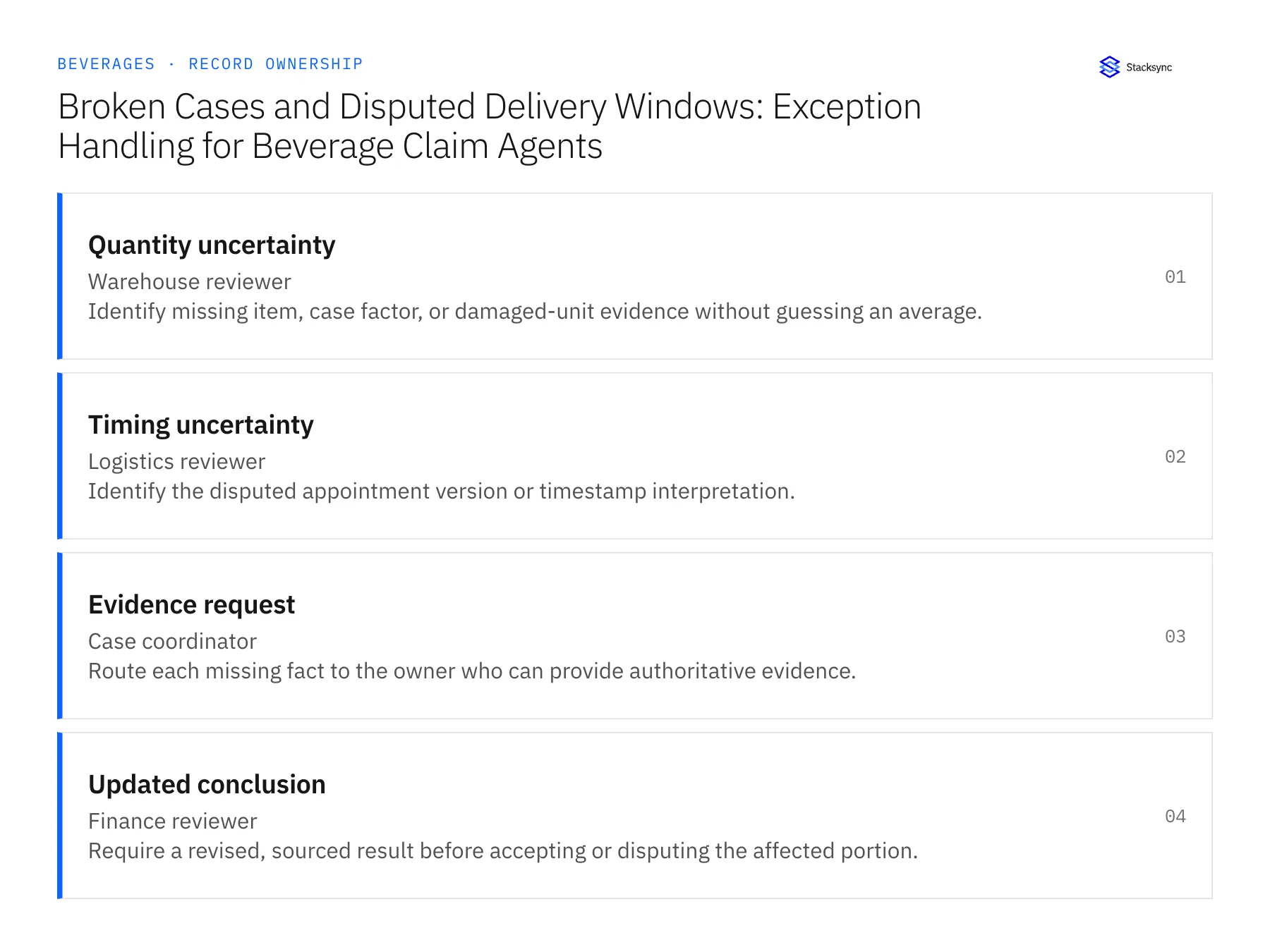
| Quantity uncertainty | Warehouse reviewer | Identify missing item, case factor, or damaged-unit evidence without guessing an average. |
| Timing uncertainty | Logistics reviewer | Identify the disputed appointment version or timestamp interpretation. |
| Evidence request | Case coordinator | Route each missing fact to the owner who can provide authoritative evidence. |
| Updated conclusion | Finance reviewer | Require a revised, sourced result before accepting or disputing the affected portion. |
Work through the process
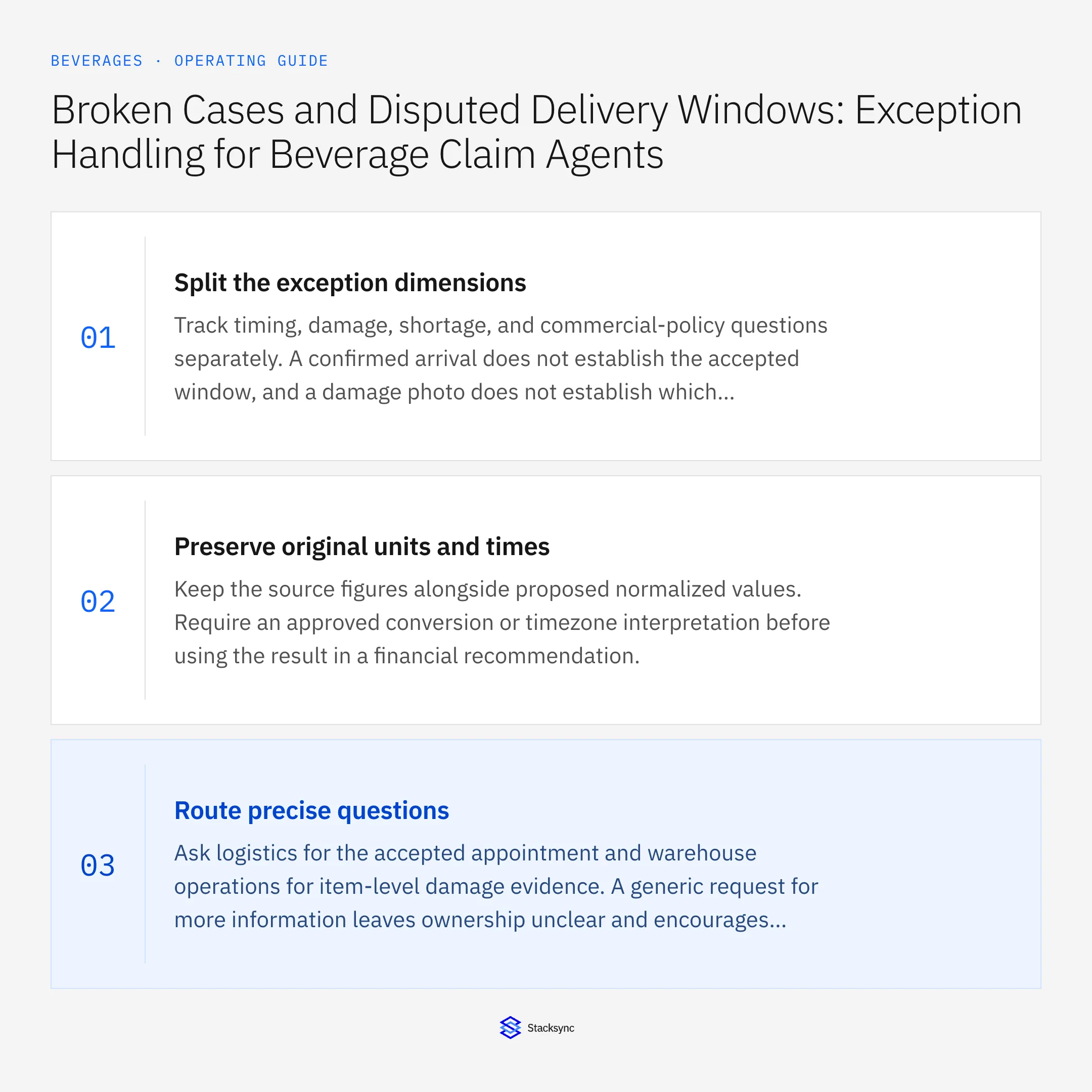
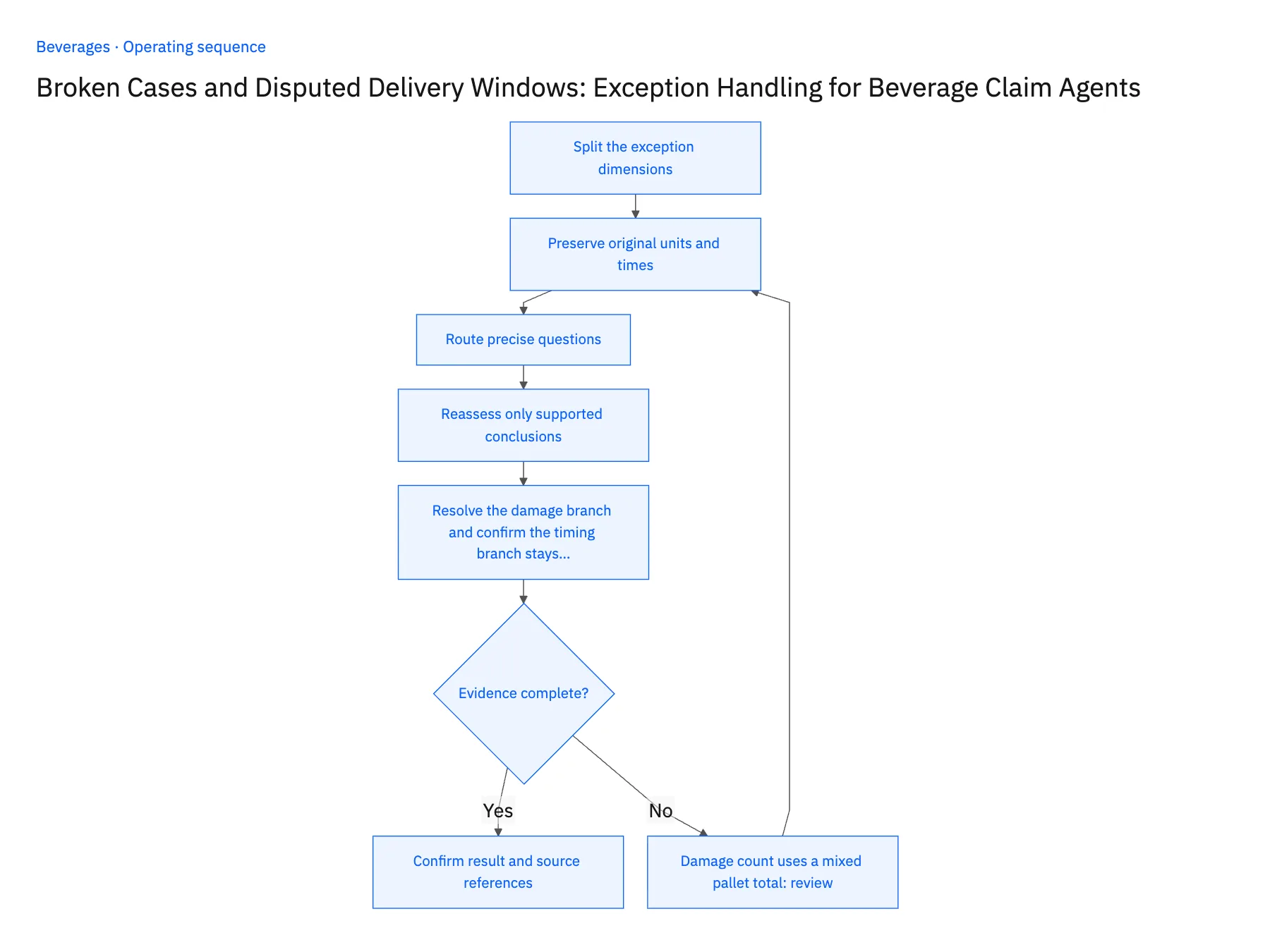
- 01Split the exception dimensionsTrack timing, damage, shortage, and commercial-policy questions separately. A confirmed arrival does not establish the accepted window, and a damage photo does not establish which case quantities should be credited.
- 02Preserve original units and timesKeep the source figures alongside proposed normalized values. Require an approved conversion or timezone interpretation before using the result in a financial recommendation.
- 03Route precise questionsAsk logistics for the accepted appointment and warehouse operations for item-level damage evidence. A generic request for more information leaves ownership unclear and encourages repeated agent retries.
- 04Reassess only supported conclusionsWhen new evidence arrives, update the relevant branch and show what changed. Keep other unresolved portions open and avoid presenting a partly supported case as fully resolved.
- 05Resolve the damage branch and confirm the timing branch stays openRun the Genie on a claim where the damage report gives one case total for a mixed pallet and the appointment exists in two versions. Its first packet should show two open branches: a request to the warehouse reviewer for item-level damaged quantities, and one to the logistics reviewer for the accepted appointment, each naming the record and the person. Supply the item-level counts through Postgres and rerun. The damage branch should close with per-item figures while the timing branch stays open. Stop the rollout if the packet applied an average case factor, if a missing fact has no owner, or if the whole claim reads as settled.
Handle the exceptions explicitly
Damage count uses a mixed pallet total
Request item-level quantities instead of applying a single case conversion.
Two appointment versions conflict
Escalate the accepted commitment decision to logistics.
Evidence arrives after a deadline
Flag the timing to the case owner without inventing a backdated submission or approval.
What to verify before expanding
- Partial certainty remains visible rather than becoming a blanket conclusion.
- Each missing fact has a named owner and a specific evidence request.
- An unresolved appointment version leaves the timing branch open even after the item-level damage quantity is established.
- Late-arriving evidence retains its actual receipt time and flags the response deadline without creating backdated approval.

Connect this process to the rest of your operation
Explore Stacksync AI agents (Genies) and scope the records and actions against your actual systems. Book a demo with a real quantity uncertainty example and the exception your team handles most often, for example damage count uses a mixed pallet total.
- AI Agents for Beverage Brands: Investigate Distributor Delivery Claims
- Beverage EDI: Reconcile Pallet Shipments, Advance Ship Notices, and Distributor Receipts
- Shopify–NetSuite Sync for Beverage Brands: Align Bottles, Cases, and Variety Packs
- Investigate Freight Invoice Disputes Across NetSuite and Postgres
- Reconcile Freight Rates and Dwell Times Before Issuing Credits
The shared architecture guide covers record matching, ownership, and recovery across systems.
Technical references
FAQ
Frequently asked questions










Related articles