







Staged jobsite delivery
Coordinate partial releases, readiness and site access without resetting the original order.
Explore workflows ↗ Salesforce
  HubSpot
  NetSuite
  Zendesk
  Microsoft Dynamics 365 Sales
  Dynamics 365 F&O
  Attio
Attio  Pipedrive
  Zoho CRM
  Campfire
  Rillet
  Front
Front  Shopify
  Amazon Seller Central
  SendGrid
 Building products manufacturing
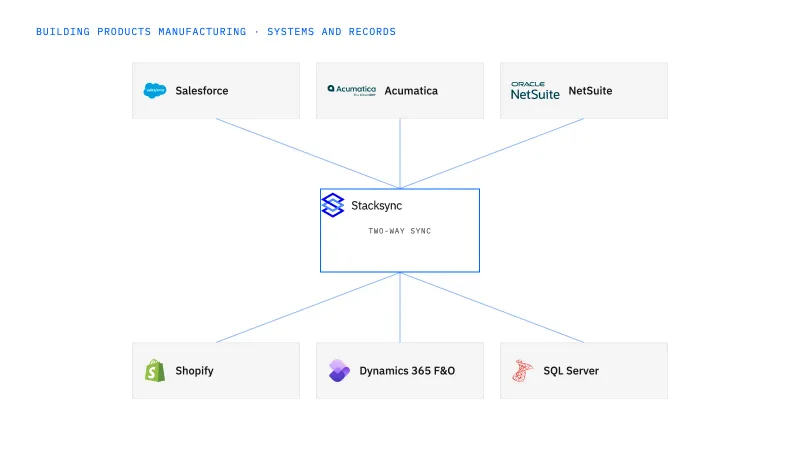
Connect dealer quotes, product variants, staged jobsite deliveries and returns across manufacturing, distribution and e-commerce.
Dealers and salespeople promise delivery using a product count that ignores bundle size, finishing status or stock already committed to another project.
Explore your process in a demo, or get our shared two-way sync architecture guide.
The platform, in operating order
Keep shared customer, order, and operational records aligned, with clear field ownership.
Explore two-way sync 02Move approved work between systems, assign exceptions, and confirm the result.
Explore workflows 03Investigate cross-system questions, assemble the evidence, and prepare the next action.
Explore ai agents (genies) 04Connect trading-partner documents to operational records and exception handling.
Explore ediBuilt around your operations
Operations, channel sales and IT leaders at US building-products manufacturers with 100–1,000 employees.
Coordinate partial releases, readiness and site access without resetting the original order.
Explore workflows ↗Reconcile photographs, receipt counts and shipment evidence before a replacement or credit is approved.
Explore workflows ↗Turn dealer emails and order forms into a reviewable product and delivery request.
Explore Genies ↗Your systems and records
| Record | Owner | Operating rule |
|---|---|---|
| Dealer quote | Channel sales | Retain customer-specific terms and the exact product variant in the approved revision. |
| Selling unit | Product operations | Separate pieces, bundles, cartons and area measures using a reviewed conversion. |
| Project delivery release | Logistics | Track each approved quantity and delivery window against the original project order. |
| Damage claim | Customer service | Link evidence and affected quantities to a shipment; a claim does not itself authorize a credit. |
Handle retailer purchase-order revisions and packaging quantities without confusing a commercial acknowledgment with a shipping commitment.
Evaluate your next process
Connect dealer quotes to accepted ERP orders while preserving project, product variant and staged-delivery context.
Connect storefront variants and selling units to the approved NetSuite product and order model.
Coordinate dealer project releases without losing the original order or remaining quantity.
Use a Genie to turn dealer emails and order forms into reviewable product and delivery drafts.
Implementation and operating guides
How a building-products manufacturer carries accepted dealer quote lines from Salesforce into Acumatica orders and shows sales which delivery stages operations confirmed.
A NetSuite and Shopify setup for trim and other building products where the store sells bundles, the ERP counts lengths, and unfinished stock must stay off the storefront.
Why a single completed flag misleads shipping, and how a Dynamics-fed SQL Server view separates production, quality release, packaging and delivery approval per release.
When a dealer moves a project phase forward or to a new unloading point, this workflow keeps the parent order intact and gives logistics the final say on the release.
A claim workflow for staged loads that matches dealer photographs to the right shipment, catches duplicate reports, and routes replacement and credit decisions to their owners.
What a dealer-order Genie should hand customer service: matched variants, side-by-side units, quote differences and delivery-stage questions, with commitments left to their owners.
Twenty bundles, a schedule in linear feet and a handwritten finish code: how an AI agent should surface each reading of a dealer order line instead of picking one.
A retailer orders cartons while NetSuite counts pieces; this intake keeps the partner line identity, applies each revision once, and separates receipt from acceptance.
Channel sales should lead, with logistics as the second owner. Channel sales holds the Dealer quote and can say which product variant and revision was sold; logistics holds the Project delivery release and knows what stock is already committed to another job. Product operations must confirm the Selling unit conversion before either team promises a count. Two-way sync between Salesforce and Acumatica shows each side the other’s record; the delivery promise itself stays a logistics decision.
Staged delivery is the better start when your projects ship in several releases and the original order keeps getting reset each time a stage is added. The workflow tracks each Project delivery release against the original order, with logistics approving each quantity and window. Damage resolution is the better start when replacements or credits are being issued before anyone has matched photographs to a shipment. There the Damage claim is linked to its shipment, and customer service reviews the evidence before any replacement or credit is approved.
Ask for one dealer email with a changed finish and an ambiguous unit, and one online order placed in cartons. The Genie should compare the email with the existing Dealer quote, separate the requested delivery stages, and hand a draft to customer service with the missing dimensions flagged. The Shopify order should land in NetSuite in its original Selling unit with the reviewed conversion beside it. Customer service approves the draft; the Genie does not create the order.
Bring one real process
Bring the systems, record types, and exceptions your team handles today. We’ll scope the connections and actions, then walk through the path to a confirmed result.
Explore your process in a demo, or get our shared two-way sync architecture guide.


