







Review the actual release impact
Connect the requested change to available stock, existing allocations and site requirements.
 Salesforce
  HubSpot
  NetSuite
  Zendesk
  Microsoft Dynamics 365 Sales
  Dynamics 365 F&O
  Attio
Attio  Pipedrive
  Zoho CRM
  Campfire
  Rillet
  Front
Front  Shopify
  Amazon Seller Central
  SendGrid
 Building products manufacturing
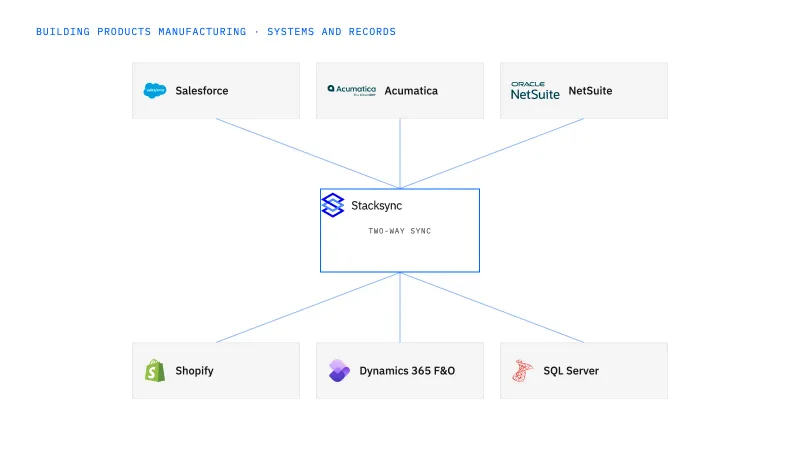
Coordinate dealer project releases without losing the original order or remaining quantity. Stacksync fits manufacturers that repeatedly copy staged-delivery changes between customer service, planning and the warehouse. The workflow collects readiness and site context, then carries the accepted release instruction to its owners.
A dealer advances one stage or changes a destination while the warehouse still works from the previous delivery plan.
Explore your process in a demo, or get our shared two-way sync architecture guide.
When this fits
Operations, channel sales and IT leaders at US building-products manufacturers with 100–1,000 employees.
Connect the requested change to available stock, existing allocations and site requirements.
Keep accepted quantity, destination and timing together so teams act on the same release.
Partial shipment does not close the whole order, and a changed stage does not create duplicate demand.
The process, end to end
an operations leader manages projects shipped in several phases. Evaluate a request to accelerate one stage with limited eligible stock, and verify that the accepted change reaches the warehouse while other stages and already shipped quantities remain intact.
Scope your implementation
Review current platform pricing alongside the records, volume, and actions in your process. Use your own operating baseline to evaluate the economics.
Explore your process in a demo, or get our shared two-way sync architecture guide.
From foundation to action
Keep shared customer, order, and operational records aligned, with clear field ownership.
Explore two-way sync 02Move approved work between systems, assign exceptions, and confirm the result.
Explore workflows 03Investigate cross-system questions, assemble the evidence, and prepare the next action.
Explore ai agents (genies) 04Connect trading-partner documents to operational records and exception handling.
Explore ediGo deeper
When a dealer moves a project phase forward or to a new unloading point, this workflow keeps the parent order intact and gives logistics the final say on the release.
A claim workflow for staged loads that matches dealer photographs to the right shipment, catches duplicate reports, and routes replacement and credit decisions to their owners.
Explore all building products manufacturing integration and automation guides ↗
Only after the scheduling method and approval conditions are explicitly scoped. Requested and confirmed windows should remain distinct.
It stays the parent commitment. The workflow opens a revision case for the affected delivery release, keeps the accepted quantity and destination in place while logistics reviews eligible stock and existing allocations, and records the approved instruction against the same NetSuite order. The account manager sees the accepted answer in Salesforce. Already shipped quantities and untouched stages keep their references, so the balance still owed to the project remains visible after the change.
Measure stage-change coordination time and mismatches between customer communication and the warehouse’s accepted instruction.
Not always. Two-way sync comes first when Salesforce and NetSuite disagree about the project order, its delivery releases or the remaining quantity. Once those records agree, workflows are the product for this page: a revision case per release, a logistics review of eligible stock and allocations, and one approved instruction back to the warehouse. Genies join when dealer stage-change emails need their requested quantity, destination and project reference compared with the current release. EDI follows for retailer purchase-order changes that move quantities or dates on NetSuite orders.


