







Keep units understandable
Retain the storefront quantity alongside the reviewed base-unit requirement.
 Salesforce
  HubSpot
  NetSuite
  Zendesk
  Microsoft Dynamics 365 Sales
  Dynamics 365 F&O
  Attio
Attio  Pipedrive
  Zoho CRM
  Campfire
  Rillet
  Front
Front  Shopify
  Amazon Seller Central
  SendGrid
 Building products manufacturing
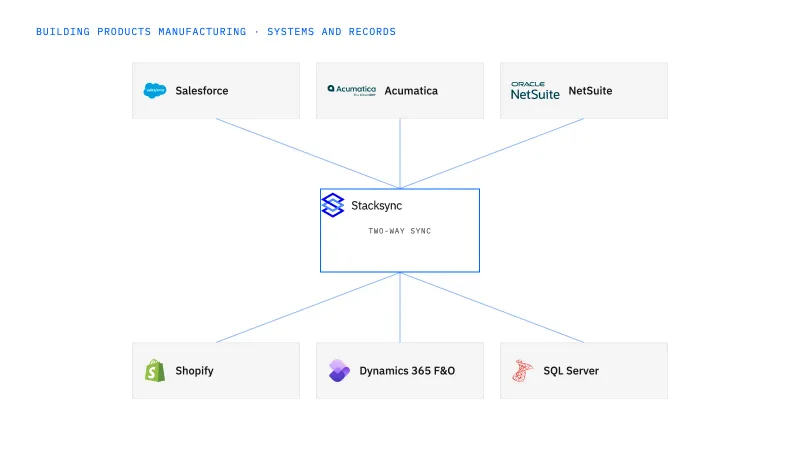
Connect storefront variants and selling units to the approved NetSuite product and order model. Stacksync fits building-products manufacturers combining dealer sales and e-commerce where bundles, pieces and finished-stock eligibility need careful reconciliation. The first scope should make quantities explainable and distinguish saleable goods from unfinished or restricted stock.
The store sells bundles while the warehouse counts pieces, and a finish-specific product cannot be fulfilled from every unit of base material.
Explore your process in a demo, or get our shared two-way sync architecture guide.
When this fits
Operations, channel sales and IT leaders at US building-products manufacturers with 100–1,000 employees.
Retain the storefront quantity alongside the reviewed base-unit requirement.
Use the agreed inventory policy for finish, location, quality and existing commitments.
Accepted orders keep their original pack definition even when future catalog packaging changes.
The process, end to end
a direct-sales manager shares inventory with wholesale dealers and wants to offer a defined finished assortment online. Ask to see one bundle conversion and one finish-related stock restriction, with the original customer quantity preserved on the accepted order.
Scope your implementation
Review current platform pricing alongside the records, volume, and actions in your process. Use your own operating baseline to evaluate the economics.
Explore your process in a demo, or get our shared two-way sync architecture guide.
From foundation to action
Keep shared customer, order, and operational records aligned, with clear field ownership.
Explore two-way sync 02Move approved work between systems, assign exceptions, and confirm the result.
Explore workflows 03Investigate cross-system questions, assemble the evidence, and prepare the next action.
Explore ai agents (genies) 04Connect trading-partner documents to operational records and exception handling.
Explore ediGo deeper
How a building-products manufacturer carries accepted dealer quote lines from Salesforce into Acumatica orders and shows sales which delivery stages operations confirmed.
A NetSuite and Shopify setup for trim and other building products where the store sells bundles, the ERP counts lengths, and unfinished stock must stay off the storefront.
Why a single completed flag misleads shipping, and how a Dynamics-fed SQL Server view separates production, quality release, packaging and delivery approval per release.
Explore all building products manufacturing integration and automation guides ↗
Only with a reviewed model for dimensions, conversion and accepted lead time. Raw material quantity alone is not a finished-product promise.
No. Confirm inventory publication, order updates and fulfillment operations individually for the selected scope.
Compare quantity corrections, manual reconciliation and orders requiring intervention because finish or pack meaning was lost.
Two-way sync is the first product. It maps Shopify variants to NetSuite base items under a reviewed pack conversion, publishes stock eligible for the direct channel, and keeps the storefront quantity on accepted orders. Add workflows when a quality hold removes finished stock from availability and the accepted orders it affects need an inventory owner’s review, or when product operations must approve a revised bundle definition for future orders while accepted orders keep the old conversion. Genies follow when dealer order forms arrive with ambiguous bundle or piece quantities, so a reviewer sees the source unit beside the proposed conversion. EDI comes last, carrying retailer carton quantities into NetSuite under approved definitions.


