







Preserve product and project meaning
Keep the dealer, project, variant and selling unit distinct where the business process needs them.
 Salesforce
  HubSpot
  NetSuite
  Zendesk
  Microsoft Dynamics 365 Sales
  Dynamics 365 F&O
  Attio
Attio  Pipedrive
  Zoho CRM
  Campfire
  Rillet
  Front
Front  Shopify
  Amazon Seller Central
  SendGrid
 Building products manufacturing
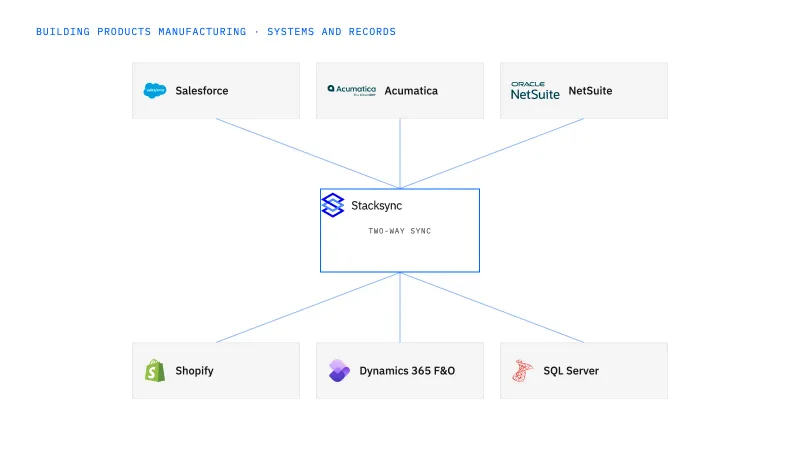
Connect dealer quotes to accepted ERP orders while preserving project, product variant and staged-delivery context. Stacksync fits building-products manufacturers whose channel teams repeatedly reconcile Salesforce opportunities with Acumatica order records. Keep requested scope separate from approved manufacturing and logistics commitments.
The dealer’s accepted quote includes finishes and delivery stages that disappear when the order is reduced to one opportunity total and ship-to field.
Explore your process in a demo, or get our shared two-way sync architecture guide.
When this fits
Operations, channel sales and IT leaders at US building-products manufacturers with 100–1,000 employees.
Keep the dealer, project, variant and selling unit distinct where the business process needs them.
Return line and delivery-stage status instead of suggesting the entire project shares one readiness state.
Route changed finishes or destinations to the appropriate owner and validate the exact order operations during scoping.
The process, end to end
a manufacturer serves dealers ordering several finishes for phased projects. Evaluate a partially accepted quote with one changed finish and two delivery destinations, then inspect what operations accepted and what sales can safely communicate.
Scope your implementation
Review current platform pricing alongside the records, volume, and actions in your process. Use your own operating baseline to evaluate the economics.
Explore your process in a demo, or get our shared two-way sync architecture guide.
From foundation to action
Keep shared customer, order, and operational records aligned, with clear field ownership.
Explore two-way sync 02Move approved work between systems, assign exceptions, and confirm the result.
Explore workflows 03Investigate cross-system questions, assemble the evidence, and prepare the next action.
Explore ai agents (genies) 04Connect trading-partner documents to operational records and exception handling.
Explore ediGo deeper
How a building-products manufacturer carries accepted dealer quote lines from Salesforce into Acumatica orders and shows sales which delivery stages operations confirmed.
A NetSuite and Shopify setup for trim and other building products where the store sells bundles, the ERP counts lengths, and unfinished stock must stay off the storefront.
Why a single completed flag misleads shipping, and how a Dynamics-fed SQL Server view separates production, quality release, packaging and delivery approval per release.
Explore all building products manufacturing integration and automation guides ↗
Not necessarily. The dealer may be the sold-to customer while the project supplies delivery context. Model the actual relationship first.
Partial quote acceptance, a product change and a stage-specific destination update that leaves other commitments intact.
Track order-preparation effort, status-checking touches and corrections caused by lost variant or delivery detail.
Start with two-way sync. It carries the accepted dealer quote from Salesforce into an Acumatica order with variant, selling unit and delivery stage intact, and returns line status to the account manager. Add workflows when a changed finish or stage destination needs review by product operations or logistics before the order changes. Bring in Genies when dealer emails and marked-up forms need comparing with the quote before anyone keys an order. EDI comes last, when retailer purchase orders and revisions must carry the same variant and packaging meaning.


