







Promotion readiness
Coordinate confirmed retail commitments, available finished-goods evidence, and approved ecommerce launch dates.
Explore workflows ↗ Salesforce
  HubSpot
  NetSuite
  Zendesk
  Microsoft Dynamics 365 Sales
  Dynamics 365 F&O
  Attio
Attio  Pipedrive
  Zoho CRM
  Campfire
  Rillet
  Front
Front  Shopify
  Amazon Seller Central
  SendGrid
 Packaged food and snacks
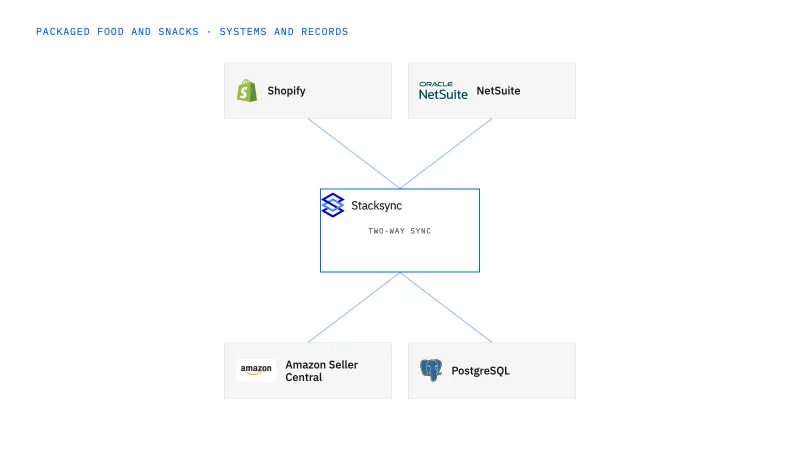
Connect food-brand ecommerce, grocery wholesale, co-packer receipts, and retailer shipment evidence.
Single units, multipacks, retailer cases, and co-packer receipts describe the same goods differently.
Explore your process in a demo, or get our shared two-way sync architecture guide.
The platform, in operating order
Keep shared customer, order, and operational records aligned, with clear field ownership.
Explore two-way sync 02Move approved work between systems, assign exceptions, and confirm the result.
Explore workflows 03Investigate cross-system questions, assemble the evidence, and prepare the next action.
Explore ai agents (genies) 04Connect trading-partner documents to operational records and exception handling.
Explore ediBuilt around your operations
Packaged-food and snack manufacturers combining DTC, marketplaces, co-packing, and grocery distribution.
Coordinate confirmed retail commitments, available finished-goods evidence, and approved ecommerce launch dates.
Explore workflows ↗Route unexpected quantities or pack definitions to supply operations before accepting a receipt.
Explore workflows ↗A Genie job that reconstructs grocery shipment and receipt evidence without inventing missing documents.
Explore Genies ↗Your systems and records
| Record | Owner | Operating rule |
|---|---|---|
| Sellable pack | Product operations | Version the unit, multipack, and grocery-case definitions instead of matching by product title. |
| Co-packer receipt | Supply operations | Retain supplier document, finished SKU, quantity, unit, and acceptance status. |
| Grocery order line | Customer operations | Preserve retailer item and line references through partial shipments. |
| Receipt evidence | Accounts receivable | Compare claimed and shipped quantities using the correct pack conversion. |
Grocery case counts, retailer item identifiers, and actual shipment notices.
Evaluate your next process
Connect snack-brand ecommerce orders to the ERP records that explain the purchased packs, customers, and financial outcomes.
Bring Amazon order and marketplace evidence into the NetSuite reconciliation process while preserving fulfillment responsibility and pack identity.
Coordinate the decisions behind a mismatched co-packer receipt before operations accepts a correction.
Connect grocery purchase orders and shipment documents with the case definitions and actual warehouse evidence behind them.
Implementation and operating guides
Snack brands selling bars, six-packs, and grocery cases need a dated pack recipe between each Shopify variant and its NetSuite line before orders reach ERP processing.
Keep FBA and merchant-fulfilled Amazon orders classified all the way into NetSuite so finance gets sales evidence and the warehouse only receives work the brand owns.
Food operations get one Postgres view of co-packer notices and NetSuite receipts, with each quantity kept apart and any ERP correction routed through an approved write path.
A promotion workflow gives the commercial owner one record showing committed grocery quantities, accepted supply evidence, and the Shopify launch window before go-live.
When a supplier's revised packing list, the dock count, and the NetSuite receipt disagree, this workflow keeps one case open until the right owner records a decision.
Before accounts receivable answers a grocer's deduction, a Genie assembles the purchase order, each truck's shipment lines, and any retailer receipt into one cited packet.
Repacked cartons, receipts from the wrong site, and absent paperwork are the moments a snack order Genie must stop, ask one precise question, and hold its work.
Grocery EDI for snacks works when the retailer item, case definition, and PO line reference survive from Orderful order intake to an ASN built from the truck's contents.
Through a versioned sellable pack, which product operations owns. Each unit, multipack, and grocery-case definition gets its own version, so two-way sync relates a Shopify variant to the NetSuite item with the right conversion instead of matching on a product title. Amazon orders enter through the Amazon Seller Central connector, which imports marketplace evidence with read-only access; it does not update listings, cancel Amazon orders, or issue marketplace refunds. Warehouse and commerce actions for those orders are scoped separately.
The co-packer receipt review workflow holds it for supply operations instead of accepting it. The receipt keeps the supplier document, finished SKU, quantity, unit, and acceptance status, and an unexpected quantity or an unknown pack definition routes to the supply owner with the difference spelled out. Acceptance status changes only after that person decides. Until then, NetSuite inventory and the Postgres finished-goods record stay as they were, so nothing downstream counts stock that has not been confirmed.
No. It reconstructs the evidence and stops there. The Genie compares the grocery order line, the shipment notice sent through EDI, and the receipt evidence, applying the effective case conversion so a claimed quantity in cases is compared with what shipped in the same unit. It cites each document and lists the differences it could not resolve. Accounts receivable owns the credit decision and any dispute; the Genie prepares the packet for that review and does not submit a dispute or approve a credit.
Bring one real process
Bring the systems, record types, and exceptions your team handles today. We’ll scope the connections and actions, then walk through the path to a confirmed result.
Explore your process in a demo, or get our shared two-way sync architecture guide.


