AI Agents for Packaged Food Brands: Investigate Grocery Short-Shipment Claims
Before accounts receivable answers a grocer's deduction, a Genie assembles the purchase order, each truck's shipment lines, and any retailer receipt into one cited packet.
- Author
- Ignacio Malpartida · GTM Engineer
- Published
- Read time
- 5 min read
The operating decision
A grocery shortage Genie should reconstruct the requested, shipped, and received quantities at the retailer’s item and pack grain. Give it purchase-order, shipment, invoice, and receiving evidence with stable references. Its job is to produce a defensible investigation packet and identify missing facts before accounts receivable accepts or disputes the claim.
Explore the complete packaged food and snacks integration and automation hub for the systems and processes around this guide.
What this looks like in packaged food and snacks
A grocer claims ten cases missing from a snack delivery. The warehouse has two shipment records, but the retailer’s receipt only covers the first truck. The Genie must link the second delivery to the same purchase order and check whether it was actually received, rather than assuming every shipped case reached the retailer.
Records, ownership, and update rules
| Record | Owner | Operating rule |
|---|---|---|
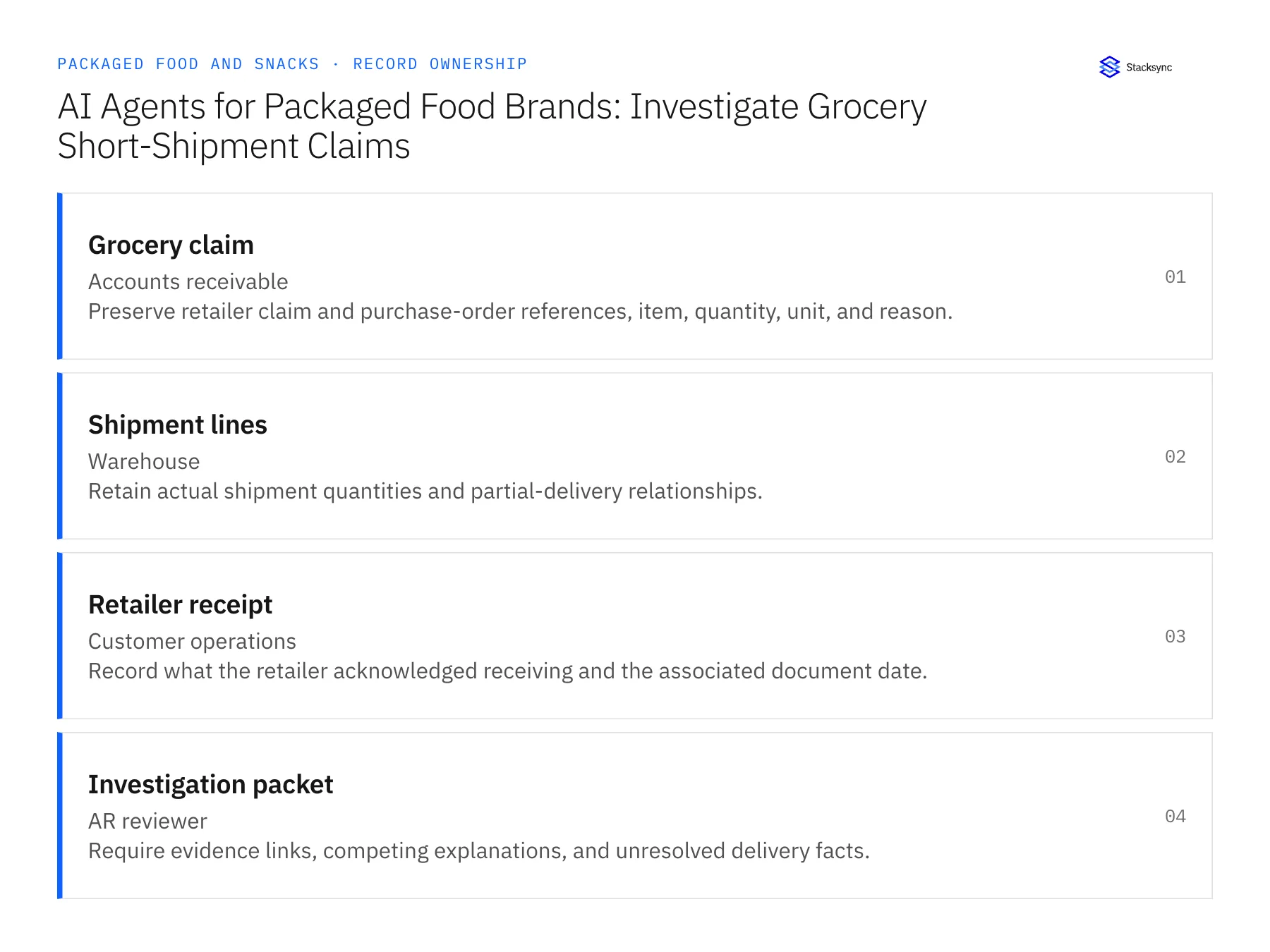
| Grocery claim | Accounts receivable | Preserve retailer claim and purchase-order references, item, quantity, unit, and reason. |
| Shipment lines | Warehouse | Retain actual shipment quantities and partial-delivery relationships. |
| Retailer receipt | Customer operations | Record what the retailer acknowledged receiving and the associated document date. |
| Investigation packet | AR reviewer | Require evidence links, competing explanations, and unresolved delivery facts. |
Work through the process
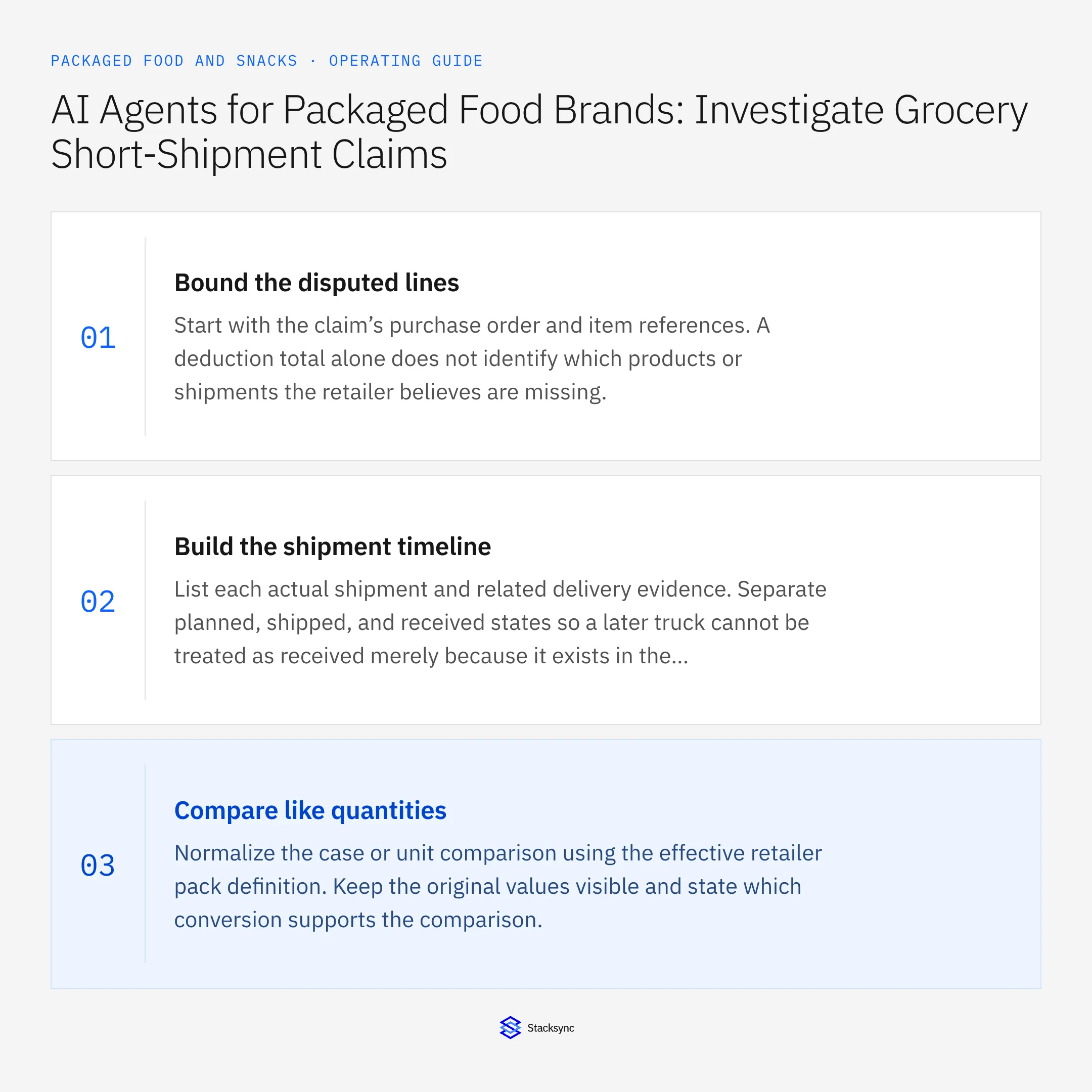
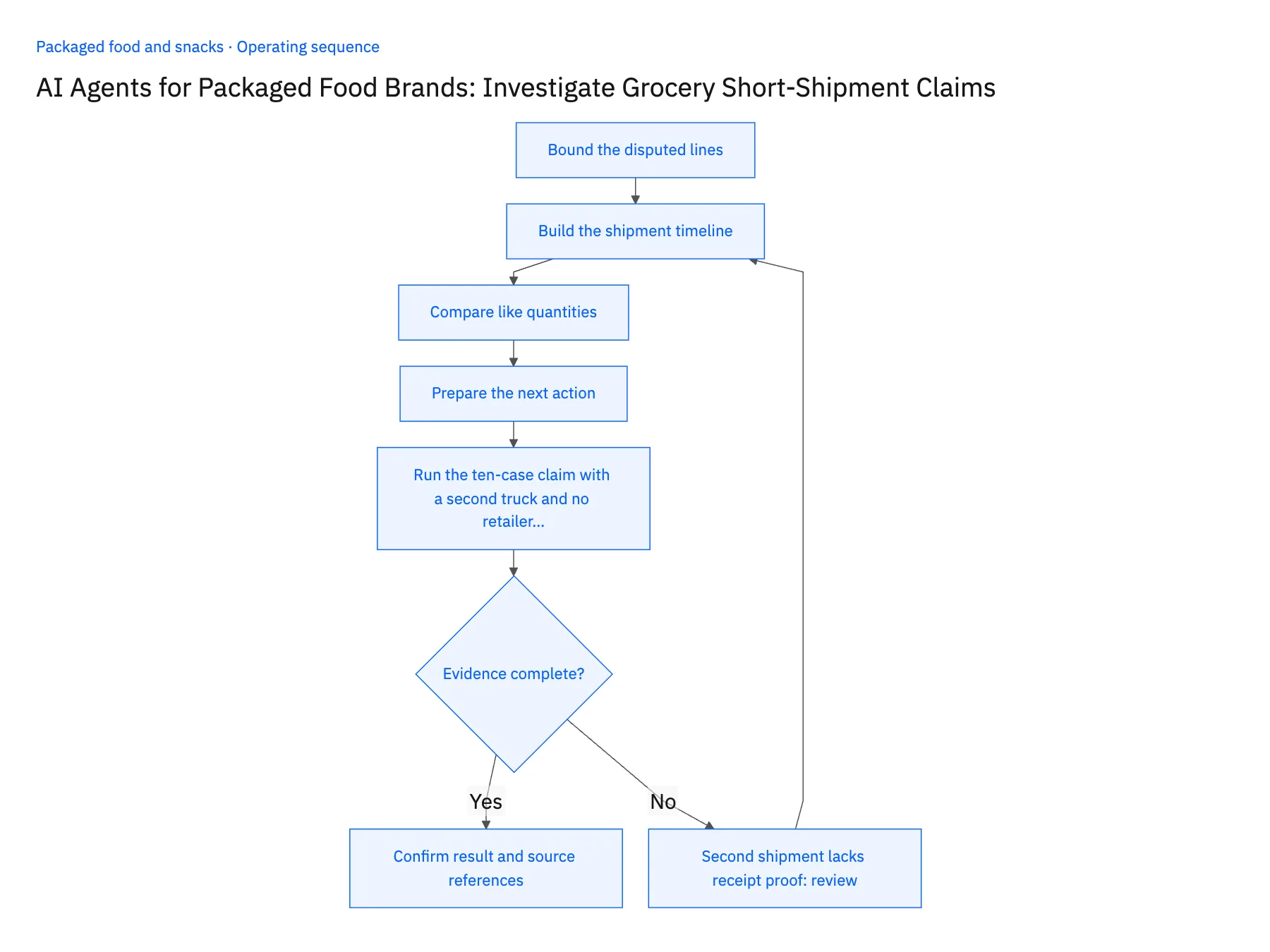
- 01Bound the disputed linesStart with the claim’s purchase order and item references. A deduction total alone does not identify which products or shipments the retailer believes are missing.
- 02Build the shipment timelineList each actual shipment and related delivery evidence. Separate planned, shipped, and received states so a later truck cannot be treated as received merely because it exists in the ERP.
- 03Compare like quantitiesNormalize the case or unit comparison using the effective retailer pack definition. Keep the original values visible and state which conversion supports the comparison.
- 04Prepare the next actionReturn the likely explanation, missing evidence, and owner. If a receipt is missing, draft a precise request for that document instead of drafting an unsupported claim rejection.
- 05Run the ten-case claim with a second truck and no retailer receiptGive the Genie the scenario claim: ten cases short, two NetSuite shipment records against one purchase order, and a retailer receipt in Postgres that covers only the first truck. Read the packet it returns. Shipped quantities and acknowledged receipts must sit in separate columns, and every case figure must name the conversion it used. If the packet counts the second truck as delivered, or shows a normalized quantity with no cited conversion, the rollout stops there. The second shipment should appear as unresolved, with a drafted Gmail request for the missing receipt waiting on customer operations for approval, not sent. A packet that settles the shortage without that request fails.
Handle the exceptions explicitly
Second shipment lacks receipt proof
Mark its delivery status unresolved and request the relevant evidence.
Retailer item maps to two SKUs
Stop the affected comparison until product operations confirms the correct item relationship.
Claim quantity changes
Version the investigation and rerun the affected comparisons before review.
What to verify before expanding
- The packet distinguishes shipped goods from acknowledged receipts.
- Every normalized case quantity cites its approved conversion.
- A second shipment without retailer receipt evidence remains unresolved instead of being counted as delivered against the claim.
- A revised claim quantity updates the comparison and packet version before the original conclusion can be reused.

Connect this process to the rest of your operation
Explore Stacksync AI agents (Genies) and scope the records and actions against your actual systems. Book a demo with a real grocery claim example and the exception your team handles most often, for example second shipment lacks receipt proof.
- Case Splits and Missing Receipts: Exception Handling for Snack-Brand Order Agents
- Grocery EDI for Snack Brands: Keep Case Counts and Advance Ship Notices Consistent
- Shopify–NetSuite Sync for Snack Brands: Match Single Units, Multipacks, and Cases
- How to Explain Split Shipments and Missing Tracking
- Identify At-Risk Orders Using Inventory and Incoming Purchase Orders
The shared architecture guide covers record matching, ownership, and recovery across systems.
Technical references
FAQ
Frequently asked questions










Related articles