







Preserve the purchased pack
Keep the original Shopify variant and order line connected to the approved NetSuite representation, including the effective component definition for a mixed box.
 Salesforce
  HubSpot
  NetSuite
  Zendesk
  Microsoft Dynamics 365 Sales
  Dynamics 365 F&O
  Attio
Attio  Pipedrive
  Zoho CRM
  Campfire
  Rillet
  Front
Front  Shopify
  Amazon Seller Central
  SendGrid
 Packaged food and snacks
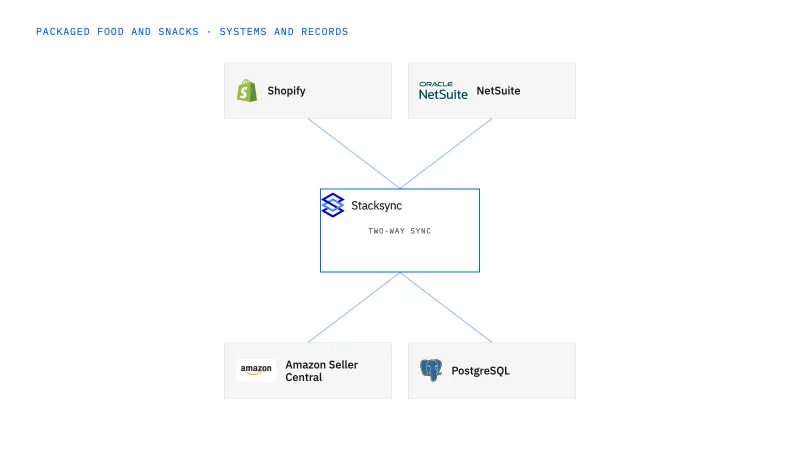
Connect snack-brand ecommerce orders to the ERP records that explain the purchased packs, customers, and financial outcomes. This is a fit when DTC, wholesale, and operations repeatedly reconcile the same single-unit, multipack, and case identities by hand. Begin with the shared records and add approved fulfillment workflows after the pack relationships are clear.
Food-brand teams waste time interpreting which physical goods a storefront bundle represents in the ERP.
Explore your process in a demo, or get our shared two-way sync architecture guide.
When this fits
Packaged-food and snack manufacturers combining DTC, marketplaces, co-packing, and grocery distribution.
Keep the original Shopify variant and order line connected to the approved NetSuite representation, including the effective component definition for a mixed box.
Make customer, order, and accepted ERP references available for support and operations without turning every storefront edit into a financial change.
Ecommerce keeps the Shopify variant ID and purchased options. Product operations keeps the component recipe and its effective date. ERP operations keeps the accepted NetSuite line and the totals NetSuite calculates. Set write permissions per object on each side, so a storefront title edit cannot rewrite a posted transaction and an ERP correction reaches the storefront only where you allow it.
The process, end to end
A brand sells mixed snack boxes online and full cases to grocery accounts. Commerce wants reliable order visibility, operations needs the correct component quantities, and finance needs one accepted transaction trail. The commercial fit is the recurring cross-system reconciliation across those teams, with approved pack definitions and clear operational owners.
Scope your implementation
Review current platform pricing alongside the records, volume, and actions in your process. Use your own operating baseline to evaluate the economics.
Explore your process in a demo, or get our shared two-way sync architecture guide.
From foundation to action
Keep shared customer, order, and operational records aligned, with clear field ownership.
Explore two-way sync 02Move approved work between systems, assign exceptions, and confirm the result.
Explore workflows 03Investigate cross-system questions, assemble the evidence, and prepare the next action.
Explore ai agents (genies) 04Connect trading-partner documents to operational records and exception handling.
Explore ediGo deeper
Snack brands selling bars, six-packs, and grocery cases need a dated pack recipe between each Shopify variant and its NetSuite line before orders reach ERP processing.
Keep FBA and merchant-fulfilled Amazon orders classified all the way into NetSuite so finance gets sales evidence and the warehouse only receives work the brand owns.
Food operations get one Postgres view of co-packer notices and NetSuite receipts, with each quantity kept apart and any ERP correction routed through an approved write path.
Explore all packaged food and snacks integration and automation guides ↗
It is especially relevant when ecommerce shares product and operational data with wholesale or manufacturing. The design preserves channel-specific packs and commercial rules while connecting the shared records.
Each order keeps the recipe that was in force on its purchase date. Product operations versions the component definition with an effective date, and the sync carries the stable Shopify variant ID and purchased options into NetSuite instead of the current display title. Placed orders stay on their original component quantities; the new definition applies to orders after the effective date. Moving an existing order onto the new bundle is a decision an operational owner records, not something a storefront edit triggers.
Start with two-way sync for Shopify product variants, orders and customers and the NetSuite items and order lines they map to, with the pack recipe owned by product operations. Once one order of each pack type resolves correctly, add workflows for handoffs that need a decision, such as an unavailable component or a launch that depends on committed retail quantities. Genies come after, assembling shipment and receipt evidence when a grocery account claims a shortage. EDI comes last, when those grocers require purchase orders and ship notices as documents.


