







Protect case-level meaning
Map retailer item numbers and units to approved internal products and case definitions before accepting the order.
 Salesforce
  HubSpot
  NetSuite
  Zendesk
  Microsoft Dynamics 365 Sales
  Dynamics 365 F&O
  Attio
Attio  Pipedrive
  Zoho CRM
  Campfire
  Rillet
  Front
Front  Shopify
  Amazon Seller Central
  SendGrid
 Packaged food and snacks
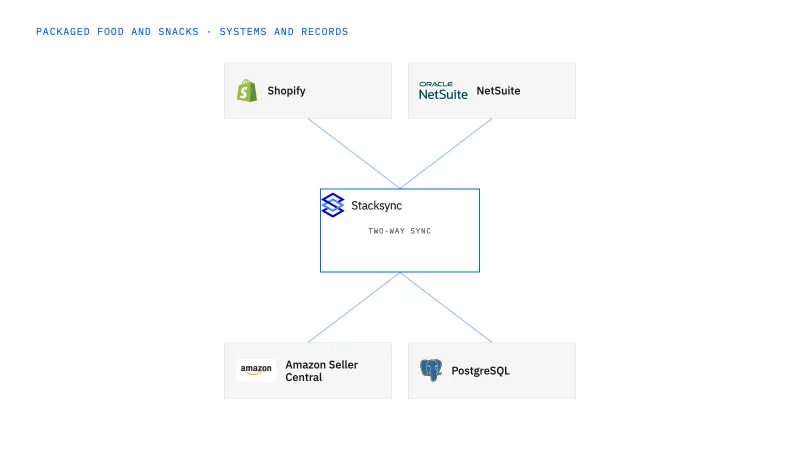
Connect grocery purchase orders and shipment documents with the case definitions and actual warehouse evidence behind them. This fits snack brands entering retail or expanding across grocery partners whose item, location, and packing rules differ. Scope the partner’s document requirements and test the business mapping before live exchange.
A valid-looking grocery document can still carry the wrong case count or describe goods missing from the truck.
Explore your process in a demo, or get our shared two-way sync architecture guide.
When this fits
Packaged-food and snack manufacturers combining DTC, marketplaces, co-packing, and grocery distribution.
Map retailer item numbers and units to approved internal products and case definitions before accepting the order.
Build shipment documents from warehouse-confirmed contents and retain open quantities for later deliveries.
Orderful carries each purchase order and shipment notice as a partner-addressed document with its own validation state, on a test stream until the grocer's test requirements pass and on a live stream afterward. That transport is not two-way sync. The retailer item mapping, purchase-order line and actual shipment stay NetSuite and warehouse records that your teams own. Retailer certification is the partner's decision, not a connection setting.
The process, end to end
A brand adds a grocer that orders under retailer item numbers and expects shipment notices for split deliveries. The ERP knows internal SKUs and the warehouse knows actual cases. The evaluation should show how those references remain connected through the partner’s order, shipment, and invoice requirements.
Scope your implementation
Review current platform pricing alongside the records, volume, and actions in your process. Use your own operating baseline to evaluate the economics.
Explore your process in a demo, or get our shared two-way sync architecture guide.
From foundation to action
Keep shared customer, order, and operational records aligned, with clear field ownership.
Explore two-way sync 02Move approved work between systems, assign exceptions, and confirm the result.
Explore workflows 03Investigate cross-system questions, assemble the evidence, and prepare the next action.
Explore ai agents (genies) 04Connect trading-partner documents to operational records and exception handling.
Explore ediGo deeper
Grocery EDI for snacks works when the retailer item, case definition, and PO line reference survive from Orderful order intake to an ASN built from the truck's contents.
Explore all packaged food and snacks integration and automation guides ↗
No. It communicates shipment details. Retailer receipt evidence remains separate and is necessary for later shortage or deduction review.
Each notice describes only the cases on its own truck. The warehouse-confirmed shipment record, with its carton or pallet relationships, is the source for the document; the ordered quantity on the purchase order is not. The remainder stays open against the same purchase-order line and partner line reference until the second shipment exists, and that shipment gets its own notice. Orderful checks each document against the grocer's validation guidelines before transmission, so an unknown item or case factor surfaces as an error on your side first.
Not as a prerequisite. On this page the first product is EDI: Orderful carries the grocer's purchase orders and your advance ship notices as partner-addressed documents, mapped and validated against that partner's specification. Two-way sync is a separate layer for records, not for document transport; add it when other systems need the same retailer item mapping and shipment evidence. Workflows come next, to hold an unknown item or case factor for product operations. Genies follow, reconstructing ordered, shipped and received quantities for accounts receivable when a shortage claim arrives.


