Case Splits and Missing Receipts: Exception Handling for Snack-Brand Order Agents
Repacked cartons, receipts from the wrong site, and absent paperwork are the moments a snack order Genie must stop, ask one precise question, and hold its work.
- Author
- Ignacio Malpartida · GTM Engineer
- Published
- Read time
- 5 min read
The operating decision
Design the snack-brand agent’s stop conditions around ambiguous pack conversions, split deliveries, and missing receipts. The exception path should preserve a partially complete investigation and request the exact missing fact. A Genie must not fill a document gap with a plausible narrative or infer that a case split was approved because the totals appear close.
Explore the complete packaged food and snacks integration and automation hub for the systems and processes around this guide.
What this looks like in packaged food and snacks
A retailer receives loose units after a damaged case is repacked. Its receipt uses units, the shipment notice uses cases, and the warehouse note mentions a mixed carton. The agent can calculate a candidate equivalence, but it still needs the approved repack evidence before treating the loose units as fulfillment of the claimed case line.
Records, ownership, and update rules
| Record | Owner | Operating rule |
|---|---|---|
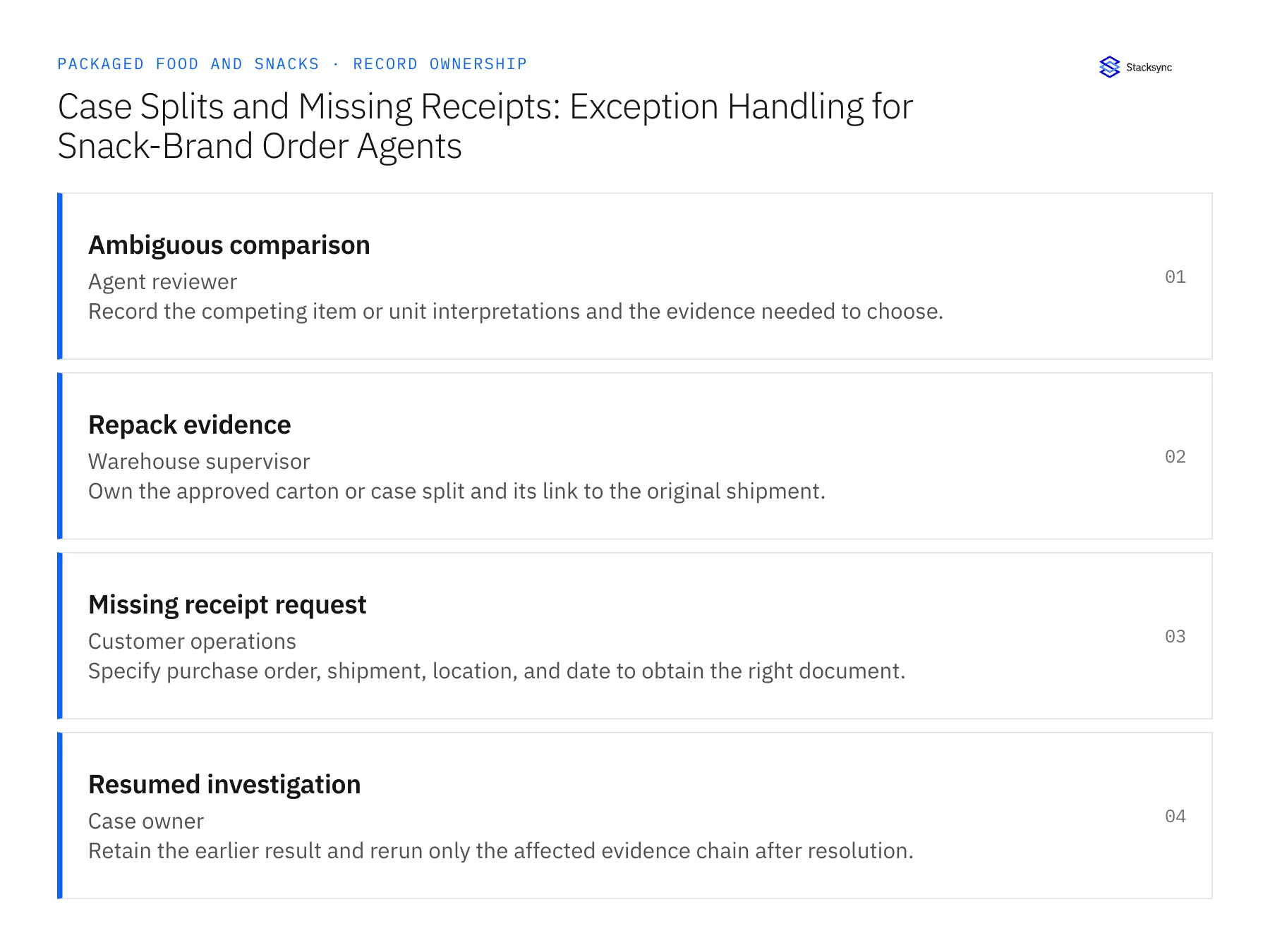
| Ambiguous comparison | Agent reviewer | Record the competing item or unit interpretations and the evidence needed to choose. |
| Repack evidence | Warehouse supervisor | Own the approved carton or case split and its link to the original shipment. |
| Missing receipt request | Customer operations | Specify purchase order, shipment, location, and date to obtain the right document. |
| Resumed investigation | Case owner | Retain the earlier result and rerun only the affected evidence chain after resolution. |
Work through the process
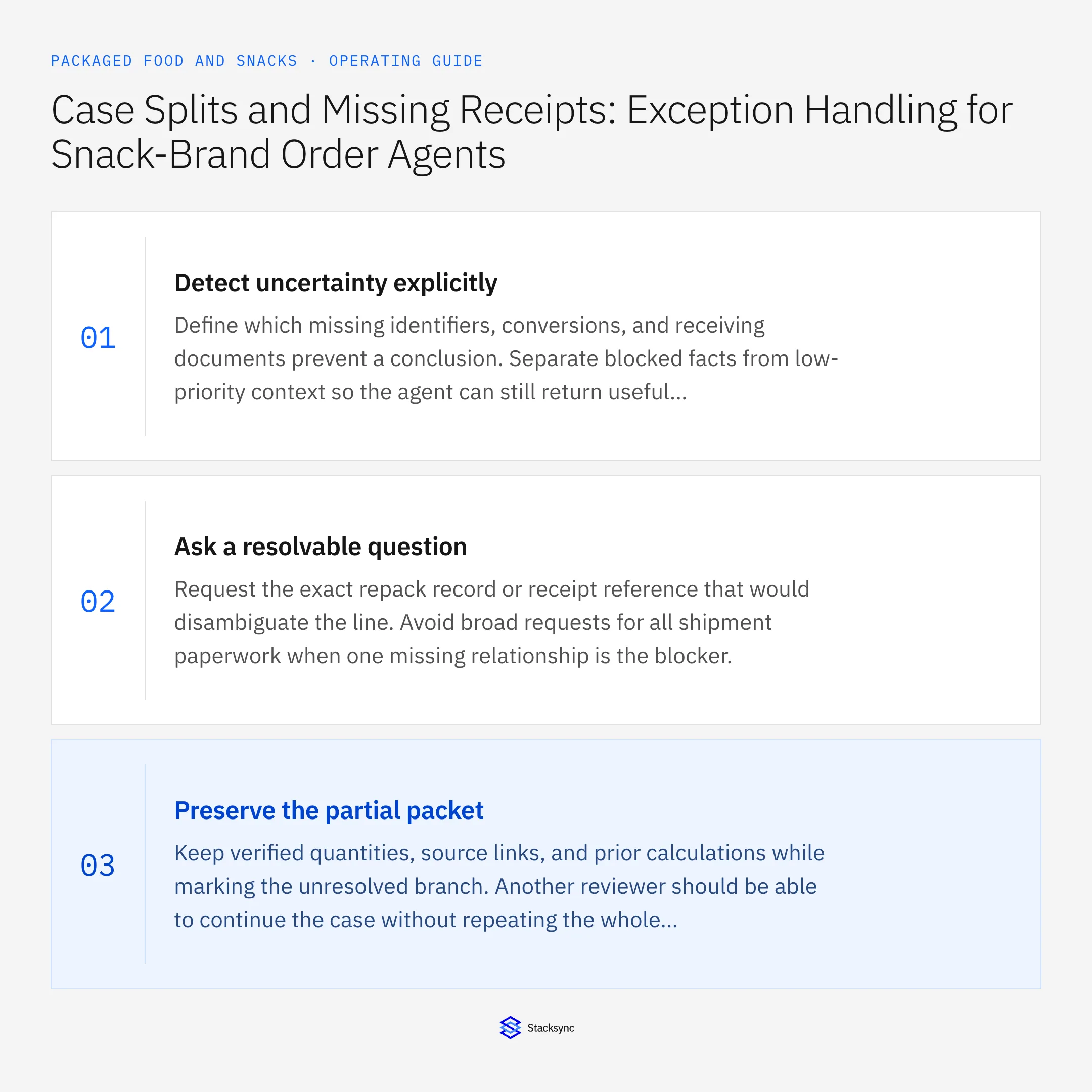
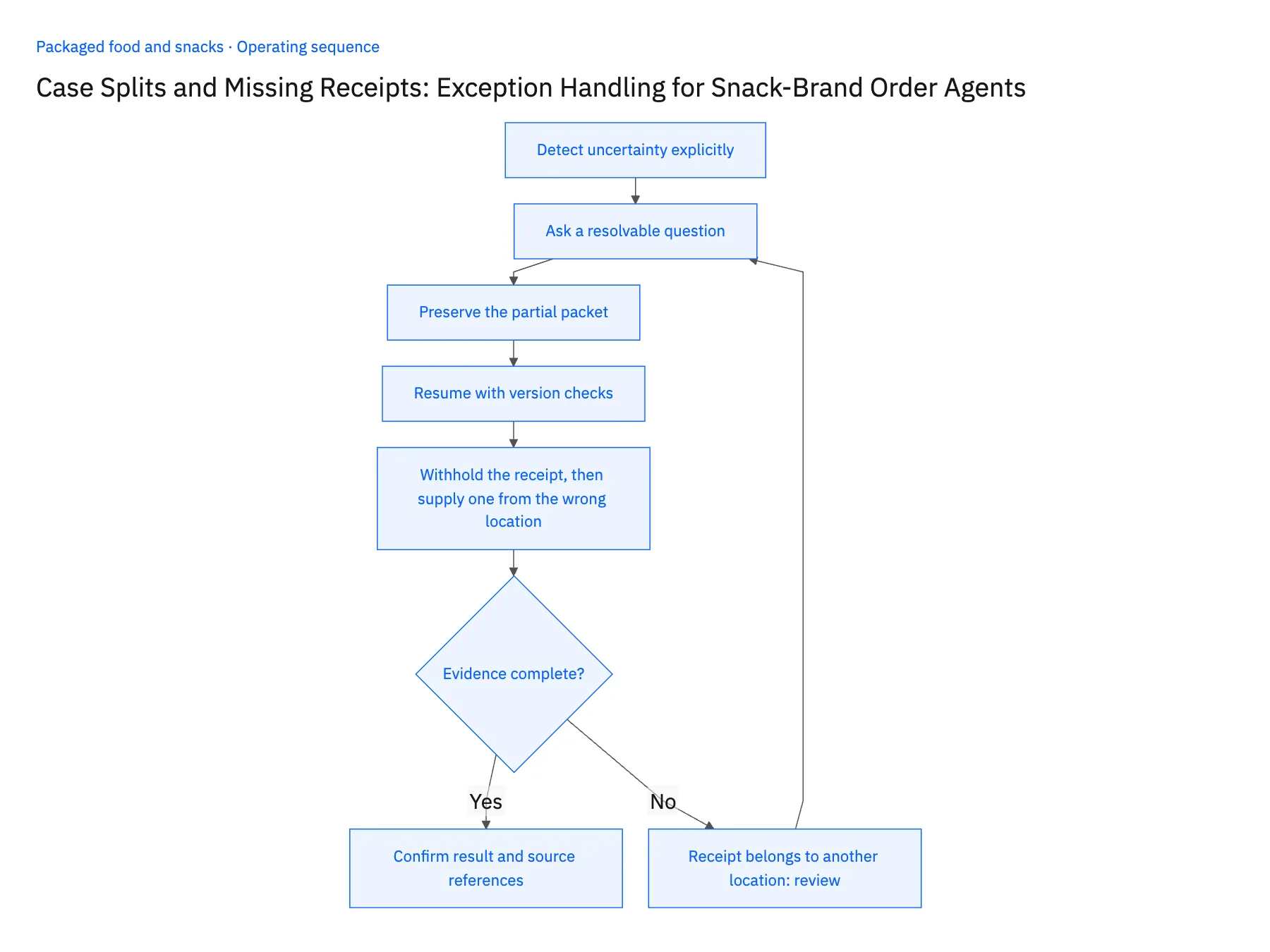
- 01Detect uncertainty explicitlyDefine which missing identifiers, conversions, and receiving documents prevent a conclusion. Separate blocked facts from low-priority context so the agent can still return useful verified findings.
- 02Ask a resolvable questionRequest the exact repack record or receipt reference that would disambiguate the line. Avoid broad requests for all shipment paperwork when one missing relationship is the blocker.
- 03Preserve the partial packetKeep verified quantities, source links, and prior calculations while marking the unresolved branch. Another reviewer should be able to continue the case without repeating the whole investigation.
- 04Resume with version checksWhen evidence arrives, confirm that it belongs to the same shipment and revision. Recalculate the affected comparison and show what changed before seeking approval of the updated conclusion.
- 05Withhold the receipt, then supply one from the wrong locationRun the repacked-carton scenario with the retailer receipt removed from Postgres. The Genie must return a named request stating the purchase order, shipment, location, and date it needs, and its packet must carry no delivery conclusion. A packet that treats the loose units as fulfillment of the case line without repack evidence stops the rollout. Then attach a receipt for a different delivery location that otherwise looks plausible. The Genie should reject the match and ask for the correct site's document. Supply the right receipt last and reopen the case; the resumed packet must show which fact arrived and which comparison it changed, while the earlier verified lines stay intact.
Handle the exceptions explicitly
Receipt belongs to another location
Reject the proposed match and request the correct destination evidence.
Pack factor changed mid-order
Apply the approved effective rule by line or stop for product review.
Uploaded document contradicts the ERP
Present the conflict to the record owner; do not silently choose the most recent-looking document.
What to verify before expanding
- A missing receipt produces a named evidence request rather than a fabricated conclusion.
- A resumed case shows which new fact changed the result.
- A receipt for another delivery location fails the claim match even when the item, date, and quantity look plausible.
- Resolving a repack factor recalculates only the affected lines and preserves the previously reviewed evidence for the other shipments.

Connect this process to the rest of your operation
Explore Stacksync AI agents (Genies) and scope the records and actions against your actual systems. Book a demo with a real ambiguous comparison example and the exception your team handles most often, for example receipt belongs to another location.
- AI Agents for Packaged Food Brands: Investigate Grocery Short-Shipment Claims
- Grocery EDI for Snack Brands: Keep Case Counts and Advance Ship Notices Consistent
- Shopify–NetSuite Sync for Snack Brands: Match Single Units, Multipacks, and Cases
- How to Explain Split Shipments and Missing Tracking
- Resolve Shopify Order Data Inconsistency with Real‑Time Sync
The shared architecture guide covers record matching, ownership, and recovery across systems.
Technical references
FAQ
Frequently asked questions










Related articles