







Keep fulfillment responsibility visible
Preserve the marketplace channel and order-line identity so FBA evidence remains distinct from orders the brand must fulfill.
 Salesforce
  HubSpot
  NetSuite
  Zendesk
  Microsoft Dynamics 365 Sales
  Dynamics 365 F&O
  Attio
Attio  Pipedrive
  Zoho CRM
  Campfire
  Rillet
  Front
Front  Shopify
  Amazon Seller Central
  SendGrid
 Packaged food and snacks
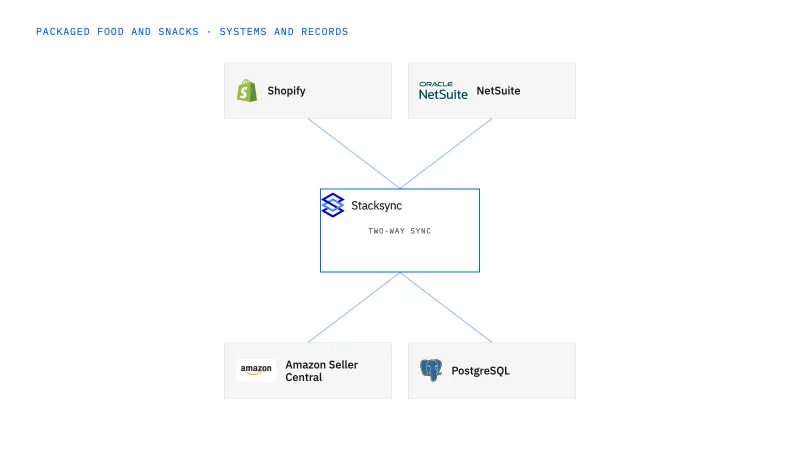
Bring Amazon order and marketplace evidence into the NetSuite reconciliation process while preserving fulfillment responsibility and pack identity. This fits food brands operating both FBA and merchant-fulfilled sales that need dependable downstream context for finance and operations. Amazon data is read-only through the sync connector.
The same snack SKU can appear in several fulfillment models, creating duplicate-shipment risk and difficult order reconciliation.
Explore your process in a demo, or get our shared two-way sync architecture guide.
When this fits
Packaged-food and snack manufacturers combining DTC, marketplaces, co-packing, and grocery distribution.
Preserve the marketplace channel and order-line identity so FBA evidence remains distinct from orders the brand must fulfill.
Connect seller-scoped offers to approved ERP item and case definitions rather than relying on familiar product names.
Orders, order lines, fee and refund entries and return reports arrive from Amazon Seller Central under read-only access. The sync never updates a listing, cancels an order or issues a refund on Amazon; those actions stay with the people authorized in Seller Central. On the NetSuite side, writes are object-scoped: the sync creates or updates only the transaction objects finance approves for each fulfillment model.
The process, end to end
A snack brand uses FBA for core multipacks and its own warehouse for seasonal offers. The finance team needs imported sales evidence, but the warehouse must receive only approved merchant-fulfilled work. A useful evaluation shows both channels side by side and proves that imported marketplace data does not indiscriminately trigger fulfillment.
Scope your implementation
Review current platform pricing alongside the records, volume, and actions in your process. Use your own operating baseline to evaluate the economics.
Explore your process in a demo, or get our shared two-way sync architecture guide.
From foundation to action
Keep shared customer, order, and operational records aligned, with clear field ownership.
Explore two-way sync 02Move approved work between systems, assign exceptions, and confirm the result.
Explore workflows 03Investigate cross-system questions, assemble the evidence, and prepare the next action.
Explore ai agents (genies) 04Connect trading-partner documents to operational records and exception handling.
Explore ediGo deeper
Snack brands selling bars, six-packs, and grocery cases need a dated pack recipe between each Shopify variant and its NetSuite line before orders reach ERP processing.
Keep FBA and merchant-fulfilled Amazon orders classified all the way into NetSuite so finance gets sales evidence and the warehouse only receives work the brand owns.
Food operations get one Postgres view of co-packer notices and NetSuite receipts, with each quantity kept apart and any ERP correction routed through an approved write path.
Explore all packaged food and snacks integration and automation guides ↗
The sync connector imports Amazon data into destination systems. Marketplace mutations require separately confirmed actions and authorization.
Classify before anything routes. The sync brings each Amazon order with its fulfillment channel, marketplace and line identifiers into NetSuite under read-only access, so the evidence arrives and no write goes back to Amazon. Marketplace operations stores an explicit classification on the order. Only orders confirmed as merchant-fulfilled become eligible for a warehouse request, and an order with no confirmed channel waits for a person rather than defaulting to your warehouse. Fees and refunds stay on the same order trail without creating shipment work.
Begin with two-way sync configured with read-only access on the Amazon Seller Central side, so orders and order lines land in NetSuite with their fulfillment channel and nothing writes back to Amazon. Then add workflows to release only confirmed merchant-fulfilled orders to your warehouse and to hold anything unclassified for marketplace operations. Genies follow, gathering the order, refund and return evidence behind a reconciliation question for finance to decide. EDI belongs to your grocery partners' purchase orders and ship notices; it plays no part in the Amazon channel.


