







Wholesale exception review
Route minimum-order and freight decisions before creating an accepted retailer order.
Explore workflows ↗ Salesforce
  HubSpot
  NetSuite
  Zendesk
  Microsoft Dynamics 365 Sales
  Dynamics 365 F&O
  Attio
Attio  Pipedrive
  Zoho CRM
  Campfire
  Rillet
  Front
Front  Shopify
  Amazon Seller Central
  SendGrid
 Pet food and treats
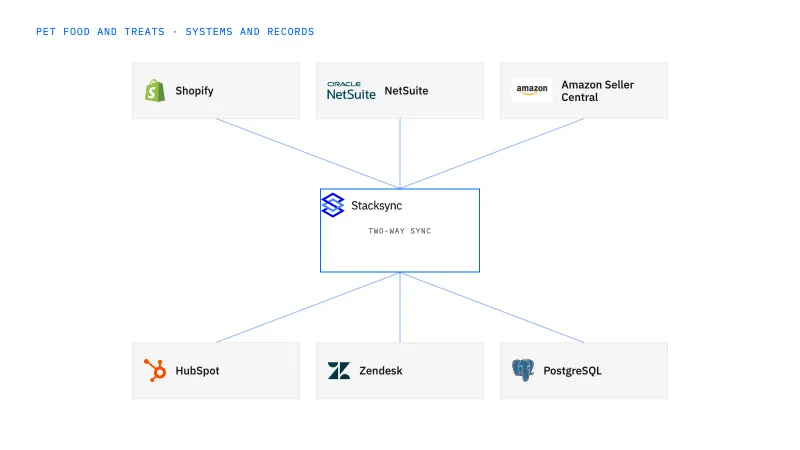
Connect pet-product ecommerce, independent retailer accounts, wholesale exceptions, approved lot holds, and complaint evidence.
Recipe, bag-size, order, and lot references are scattered when teams handle reorders, holds, or customer complaints.
Explore your process in a demo, or get our shared two-way sync architecture guide.
The platform, in operating order
Keep shared customer, order, and operational records aligned, with clear field ownership.
Explore two-way sync 02Move approved work between systems, assign exceptions, and confirm the result.
Explore workflows 03Investigate cross-system questions, assemble the evidence, and prepare the next action.
Explore ai agents (genies) 04Connect trading-partner documents to operational records and exception handling.
Explore ediBuilt around your operations
Pet food and treat brands combining production, DTC, marketplaces, independent retail, and wholesale distribution.
Route minimum-order and freight decisions before creating an accepted retailer order.
Explore workflows ↗Carry the quality owner’s decision into verified order operations and confirm the resulting state.
Explore workflows ↗A customizable Genie job that connects a complaint to available order, product, shipment, and production-lot evidence.
Explore Genies ↗Your systems and records
| Record | Owner | Operating rule |
|---|---|---|
| Pet-product variant | Product operations | Preserve recipe, bag size, treat pack, and variety-pack identity. |
| Independent retailer | Sales operations | Map buyer, legal payer, and store location before assigning order status. |
| Approved lot decision | Quality owner | Own the affected product and lot scope, action, approver, and effective time. |
| Complaint evidence | Support | Preserve the customer’s original description and connect it only to verified order and lot references. |
Retailer product codes, recipe and bag-size identity, and case-level order and shipment quantities.
Evaluate your next process
Connect pet-product ecommerce orders to the exact recipe, bag size, and variety-pack definition in the ERP.
Connect pet-product marketplace return and refund evidence to the original order and ERP context.
Carry a quality owner’s approved lot-hold decision into verified order and warehouse operations.
Configure a Genie to assemble the operational evidence behind a pet-food complaint: original report, order, exact product, shipment, and available lot relationships.
Implementation and operating guides
One recipe in two bag sizes plus a trial pack should reach NetSuite as the same distinct products the customer chose in Shopify.
A refund for a variety pack sold weeks ago gets matched to its original Amazon order line and the pack contents on that date, not to today's catalog.
Reps see which store already has an accepted NetSuite order on the way, while the retailer's central payer and each location stay separate records in HubSpot.
Under-minimum and free-freight requests from independent stores go to the person with authority, and the approved terms stay attached to the NetSuite order.
A quality manager's hold on one lot at two warehouses becomes a checklist of confirmed NetSuite actions, open manual tasks, and escalations for goods already gone.
Support gets a sourced packet that ties the customer's own words to the exact recipe, bag, and shipment, and hands any unresolved lot code to quality.
A tracing job that knows when to stop: partial codes and split shipments stay as candidates, and quality sees exactly which fact would close each branch.
A retailer's case order for the small bag lands in NetSuite as that bag and case count, not the larger bag or the trial pack that shares its recipe name.
Through the approved lot-hold handoff workflow, which carries the decision rather than making one. The quality owner records the approved lot decision with the affected product and lot scope, the action, the approver, and the effective time. The workflow then applies that scope to verified order records in NetSuite and confirms the resulting state back to the quality owner. It does not widen the scope, guess at an unlisted lot, or lift the hold; only a new approved decision changes it.
It routes the concern to the responsible team and keeps tracing the order. The Genie preserves the complaint evidence exactly as the customer described it, including any lot text, and connects it only to verified order and product references such as the pet-product variant and its shipment. It lists every link it confirmed and every point of ambiguity. It does not diagnose, judge product safety, or start a recall; those calls belong to the quality owner and support, who receive the trace.
Listing edits, order cancellations, and marketplace refunds all stay in Seller Central. The Amazon Seller Central connector imports marketplace evidence with read-only access; it does not update listings, cancel Amazon orders, or issue marketplace refunds. What it provides is the marketplace order and any return it reports, matched to the pet-product variant so recipe and bag size are correct when NetSuite books the outcome. Warehouse and commerce actions are scoped separately from that import.
Bring one real process
Bring the systems, record types, and exceptions your team handles today. We’ll scope the connections and actions, then walk through the path to a confirmed result.
Explore your process in a demo, or get our shared two-way sync architecture guide.


