Amazon–NetSuite Sync for Pet Brands: Reconcile Marketplace Returns and Original Orders
A refund for a variety pack sold weeks ago gets matched to its original Amazon order line and the pack contents on that date, not to today's catalog.
- Author
- Ruben Burdin · Founder & CEO
- Published
- Read time
- 5 min read
The operating decision
Use Amazon marketplace evidence to connect pet-product returns to the original seller offer, order line, and approved ERP representation. Keep return, refund, and physical receipt as separate facts. The sync connector has read-only Amazon access, and marketplace evidence should not automatically create a warehouse receipt or financial adjustment.
Explore the complete pet food and treats integration and automation hub for the systems and processes around this guide.
What this looks like in pet food and treats
A pet brand sees a refund for a variety pack sold several weeks earlier. The catalog now uses a different assortment, and the returned item has not reached the brand’s warehouse. Finance needs the original order context, while operations must avoid assuming that today’s pack definition or a refund event establishes what physically came back.
Records, ownership, and update rules
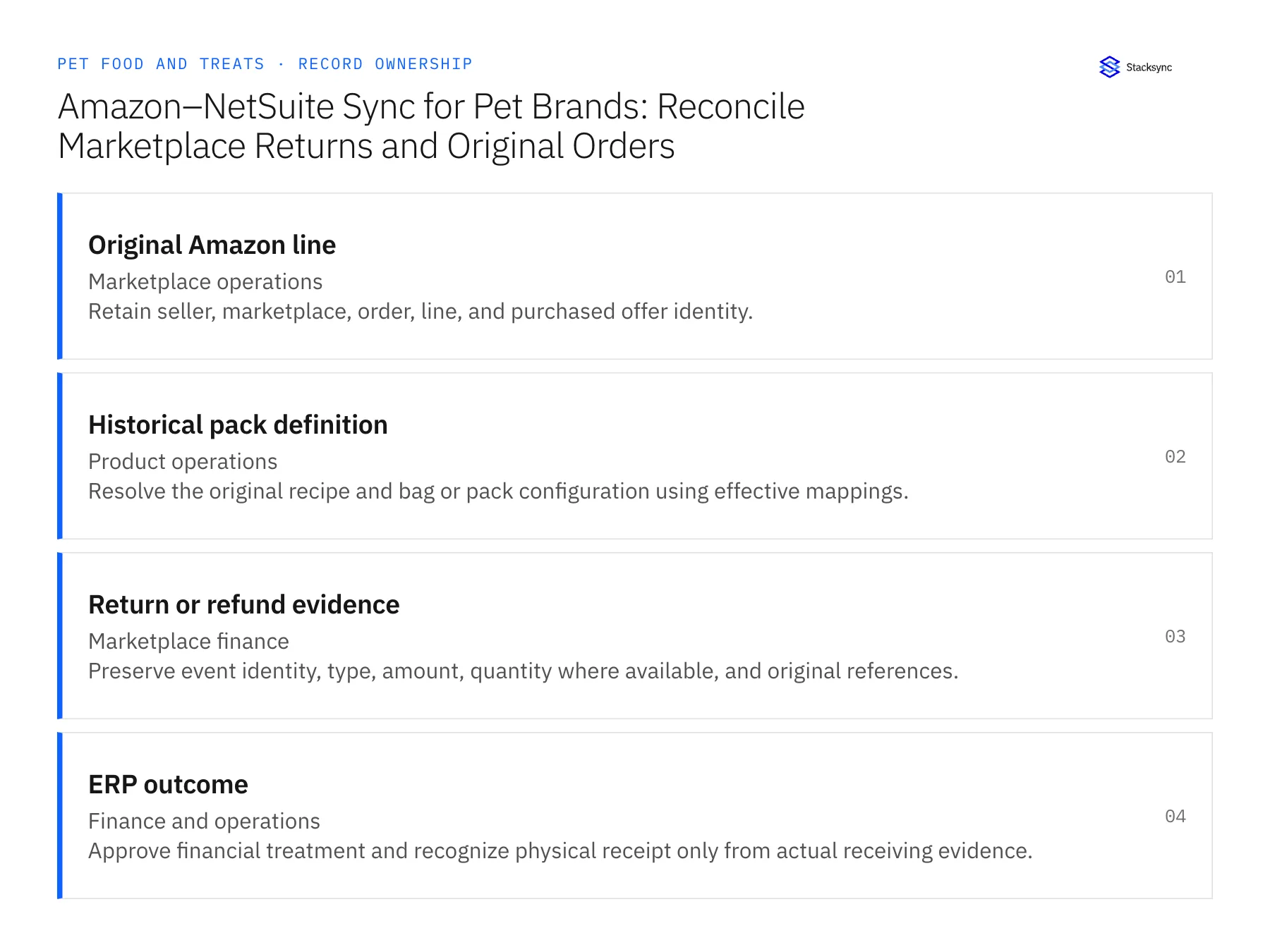
| Record | Owner | Operating rule |
|---|---|---|
| Original Amazon line | Marketplace operations | Retain seller, marketplace, order, line, and purchased offer identity. |
| Historical pack definition | Product operations | Resolve the original recipe and bag or pack configuration using effective mappings. |
| Return or refund evidence | Marketplace finance | Preserve event identity, type, amount, quantity where available, and original references. |
| ERP outcome | Finance and operations | Approve financial treatment and recognize physical receipt only from actual receiving evidence. |
Work through the process
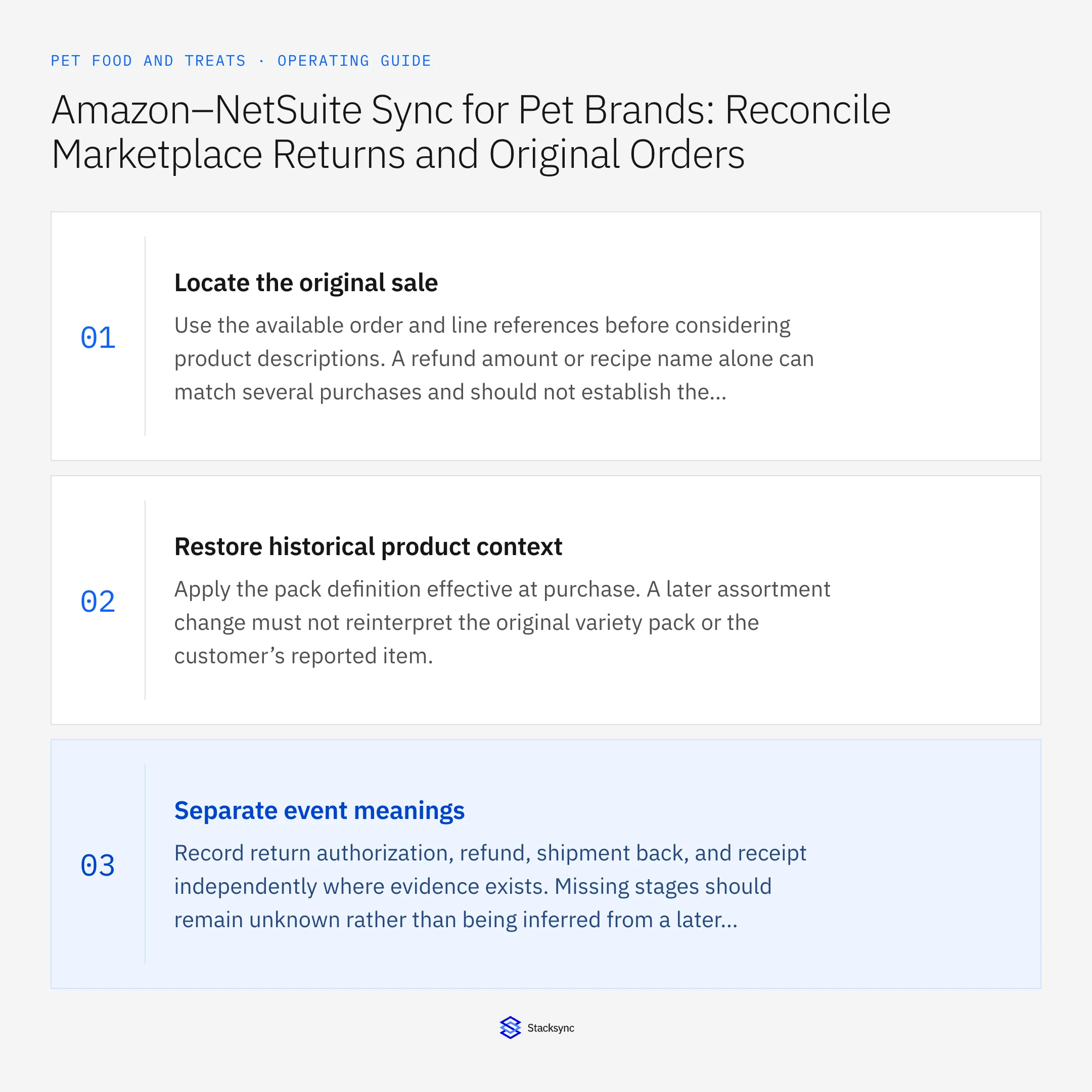
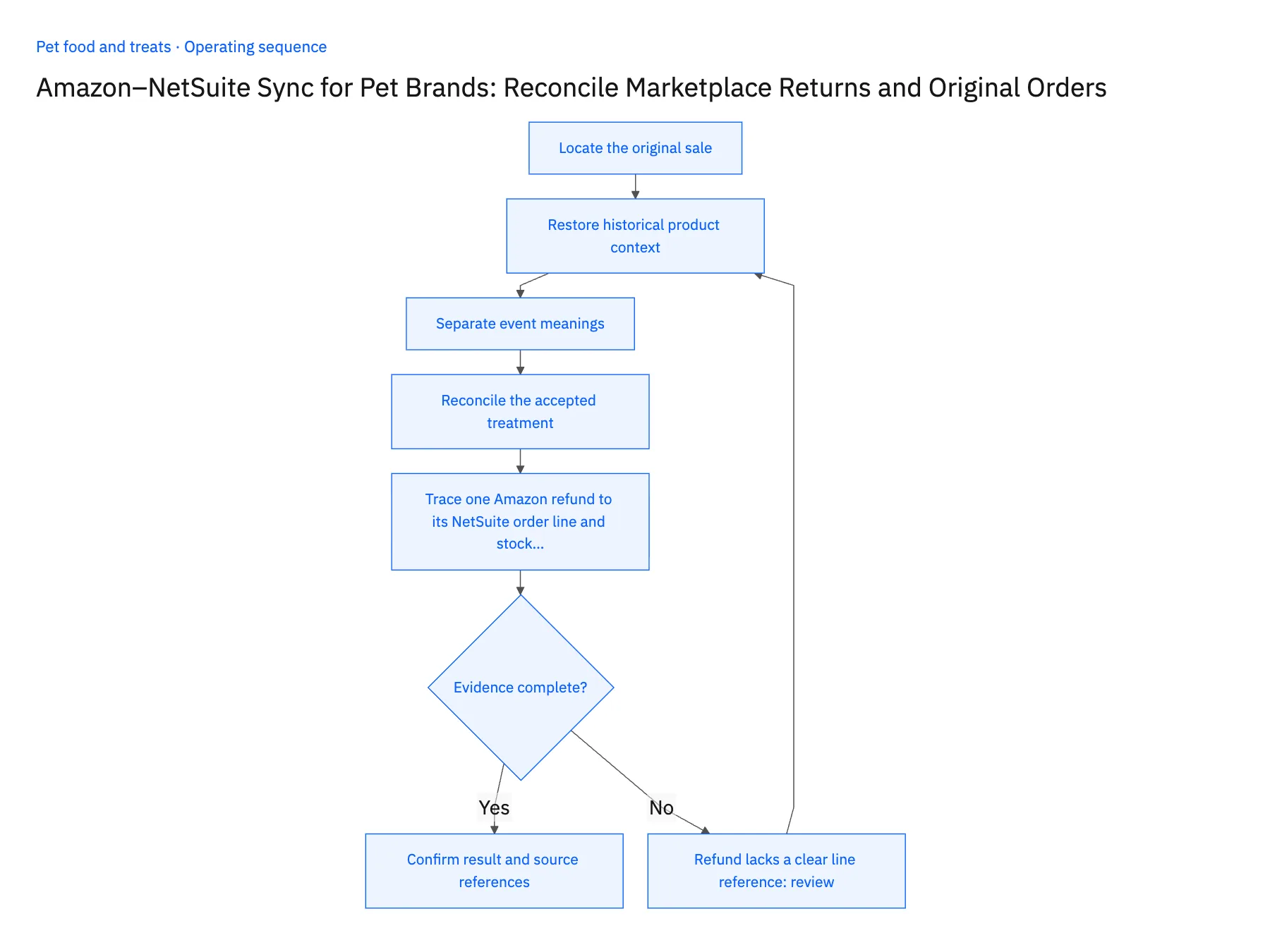
- 01Locate the original saleUse the available order and line references before considering product descriptions. A refund amount or recipe name alone can match several purchases and should not establish the relationship.
- 02Restore historical product contextApply the pack definition effective at purchase. A later assortment change must not reinterpret the original variety pack or the customer’s reported item.
- 03Separate event meaningsRecord return authorization, refund, shipment back, and receipt independently where evidence exists. Missing stages should remain unknown rather than being inferred from a later financial event.
- 04Reconcile the accepted treatmentLet finance approve the ERP representation and keep the source event reference. Let receiving establish any physical stock outcome through its own verified record and disposition process.
- 05Trace one Amazon refund to its NetSuite order line and stock countPick a refund event Amazon reported last month for a variety pack whose assortment has since changed. In NetSuite, open the imported event and confirm it carries the seller-scoped order ID and line reference, and that the linked item is the pack as sold on the order date, not the current one. Next, check the returns location: on-hand quantity must be unchanged, because no receiving transaction exists yet. Then test a refund whose line reference is blank. It should sit unresolved with the amount visible and no order attached. A refund that raises inventory, or a blank reference that attaches itself to the nearest order, stops the rollout.
Handle the exceptions explicitly
Refund lacks a clear line reference
Keep the amount unresolved and obtain the reliable original-order relationship.
Current pack differs from the purchase
Use historical mapping evidence and preserve the discrepancy.
No brand warehouse receipt exists
Do not create returned inventory solely from the marketplace refund.
What to verify before expanding
- Every resolved return links to the correct original seller-scoped order line.
- A refund event cannot imply physical receipt or resaleable stock.
- An Amazon refund without brand receiving evidence creates no warehouse receipt or returned-inventory increase.
- A changed current pack definition leaves the original marketplace recipe and quantity interpretation available for return review.

Connect this process to the rest of your operation
Explore Stacksync two-way sync and scope the records and actions against your actual systems. Book a demo with a real original Amazon line example and the exception your team handles most often, for example refund lacks a clear line reference.
- Shopify–NetSuite Integration for Pet Food and Treat Brands
- Amazon–NetSuite Integration for Pet Product Returns
- HubSpot–NetSuite Sync for Pet Food Brands: Connect Independent Retailers and Reorder Status
- Pet Food Wholesale Workflows: Route Minimum-Order and Freight Exceptions
- Pet Food Lot-Hold Workflows: Carry Approved Quality Decisions Into Order Operations
- Automate Shopify Order Status Replies in Slack
- NetSuite Ecommerce Integration: Boost Efficiency & Sales
The shared architecture guide covers record matching, ownership, and recovery across systems.
Technical references
FAQ
Frequently asked questions










Related articles