







Assemble a sourced trace
Connect the original complaint to verified order and operational references while retaining the customer’s own wording.
 Salesforce
  HubSpot
  NetSuite
  Zendesk
  Microsoft Dynamics 365 Sales
  Dynamics 365 F&O
  Attio
Attio  Pipedrive
  Zoho CRM
  Campfire
  Rillet
  Front
Front  Shopify
  Amazon Seller Central
  SendGrid
 Pet food and treats
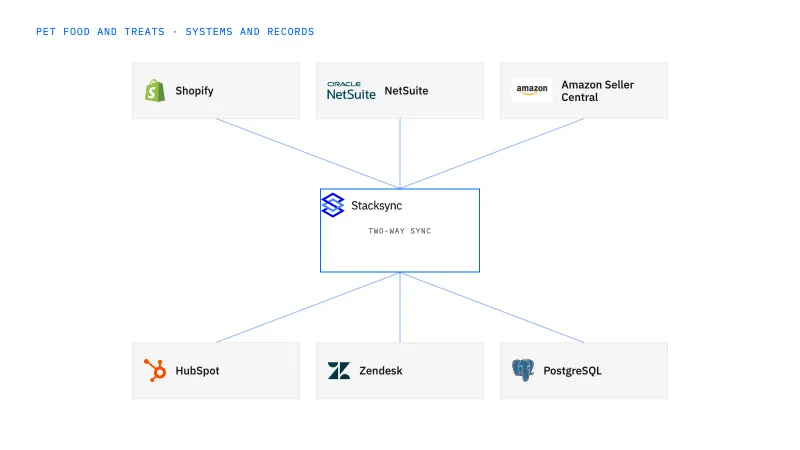
Configure a Genie to assemble the operational evidence behind a pet-food complaint: original report, order, exact product, shipment, and available lot relationships. This fits support and quality teams that currently gather the same facts across several systems. The agent makes confirmed links and uncertainty visible for review.
Support can find the order but still spends time resolving mixed recipes, partial bag codes, and missing shipment-to-lot links.
Explore your process in a demo, or get our shared two-way sync architecture guide.
When this fits
Pet food and treat brands combining production, DTC, marketplaces, independent retail, and wholesale distribution.
Connect the original complaint to verified order and operational references while retaining the customer’s own wording.
List candidate products, missing links, and precise evidence requests rather than presenting a likely match as confirmed.
The Genie reads the Zendesk ticket, the NetSuite order line, and the shipment and lot tables in Postgres. It writes a trace packet with cited links and open questions. It does not edit the customer's complaint, post a reply, place a hold, or credit an order. Safety judgment, hold decisions, and any customer response stay with the quality reviewer and support under your approval rules.
The process, end to end
A customer supplies an order number and an incomplete bag-code photo after buying a variety pack. A useful demo should preserve the original report, identify confirmed product and shipment facts, and route the missing lot evidence to quality without guessing a batch or making a health conclusion.
Scope your implementation
Review current platform pricing alongside the records, volume, and actions in your process. Use your own operating baseline to evaluate the economics.
Explore your process in a demo, or get our shared two-way sync architecture guide.
From foundation to action
Keep shared customer, order, and operational records aligned, with clear field ownership.
Explore two-way sync 02Move approved work between systems, assign exceptions, and confirm the result.
Explore workflows 03Investigate cross-system questions, assemble the evidence, and prepare the next action.
Explore ai agents (genies) 04Connect trading-partner documents to operational records and exception handling.
Explore ediGo deeper
Support gets a sourced packet that ties the customer's own words to the exact recipe, bag, and shipment, and hands any unresolved lot code to quality.
A tracing job that knows when to stop: partial codes and split shipments stay as candidates, and quality sees exactly which fact would close each branch.
Explore all pet food and treats integration and automation guides ↗
No. This job assembles operational evidence and routes it to the responsible team. It should not diagnose, infer safety, or initiate an unapproved action.
It keeps the customer's exact characters and leaves gaps unfilled. The NetSuite order line narrows the purchase to its recipes and bag sizes; for a variety pack shipped in two parcels, each plausible product stays listed with its evidence. It drafts a follow-up for support requesting the full code or a clearer package photo without suggesting a code that might steer the answer. Until a verified shipment-to-lot record in Postgres confirms one candidate, the packet lists the lot as unresolved and names quality as the next owner.
Two-way sync comes first so Zendesk tickets, NetSuite order lines, and the Postgres shipment and lot tables share stable identifiers. Workflows come next for handoffs with fixed rules, such as moving an approved hold into order operations. Genies are the product this page is about: configure the complaint trace job once those records are connected, and let it build the packet a quality reviewer signs off on. EDI applies later, when retailer purchase orders and shipment notices need the same product identity.


