Manufacturing CRM and ERP ownership: decide who controls each order field
A field ownership matrix gives each order decision one owner, so a CRM edit becomes a request and a planning date, quality release or credit hold cannot be overwritten.
- Author
- Ruben Burdin · Founder & CEO
- Published
- Read time
- 4 min read

The operating decision
Manufacturing CRM–ERP field ownership should be defined by the business decision represented by a field. Sales owns a requested delivery date; planning owns the accepted promise; quality owns release; finance owns credit. Two-way sync should carry these decisions without collapsing them into a single editable value. Document identity, allowed direction, revision behavior and exception ownership for the small set of fields that trigger work before expanding into a broader data program.
Explore the complete manufacturing integration and automation hub for the systems and processes around this guide.
What this looks like in manufacturing
A mid-market manufacturer connects its CRM and ERP to reduce status-checking emails. Initially, both applications expose a field called delivery date. Sales updates it after a customer call, while planning updates it after a machine outage. Each synchronization overwrites the other team’s value, and nobody can explain which commitment was accepted. Splitting the requested date from the planned and confirmed dates resolves the semantic conflict. The integration can then transmit the request, route the review and return the decision without pretending the two edits meant the same thing.
Records, ownership, and update rules
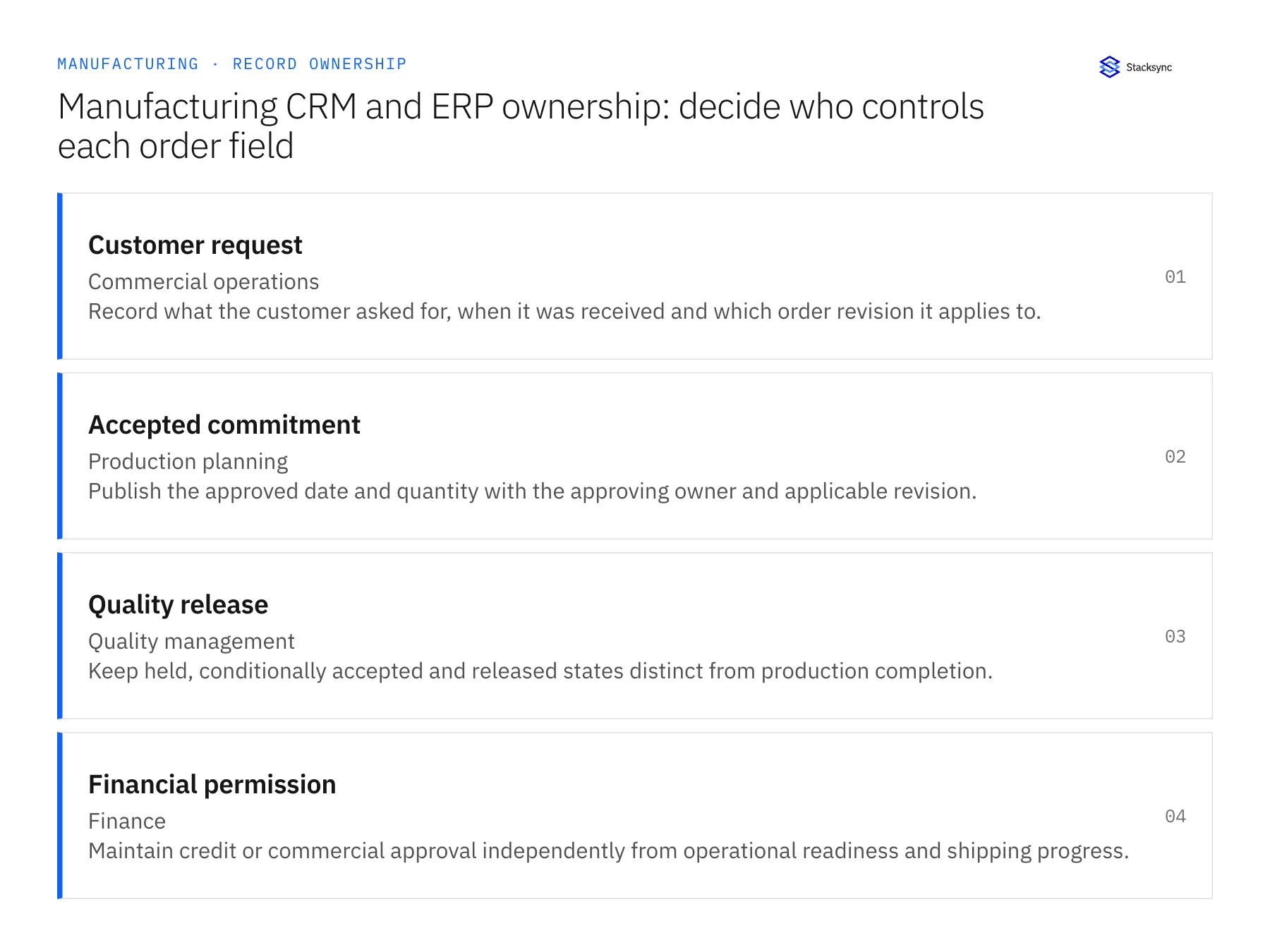
| Record | Owner | Operating rule |
|---|---|---|
| Customer request | Commercial operations | Record what the customer asked for, when it was received and which order revision it applies to. |
| Accepted commitment | Production planning | Publish the approved date and quantity with the approving owner and applicable revision. |
| Quality release | Quality management | Keep held, conditionally accepted and released states distinct from production completion. |
| Financial permission | Finance | Maintain credit or commercial approval independently from operational readiness and shipping progress. |
Work through the process
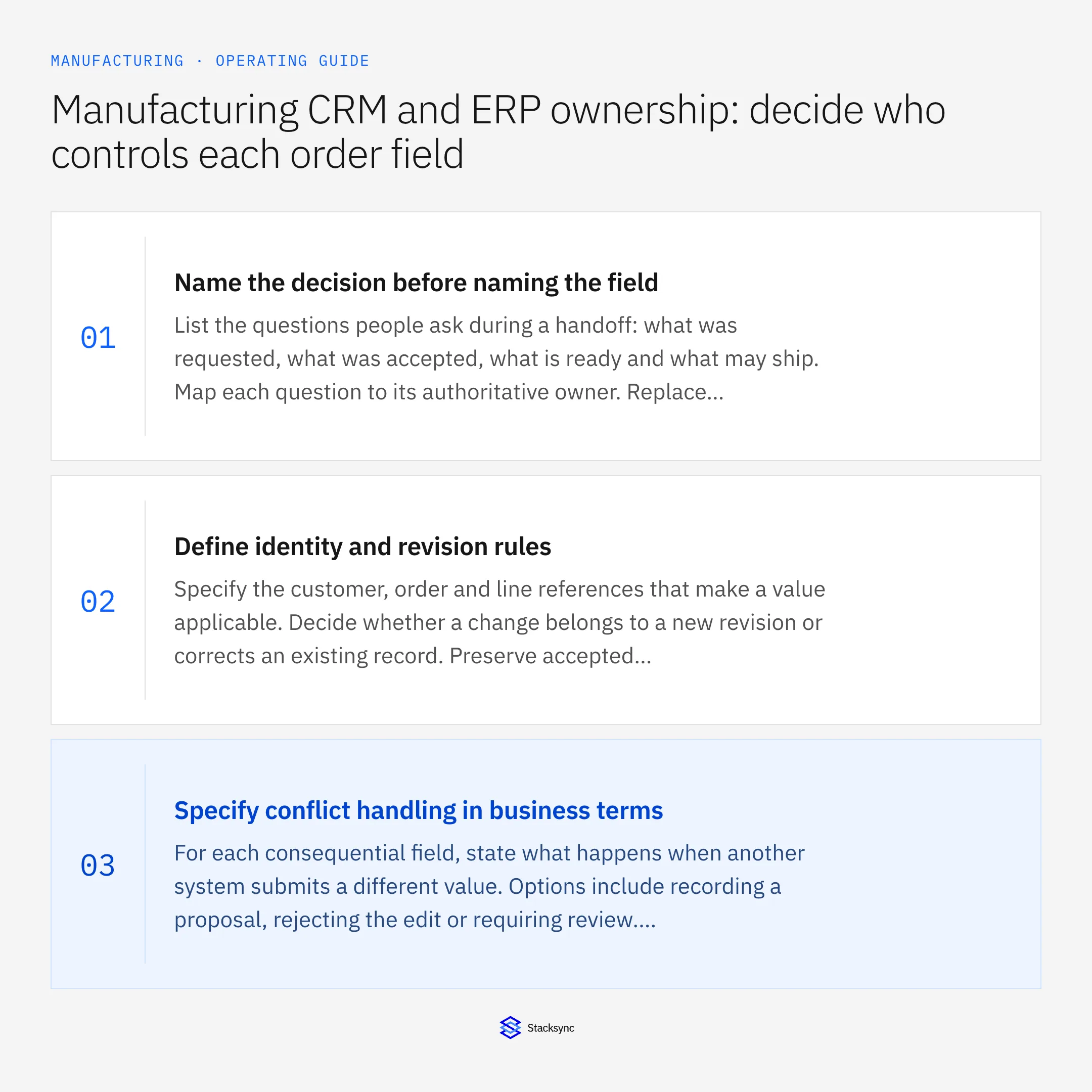
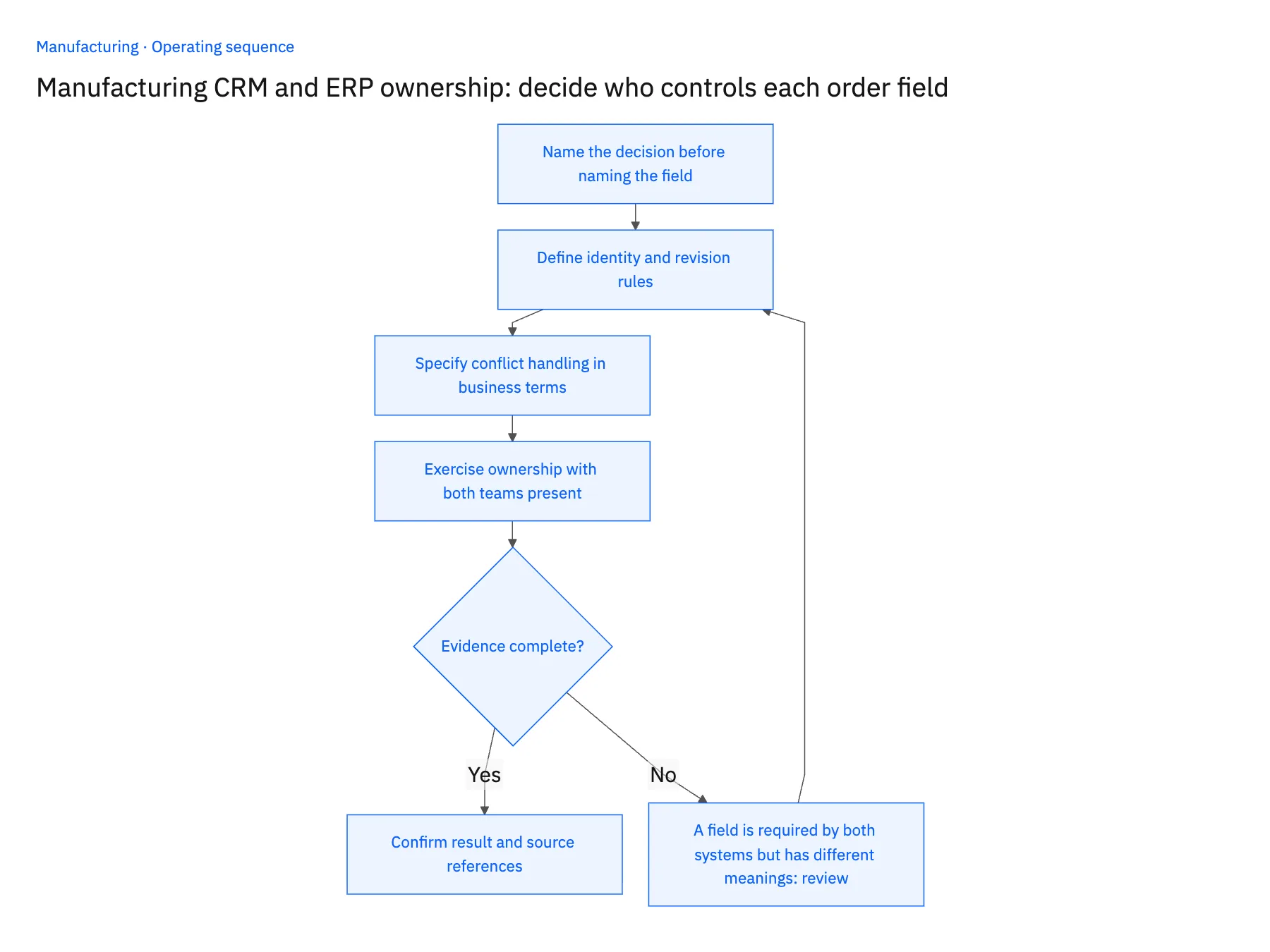
- 01Name the decision before naming the fieldList the questions people ask during a handoff: what was requested, what was accepted, what is ready and what may ship. Map each question to its authoritative owner. Replace overloaded labels with explicit meanings before choosing a synchronization direction.
- 02Define identity and revision rulesSpecify the customer, order and line references that make a value applicable. Decide whether a change belongs to a new revision or corrects an existing record. Preserve accepted history when later requests arrive, particularly after materials are committed or production has started.
- 03Specify conflict handling in business termsFor each consequential field, state what happens when another system submits a different value. Options include recording a proposal, rejecting the edit or requiring review. Last-write-wins is appropriate only when the business deliberately accepts that behavior for the selected data.
- 04Exercise ownership with both teams presentUse a sample containing an approved order, a changed request and a hold. Ask sales and operations to edit their respective fields. Inspect which values moved, which requests await review and what an ordinary user sees. Record disagreements as policy decisions, not just mapping defects.
Handle the exceptions explicitly
A field is required by both systems but has different meanings
Create separate requested and accepted representations, or transform through an explicit rule. Do not solve a semantic disagreement by choosing whichever system updated last.
No team accepts ownership
Keep the field out of an automated decision until a process owner is named. Publishing a value without an accountable owner creates a faster disagreement.
An approved value is corrected retrospectively
Record the correction and its effective scope. Reconcile dependent records without rewriting the history of actions already taken on the earlier approval.
What to verify before expanding
- Each production-triggering field has one named owner and an allowed update path.
- A new customer request cannot silently replace an accepted production commitment.
- Quality hold and credit hold remain independently visible when production is complete.
- Users can explain why an update was accepted, rejected or routed for review.

Connect this process to the rest of your operation
Explore Stacksync two-way sync and scope the records and actions against your actual systems. Book a demo with a real customer request example and the exception your team handles most often, for example A field is required by both systems but has different meanings.
- Salesforce and Acumatica for manufacturing: turn an approved quote into a traceable order
- Manufacturing order revisions after production release: automate the review handoff
- Supplier-delay workflows for manufacturers: connect PO confirmations to customer commitments
- Real-Time Sync for Manufacturing ERP & Shop Floor Data
- Making SQL Server and NetSuite Agree on the Same Record
The shared architecture guide covers record matching, ownership, and recovery across systems.
Technical references
FAQ
Frequently asked questions










Related articles