


















EDI for Automotive Suppliers and OEMs: Powering Real-Time Manufacturing Communication
Learn how EDI for automotive suppliers and OEMs supports Just In Time production, DELFOR, DELJIT, ASN automation, and real-time supply chain visibility.
- Author
- Ruben Burdin · Founder & CEO
- Published
- Updated
- Read time
- 7 min read

What Is EDI for Automotive Suppliers and OEMs?
EDI for automotive suppliers and OEMs enables automated, standardized electronic communication across the automotive supply chain. It connects original equipment manufacturers, Tier 1 suppliers, Tier 2 suppliers, logistics providers, and distributors through structured digital messages such as forecasts, shipment notices, and invoices. In an industry built on Just In Time production and lean manufacturing, EDI is the backbone of synchronized operations.
Key Takeaways
- EDI for automotive suppliers and OEMs enables synchronized production, accurate forecasting, and compliant shipment execution across complex supply chains.
- Batch-based EDI systems introduce latency and operational risk that conflict with Just In Time manufacturing models.
- Modern real-time EDI architectures that integrate directly with databases enhance visibility, reduce disruptions, and support scalable collaboration between OEMs and Tier suppliers.
Why EDI Is Foundational in the Automotive Industry
Automotive manufacturing depends on precision timing. Production lines cannot afford delays in component delivery, shipment confirmation, or demand forecasting.
OEMs rely on Tier suppliers for thousands of parts, each governed by strict production schedules. Suppliers depend on accurate forecasts and delivery sequences to plan capacity, manage inventory, and meet compliance standards.
EDI enables this coordination by replacing manual communication with standardized, automated data exchange.
Core Automotive EDI Messages
The automotive ecosystem uses specific EDI standards to maintain operational flow.
- DELFOR or X12 830 for delivery forecasts
- DELJIT or X12 862 for just in time delivery schedules
- DESADV or 856 ASN for shipment confirmation
- INVOIC or 810 for invoicing
- 997 functional acknowledgments for validation
Accurate processing of these documents ensures production continuity and financial alignment.
For deeper insight into automating these transactions, explore this guide on EDI 850, 855, and 856 automation.
Just In Time, Lean Manufacturing, and Real-Time EDI
Just In Time production reduces inventory buffers and requires parts to arrive exactly when needed. Lean manufacturing removes inefficiencies and non-value activities.
Both models depend on reliable and continuous EDI communication. Delays or errors can halt assembly lines, increase costs, and damage supplier relationships.
Traditional batch-based EDI systems often introduce latency and fragility. Learn more about why older systems struggle in modern environments in this analysis of why traditional EDI systems are slow and brittle.
Common EDI Challenges for Automotive Suppliers
Forecast Inaccuracy
If DELFOR messages are delayed or misinterpreted, suppliers cannot plan production accurately.
Shipment Compliance Risks
Late or incorrect DESADV transmissions trigger penalties and disrupt receiving operations.
Engineering Change Complexity
Frequent updates to specifications require fast synchronization across multiple tiers.
Data Silos
Disconnected ERP, warehouse, and logistics systems create visibility gaps.
For a breakdown of recurring supply chain issues, see this overview of common EDI errors in the supply chain.
Batch vs Real-Time EDI in Automotive Supply Chains
| Integration Model | Data Speed | Production Impact | Risk Level |
|---|---|---|---|
| Manual or Batch EDI | 15–60 minute delays between updates | Slower response to demand shifts and supply changes | High disruption risk across operations |
| One-Way Sync | Partial visibility with delayed reverse updates | Limited coordination between systems and teams | Medium operational risk |
| Real-Time Bi-Directional EDI | Sub-second updates across connected systems | Synchronized manufacturing and fulfillment flow | Reduced operational and disruption risk |
Key Takeaways
Manual and batch EDI models introduce latency that slows production decisions and increases the risk of operational disruptions.
One-way synchronization improves automation but still limits full coordination across manufacturing and supply chain systems.
Real-time bi-directional EDI enables synchronized production flows, faster responses to demand shifts, and significantly lower operational risk.
In high-volume automotive production, even minutes of delay can cascade across suppliers.
To understand how continuous processing improves resilience, review this explanation of real-time EDI processing.
Modernizing Automotive EDI Architecture
Automotive organizations are shifting away from rigid file-based gateways toward integration layers that parse EDI documents directly into operational systems.
Instead of relying on legacy parsers, modern architectures convert EDI into structured database records that ERP systems can consume instantly.
Learn how EDI files can be transformed into SQL-ready data in this guide on parsing EDI files into a SQL database.
This approach improves traceability, simplifies troubleshooting, and enhances cross-tier visibility.
EDI Integrations Across Retail and Distribution Channels
Automotive suppliers frequently sell components beyond OEM channels into retail and aftermarket distribution.
Connecting seamlessly with major retailers requires reliable EDI integration. Examples include:
Automotive suppliers expanding into retail can connect with partners such as Amazon EDI integration, Walmart EDI integration, and Costco EDI integration. Additional retailer connectivity includes The Home Depot EDI integration, Walgreens EDI integration, and CVS Health via MercuryGate EDI integration.
Managing multiple trading partner requirements manually increases complexity and risk.
For broader partner connectivity and technical capabilities, explore the full Stacksync EDI platform overview.
Simplifying Automotive EDI with Modern Platforms
Legacy EDI environments often require stitching together separate tools for file transfer, transformation, monitoring, and workflow automation.
Modern platforms are designed differently. Stacksync transforms legacy EDI complexity into simple database interactions. Incoming EDI documents are parsed directly into database tables, while outgoing data is automatically converted back into compliant EDI formats. Automotive suppliers can manage supply chain communication using SQL instead of fragile file parsers.
Six products. One platform. Zero batch windows. Real-time sync, workflow automation, event queues, databases, EDI, and monitoring operate together without stitching multiple integration tools.
This unified approach reduces operational overhead while improving reliability for OEM and Tier communications.

Scalable EDI Integrations for Every Trading Partner
Automotive suppliers work with global OEMs, logistics providers, and aftermarket retailers, each with unique protocol and message requirements.
Pre-built EDI connectors allow organizations to connect to trading partners faster, go live in days instead of months, and reduce onboarding friction.
For companies evaluating modernization strategies, Stacksync provides EDI integrations for every trading partner while eliminating batch windows and manual reconciliation.
Why Explore Stacksync for Automotive EDI
Automotive supply chains demand precision, speed, and traceability. Platforms that parse EDI directly into databases and enable real-time synchronization provide operational advantages beyond simple document exchange.
By combining EDI, workflow automation, event queues, and monitoring into a single platform, organizations reduce technical complexity and improve data visibility across OEM and supplier networks.
For teams seeking to modernize legacy EDI systems and eliminate brittle infrastructure, Stacksync offers a path toward real-time automotive integration without rebuilding core ERP systems.
Apply this in automotive components: incoming release evidence and accepted comparison state
Automotive supplier communication needs firm-order and revision identity preserved from the partner document into operational review. The linked guides compare release changes and distinguish accepted demand from forecasts without assuming a new message should create another order.
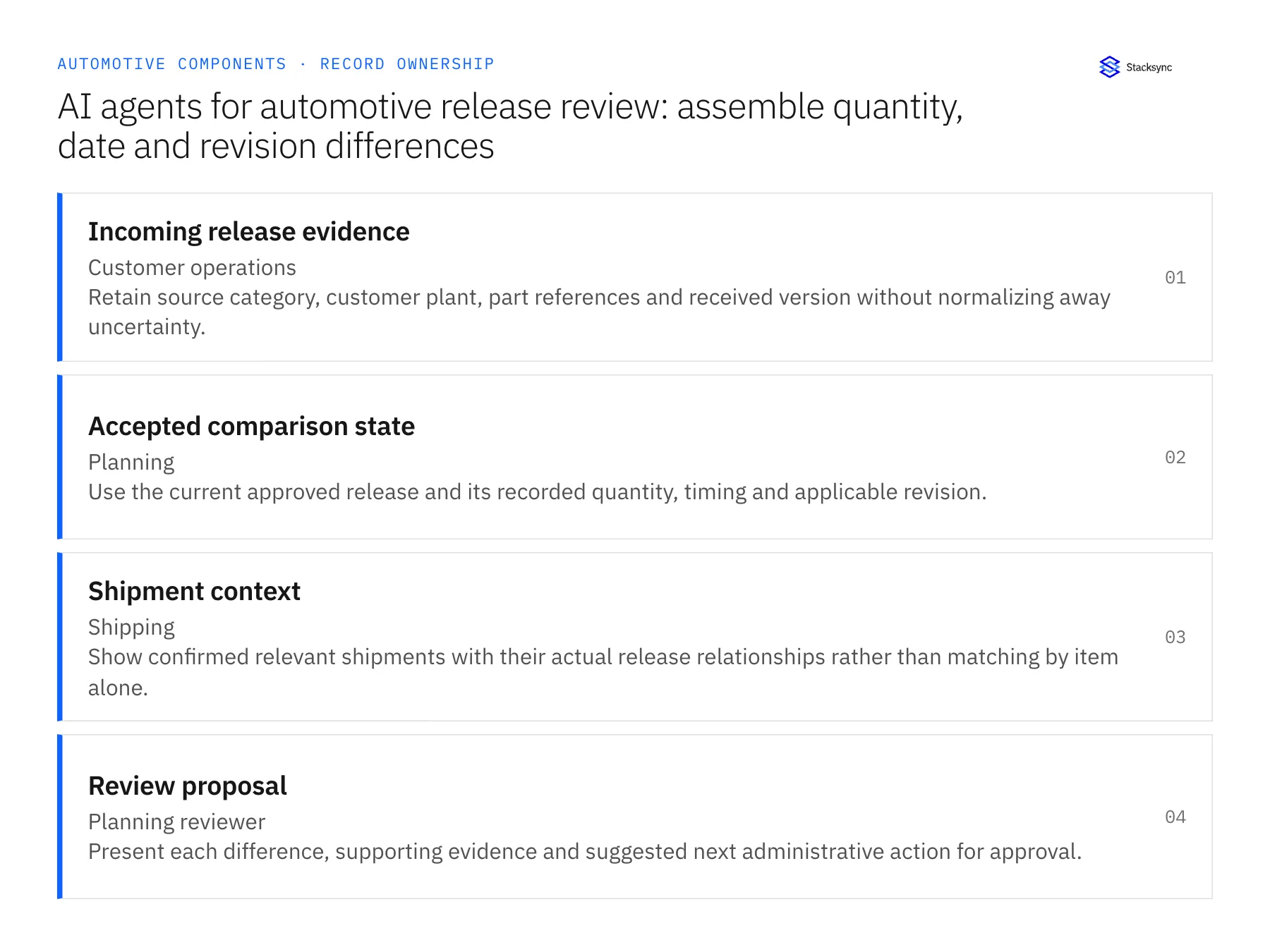
| Record to reconcile | Responsible owner | Rule to preserve |
|---|---|---|
| Incoming release evidence | Customer operations | Retain source category, customer plant, part references and received version without normalizing away uncertainty. |
| Accepted comparison state | Planning | Use the current approved release and its recorded quantity, timing and applicable revision. |
| Shipment context | Shipping | Show confirmed relevant shipments with their actual release relationships rather than matching by item alone. |
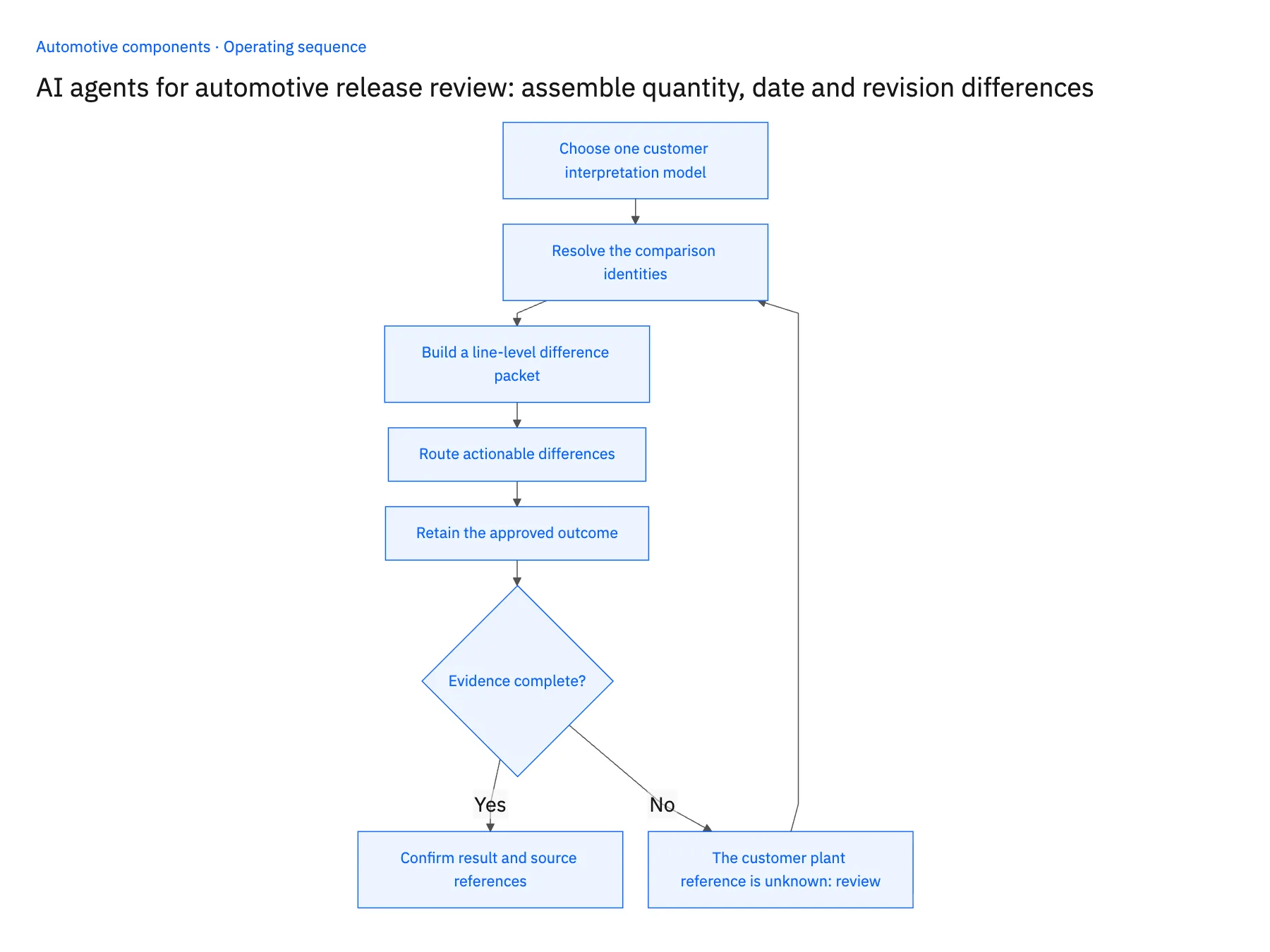
An exception to plan for: The customer plant reference is unknown. Hold the affected lines for mapping review and show candidate context without choosing a default plant. Acceptance check for the pilot: the packet preserves raw line differences beside its summary.
The automotive components hub connects the broader operating context. These guides develop the specific record mappings and decisions for this application:
- AI agents for automotive release review: assemble quantity, date and revision differences
- Automotive component EDI 850 and 860: preserve firm orders and approved revisions
- EDI order and revision automation for automotive component suppliers
Building Resilient Automotive Supply Chains Through Modern EDI
The automotive industry operates on coordination, speed, and accuracy. Electronic data interchange remains central to OEM and Tier communication, but legacy infrastructure limits agility.
Organizations that modernize EDI with real-time synchronization and unified integration platforms create supply chains that respond instantly to demand changes and engineering updates.
If you are evaluating ways to modernize automotive EDI infrastructure, start by exploring modern integration approaches that eliminate batch windows and simplify data management.
FAQ
Frequently asked questions










Related articles