Equipment parts AI exceptions: serial ambiguity, supersession and incomplete kits
A plausible active SKU is not a compatible part; these exceptions show which serial, retrofit or kit fact is missing before service engineering can sign off.
- Author
- Ignacio Malpartida · GTM Engineer
- Published
- Read time
- 4 min read

The operating decision
Equipment-parts exception handling should identify why a proposal cannot yet be trusted. Common blockers include an unresolved machine serial, incomplete retrofit history, conditional part supersession and missing kit components. A Genie can assemble the relevant evidence and ask a focused question, while service engineering approves compatibility. Keep each candidate and its limitations visible. The exception is resolved when the approved proposal matches the installed machine and commercial scope, not when the agent finds any available part.
Explore the complete industrial equipment and machinery integration and automation hub for the systems and processes around this guide.
What this looks like in industrial equipment and machinery
A service request refers to an older conveyor model. Two serial ranges used different drive assemblies, and the replacement catalog lists a new kit that applies only after a retrofit. The customer’s photograph confirms the model but not the installed revision. A generic search can return a plausible active SKU while omitting a required adapter. The exception workflow should compare serial candidates, known modification records and the conditions attached to the replacement kit, then ask for the specific evidence needed to select the correct path.
Records, ownership, and update rules
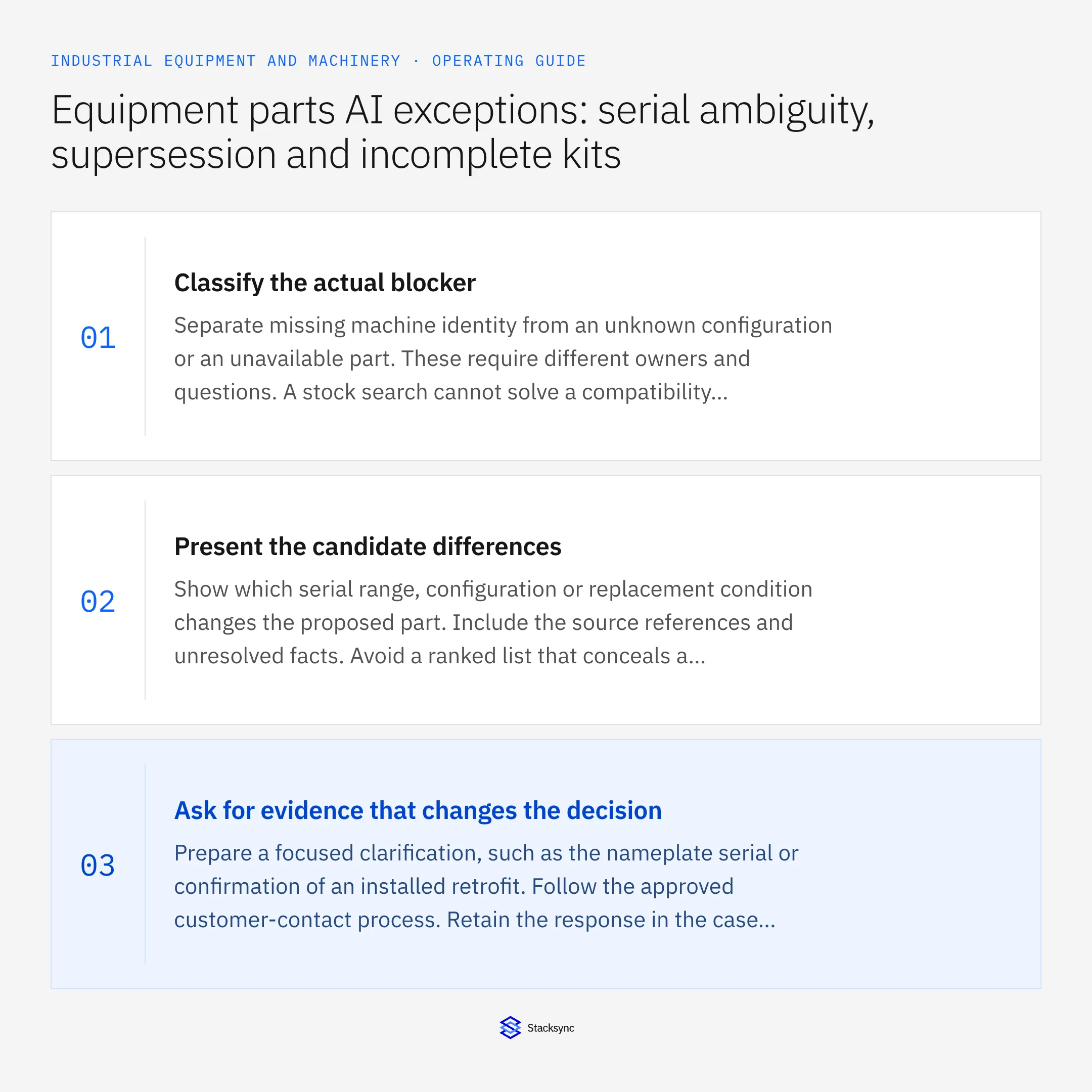
| Record | Owner | Operating rule |
|---|---|---|
| Asset ambiguity | Installed-base owner | Retain candidate serials and the evidence missing from a unique match. |
| Conditional supersession | Service engineering | Preserve the conditions under which the replacement applies rather than copying only its successor SKU. |
| Kit completeness | Product operations | Identify required companion items and distinguish mandatory components from optional accessories. |
| Approved resolution | Service reviewer | Record the accepted asset and part relationship, supporting evidence and scope of the decision. |
Work through the process
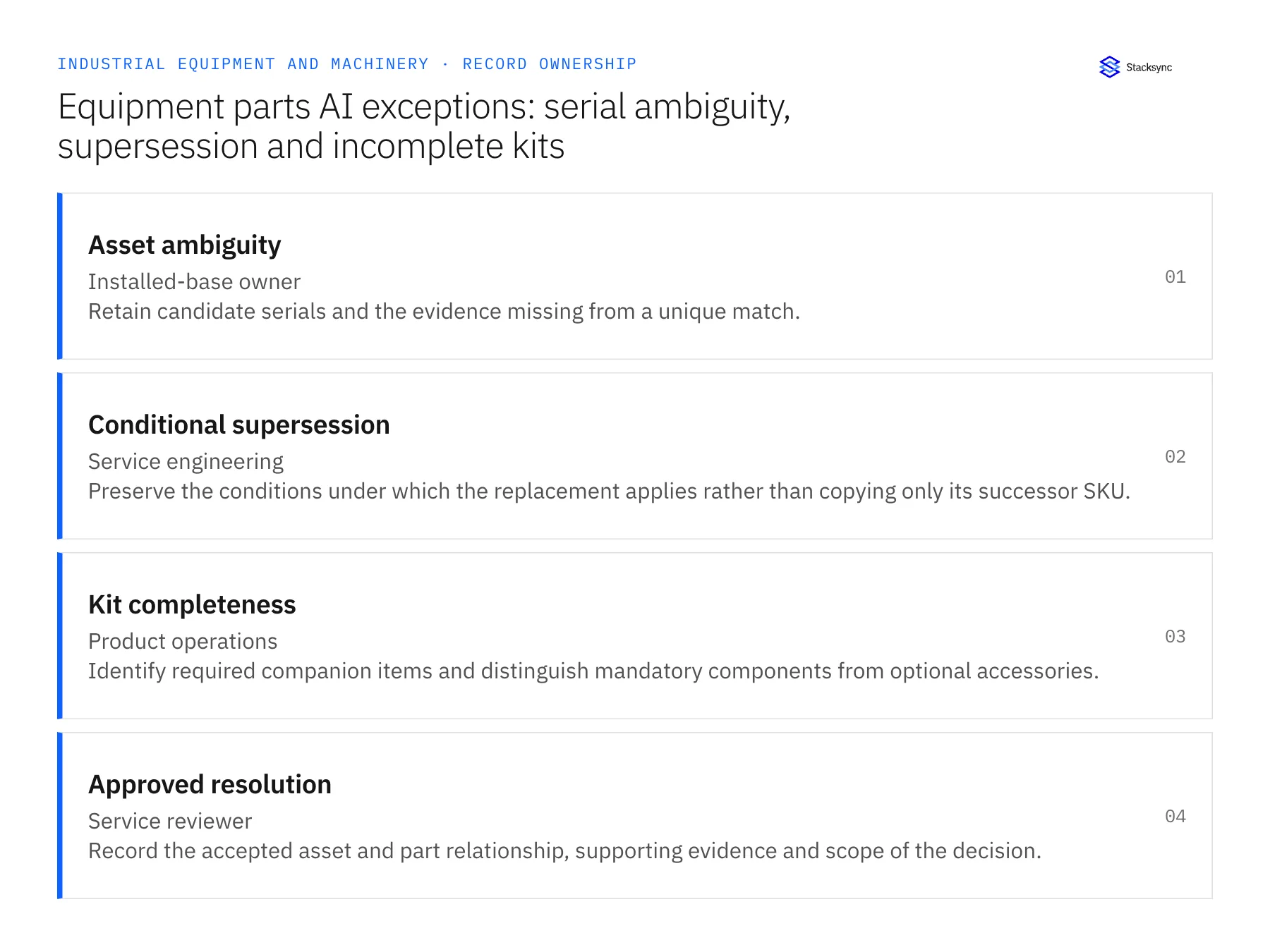
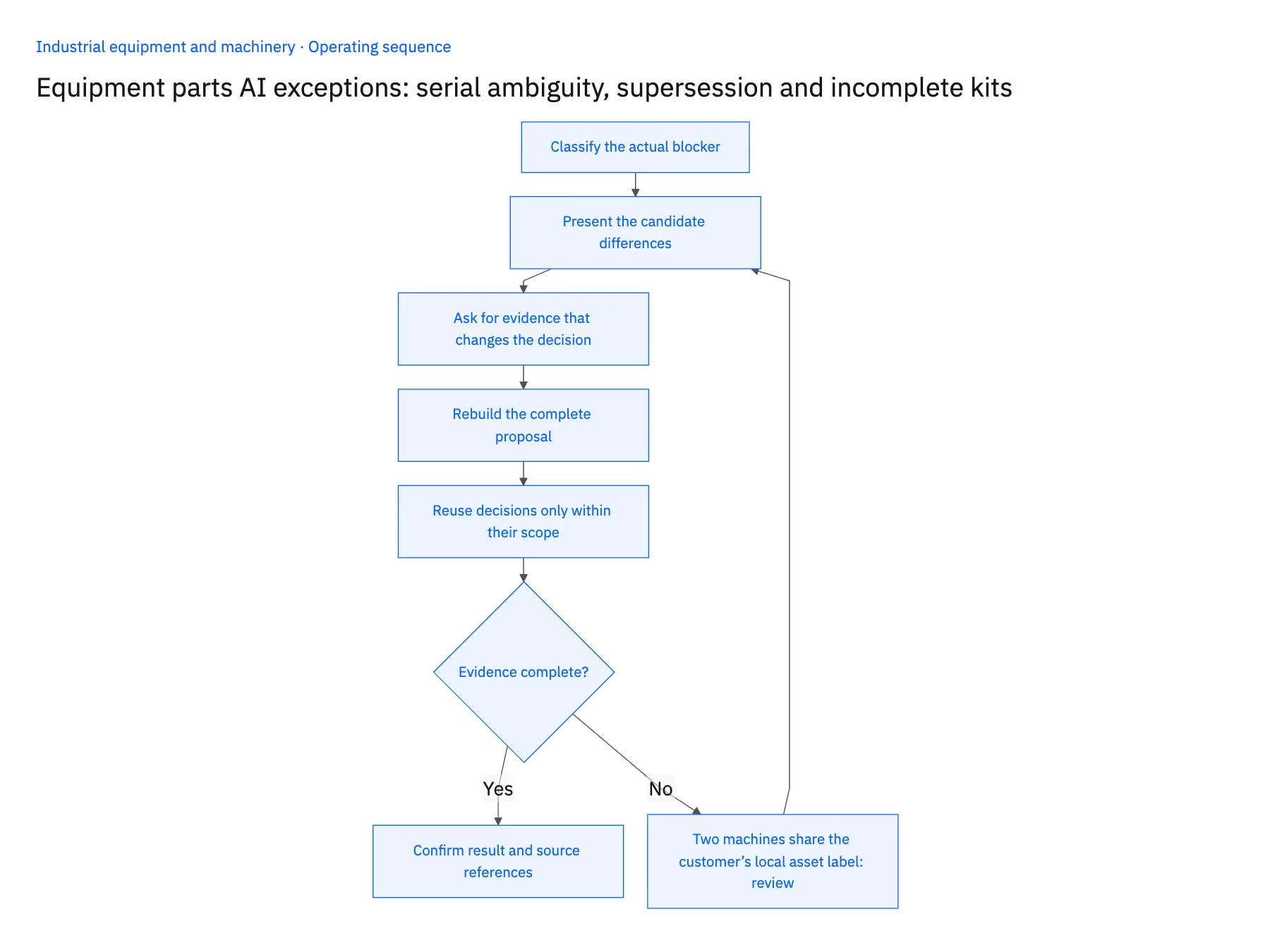
- 01Classify the actual blockerSeparate missing machine identity from an unknown configuration or an unavailable part. These require different owners and questions. A stock search cannot solve a compatibility problem, and asking for another photograph may not resolve a missing retrofit record.
- 02Present the candidate differencesShow which serial range, configuration or replacement condition changes the proposed part. Include the source references and unresolved facts. Avoid a ranked list that conceals a material incompatibility behind a high similarity score.
- 03Ask for evidence that changes the decisionPrepare a focused clarification, such as the nameplate serial or confirmation of an installed retrofit. Follow the approved customer-contact process. Retain the response in the case so another reviewer does not repeat the same investigation.
- 04Rebuild the complete proposalAfter service engineering approves the relationship, recheck the kit contents, availability and commercial route. A resolved serial does not automatically approve warranty coverage or confirm a delivery date. Keep these remaining decisions visible.
- 05Reuse decisions only within their scopeRecord whether the answer is a one-machine exception, a corrected asset history or a reviewed catalog rule. Update reusable references only through the appropriate owner. Do not turn a one-off field modification into a universal supersession rule.
Handle the exceptions explicitly
Two machines share the customer’s local asset label
Require evidence that distinguishes the actual unit. Preserve the alias history rather than merging the serials.
A supersession chain ends in an unavailable item
Keep compatibility established and route supply alternatives separately. Availability does not authorize a different technical substitute.
A kit is missing one required component
Present the incomplete fulfillment condition and ask service how to proceed. Do not describe the kit as ready merely because its main item is in stock.
What to verify before expanding
- A reviewer can see which missing fact prevents a unique part selection.
- Conditional supersession retains its applicability conditions.
- Required kit components are included in the accepted proposal.
- A one-off resolution cannot silently change the general replacement catalog.

Connect this process to the rest of your operation
Explore Stacksync AI agents (Genies) and scope the records and actions against your actual systems. Book a demo with a real asset ambiguity example and the exception your team handles most often, for example two machines share the customer’s local asset label.
- AI agents for equipment aftermarket parts requests
- AI agents for equipment aftermarket requests: prepare compatible parts proposals
- Equipment EDI orders: preserve distributor kits, service lines and partial shipments
- Equipment manufacturers: connect Salesforce configurations to NetSuite orders
- Human-in-the-Loop Automation: When to Escalate a Workflow to a Person
- Coordinate Closed-Won Onboarding Across Salesforce and NetSuite
The shared architecture guide covers record matching, ownership, and recovery across systems.
Technical references
FAQ
Frequently asked questions










Explore these integrations and topics
Related articles