Equipment commissioning readiness: connect sales promises, site prerequisites and service dispatch
Before a technician travels, this workflow shows which accessory, site condition or customer confirmation is still missing and who owns resolving it.
- Author
- Ignacio Malpartida · GTM Engineer
- Published
- Read time
- 4 min read

The operating decision
A commissioning-readiness workflow should connect the sold service scope to the machine, delivery status, site prerequisites and assigned service owner. Automate the collection of evidence and follow-up while keeping dispatch approval with service operations. A shipped machine does not establish that the site is ready, and a calendar invitation is not proof that required conditions are satisfied. Show which prerequisite blocks a visit and what evidence will resolve it.
Explore the complete industrial equipment and machinery integration and automation hub for the systems and processes around this guide.
What this looks like in industrial equipment and machinery
A machinery builder schedules commissioning shortly after equipment delivery. The site contact says installation is ready, but one purchased accessory has not arrived and the customer has not confirmed a required site condition. Sales wants to preserve the promised date, while service risks sending a technician who cannot complete the work. A shared readiness case can combine the accepted service scope, shipment information and customer confirmations, allowing the dispatcher to approve a visit with clear evidence or negotiate a revised plan before travel is committed.
Records, ownership, and update rules
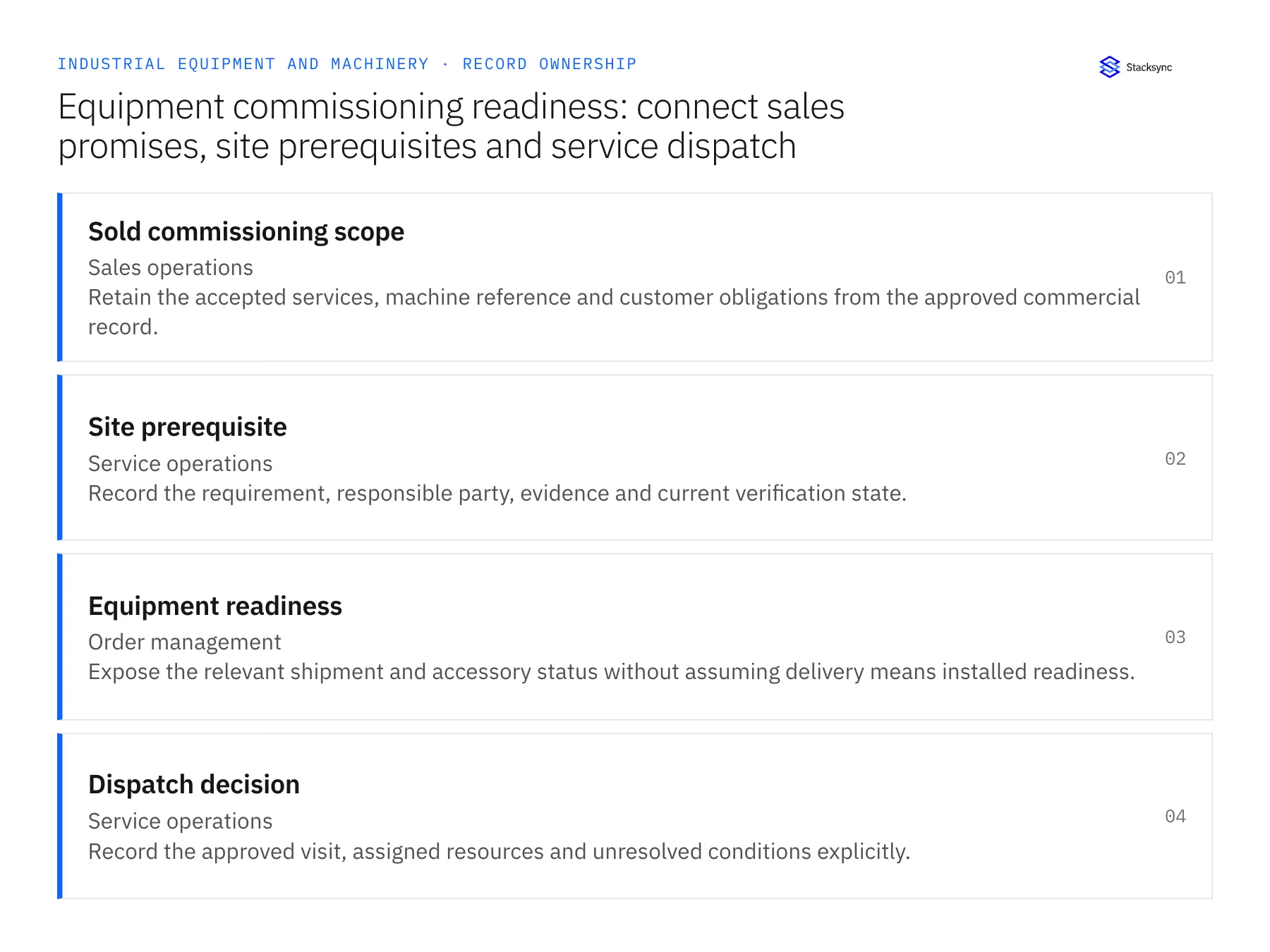
| Record | Owner | Operating rule |
|---|---|---|
| Sold commissioning scope | Sales operations | Retain the accepted services, machine reference and customer obligations from the approved commercial record. |
| Site prerequisite | Service operations | Record the requirement, responsible party, evidence and current verification state. |
| Equipment readiness | Order management | Expose the relevant shipment and accessory status without assuming delivery means installed readiness. |
| Dispatch decision | Service operations | Record the approved visit, assigned resources and unresolved conditions explicitly. |
Work through the process
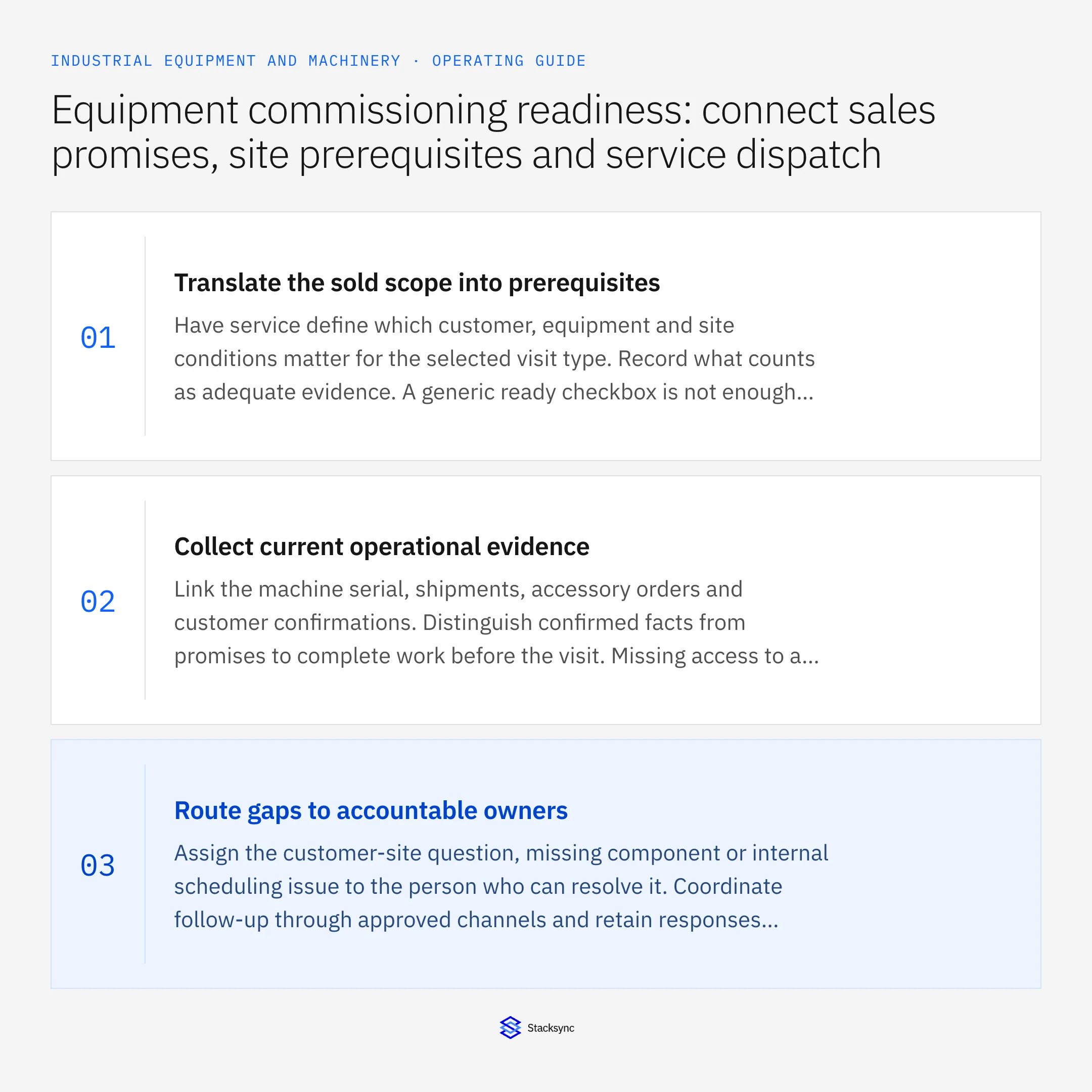
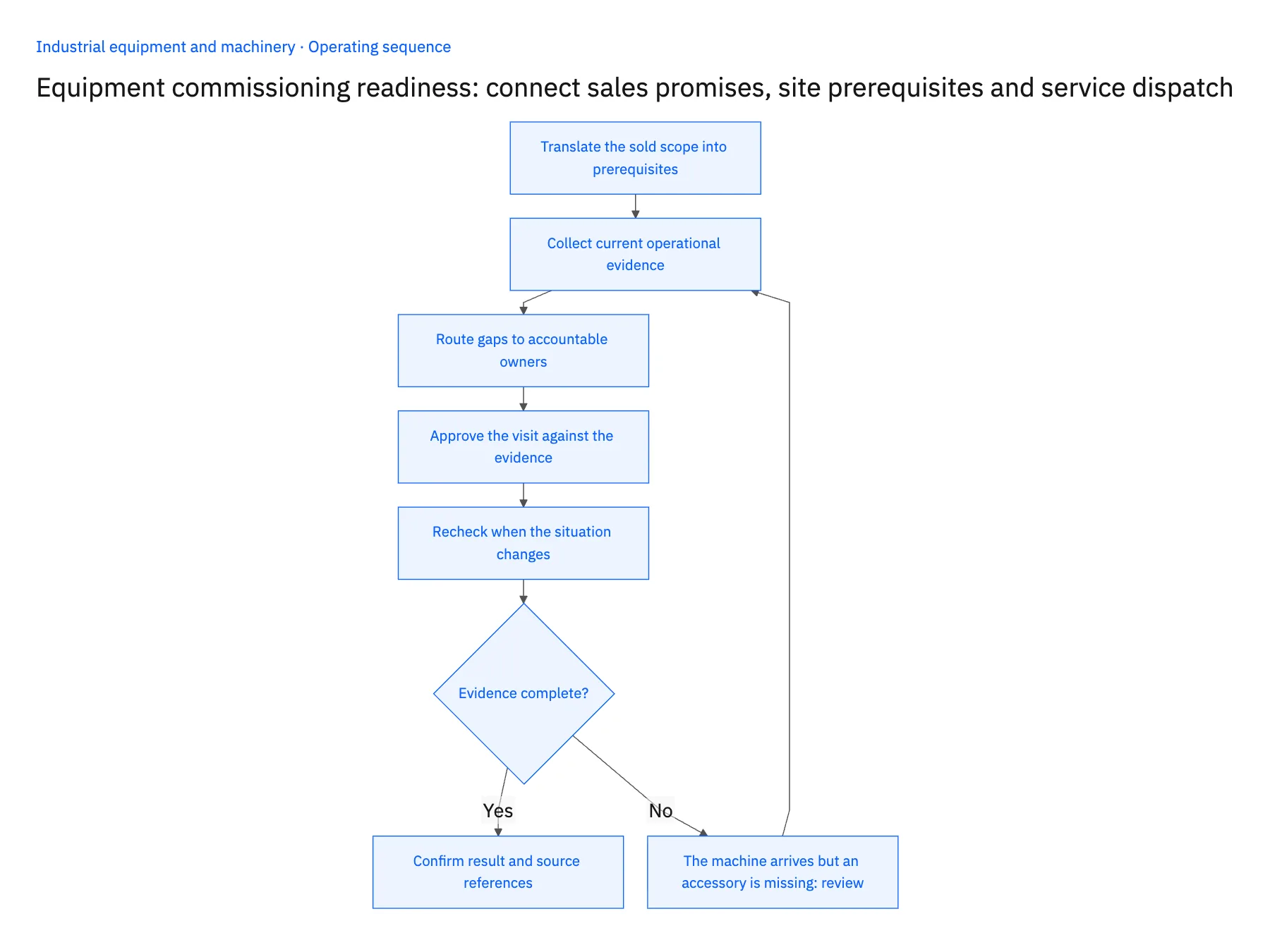
- 01Translate the sold scope into prerequisitesHave service define which customer, equipment and site conditions matter for the selected visit type. Record what counts as adequate evidence. A generic ready checkbox is not enough when different machines require different preparation.
- 02Collect current operational evidenceLink the machine serial, shipments, accessory orders and customer confirmations. Distinguish confirmed facts from promises to complete work before the visit. Missing access to a source should remain visible instead of being interpreted as a satisfied condition.
- 03Route gaps to accountable ownersAssign the customer-site question, missing component or internal scheduling issue to the person who can resolve it. Coordinate follow-up through approved channels and retain responses on the same case. Escalate when the required decision date approaches.
- 04Approve the visit against the evidenceLet service operations review the complete readiness state and any accepted exceptions. Record the approved conditions under which dispatch may proceed. A salesperson’s target date should not automatically overrule a known unresolved prerequisite.
- 05Recheck when the situation changesIf delivery slips or a customer withdraws confirmation, reassess the dispatch decision. Preserve the prior plan and notify its owner. Close readiness only when the visit is appropriately authorized or deliberately rescheduled, not when reminders have been delivered.
Handle the exceptions explicitly
The machine arrives but an accessory is missing
Ask service whether the visit can proceed under an approved limited scope. Do not infer that the accessory is optional.
The customer provides an informal verbal confirmation
Record it through the accepted process and identify whether further evidence is required for that prerequisite.
The assigned technician changes
Reconfirm the skills, availability and handoff information required for the new assignment. A name replacement alone may not preserve readiness.
What to verify before expanding
- Each blocking prerequisite has a named owner and defined evidence requirement.
- Dispatch approval is separate from shipment and requested visit date.
- A later prerequisite failure reopens the readiness decision.
- The service team can explain any approved exception before committing the visit.

Connect this process to the rest of your operation
Explore Stacksync workflows and scope the records and actions against your actual systems. Book a demo with a real sold commissioning scope example and the exception your team handles most often, for example the machine arrives but an accessory is missing.
- Commissioning-readiness automation for equipment manufacturers
- Equipment warranty RMAs: coordinate replacement, return and credit decisions
- AI agents for equipment aftermarket requests: prepare compatible parts proposals
- Equipment parts AI exceptions: serial ambiguity, supersession and incomplete kits
- Coordinate Closed-Won Onboarding Across Salesforce and NetSuite
- Salesforce ERP Integration: Best Real-Time Sync Solutions in 2026
The shared architecture guide covers record matching, ownership, and recovery across systems.
Technical references
FAQ
Frequently asked questions










Related articles